
TORUŃ, Poland — The 34th ToruńCAMERIMAGE International Film Festival opened on Saturday night, 7 November 2026, with a scene that would have seemed like science fiction only a few years ago: a humanoid robot took the stage before any human being did, addressed the audience in Polish, and opened a week-long conversation about artificial intelligence. The festival, the world’s leading celebration of cinematography, chose the most contested subject in modern filmmaking as its central theme — on an evening that began with a minute of silence for the victims of a mass shooting in Kraków earlier that day.

Illustration: A humanoid robot takes the stage to open the 34th Camerimage festival in Toruń, where artificial intelligence is the central theme of the 2026 edition.
The opening ceremony, held at the CKK Jordanki Culture and Congress Centre and lasting around three hours, set the tone for the seven-day event, which runs until 14 November. Festival director Marek Żydowicz, who founded Camerimage in 1993 to champion cinematographers and other craftspeople long treated as mere technicians, did not deliver the traditional opening address alone. The Polish-speaking humanoid robot known as “Edward Warchocki” spoke first, and Żydowicz then joined it on stage for an extended discussion about AI in cinema. Żydowicz stressed that the “hopes and threats” of the technology would be a major talking point throughout the festival.
What Happened
The robot was not a gimmick tucked into the margins of the evening. It was the opening act, and it shaped everything that followed. The ceremony was regularly interspersed with video messages from some of the most prominent figures in world cinema, each weighing in on AI in entertainment: Francis Ford Coppola, Gal Gadot, Christopher Nolan, Maggie Gyllenhaal, Steven Spielberg and Ben Affleck all appeared on screen. The range of voices underlined how completely AI has moved from a specialist concern to the defining argument of the moment.
The evening also carried a formal honour with a direct connection to that debate. Darren Aronofsky, the director of Requiem for a Dream, Black Swan and The Whale, received Camerimage’s honorary Award for Director, praised for work that shows the power of cinema when form becomes part of the story. Aronofsky, who said it was his third visit to the festival, is one of the rare major Hollywood filmmakers to embrace generative AI openly. Last year he launched Primordial Soup, a studio producing AI-driven video using technology from Google DeepMind. Its short-form series On This Day… 1776 drew sharp criticism, but he has pressed on — and his presence on the opening-night stage embodied the tension at the heart of this year’s festival.
AI supplied the opening-night film as well. Luca Guadagnino’s Artificial, a drama about the creation of OpenAI, screened immediately after the ceremony, with Guadagnino and cinematographer Malik Hassan Sayeed introducing the film and taking questions. The film stars Andrew Garfield as OpenAI chief executive Sam Altman and Yura Borisov as co-founder Ilya Sutskever, alongside Monica Barbaro, Cooper Hoffman, Jason Schwartzman, Chris O’Dowd, Ike Barinholtz and Mark Rylance. Written by Simon Rich, it dramatises November 2023, when Altman was fired by OpenAI’s board and reinstated within days. Guadagnino shot the film on 35mm and told the Toruń audience he has no interest in using AI for his own work.
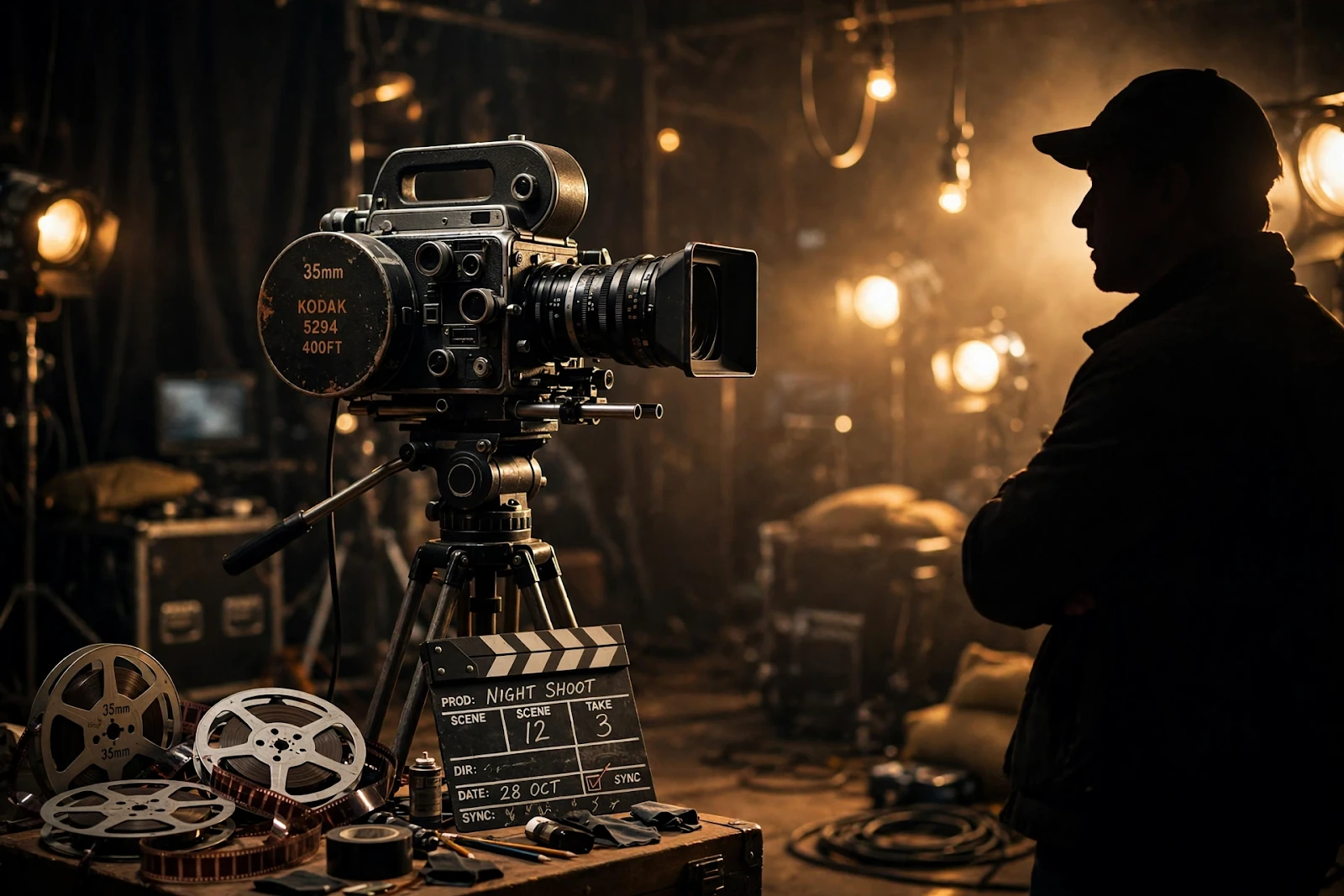
Illustration: A 35mm cinema camera on a film set, evoking Luca Guadagnino's Artificial, the OpenAI origin story that opened Camerimage 2026.
For Guadagnino, the real subject of Artificial is not the technology but the people who control it. He described the film as being about “what they call the tech oligarchs, the tech bros” and the unprecedented levels of power — “economic power and political power” — they have acquired over our lives. Artificial had its world premiere at the New York Film Festival on 5 October 2026. Neon will release it in the United States on 25 December 2026, and it reaches UK cinemas on 22 January 2027.
The evening began, however, in silence. Before the robot, the video messages or the film, the ceremony observed a minute of silence for the victims of the mass shooting in Kraków earlier on Saturday. According to police and officials, six people were killed — four women and two men, including a British citizen — when a gunman opened fire in the city’s Main Market Square on Saturday afternoon, and at least 15 people were wounded, including two police officers. The suspected gunman, a Polish man in his mid-20s, was shot by police and detained. Three more bodies, believed to be his parents and sister, were later found at his home in Ostrowiec Świętokrzyski, around 200 kilometres north of Kraków. Prime Minister Donald Tusk called the attack a terrorist attack and said it was likely inspired by far-right ideology; Poland declared two days of national mourning, on 8 and 9 November. It was the deadliest shooting in Poland in decades.
Background
Camerimage occupies an unusual place in the festival calendar. Founded by Żydowicz in 1993, it is the only major international festival devoted primarily to cinematography rather than to directors or stars. Its top prize, the Golden Frog, is awarded for cinematography, and its juries, workshops and retrospectives are built around the people behind the camera. It has since grown into a fixture of the awards season.
Żydowicz set out the festival’s position in an interview with The Hollywood Reporter ahead of this year’s edition. Camerimage, he said, will remain open to a diversity of techniques and technologies, including discussion of generative AI, but it draws a line at films made entirely by AI. “We do not accept productions generated entirely by AI,” he said, adding that the festival’s selection focuses on the art of cinematographers. He said he personally favours hybrid films, with the actors deciding how far AI may intervene.
This year’s edition also carries a note of Polish film history. Poland’s Senate designated 2026 as the Year of Andrzej Wajda, marking the centenary of the birth of the country’s most celebrated director, born on 6 March 1926 and deceased on 9 October 2016, a decade ago. The opening ceremony included a musical tribute to Wajda, performed by the Polish Radio Choir of Lusławice. Wajda, whose films include Ashes and Diamonds, Man of Marble and Man of Iron, chronicled Poland’s upheavals across six decades.
The main competition for the Golden Frog lists 15 titles this year, mixing large-scale English-language studio productions with European auteur cinema. Among the contenders are Project Hail Mary, directed by Phil Lord and Christopher Miller and photographed by Greig Fraser; Steven Spielberg’s Disclosure Day, shot by Polish cinematographer Janusz Kamiński; Martin McDonagh’s Wild Horse Nine, photographed by Ben Davis; Tony Gilroy’s Behemoth!, shot by Damián García; Andrey Zvyagintsev’s Minotaur, photographed by Mikhail Krichman; and Paweł Pawlikowski’s Fatherland, shot by Łukasz Żal. Joe Walker, the editor behind Dune and 12 Years a Slave, chairs the jury, and Kamiński will receive The Hollywood Reporter’s Visionary award.
Why It Matters
The choice of AI as the organising idea of Camerimage 2026 is significant precisely because this festival speaks for the craft most directly threatened by generative tools. For cinematographers, the challenge is concrete: generative video systems can now produce moving images that resemble, however imperfectly, the work of a camera, a lens and a lighting crew. The question is not whether the technology will improve — it will — but where the line falls between a tool that extends a cinematographer’s imagination and a substitute that erases it.
Camerimage’s answer, as articulated by Żydowicz, is a qualified welcome: debate the technology, use it where it serves the image, but refuse to celebrate films in which no human stood behind a camera at all. That puts the festival at the centre of an industry argument over synthetic imagery, cost savings and union demands for protections over likeness, voice and authorship. Aronofsky’s honour sits at the centre of that argument: Żydowicz has said the award recognises more than thirty years of filmmaking, not how Aronofsky uses AI — but honouring Hollywood’s most prominent AI adopter on the same night the festival opened with a robot host was, intentionally or not, a statement of its own.
Artificial sharpens the point in a different way. Guadagnino’s film is, by his own account, about concentrated power: a small group of technology executives whose decisions now shape economies, elections and the information environment. The film’s own path to the screen adds another layer: Amazon MGM Studios, which originally developed it, dropped it earlier in 2026 before Neon acquired it. There is also a Polish dimension: Toruń, a Gothic city on the Vistula and the birthplace of Nicolaus Copernicus, has hosted Camerimage for years. On a weekend when Poland mourned the Kraków victims, the balance between a global conversation about technology and a national moment of grief gave the opening night a gravity no programme note could have planned.
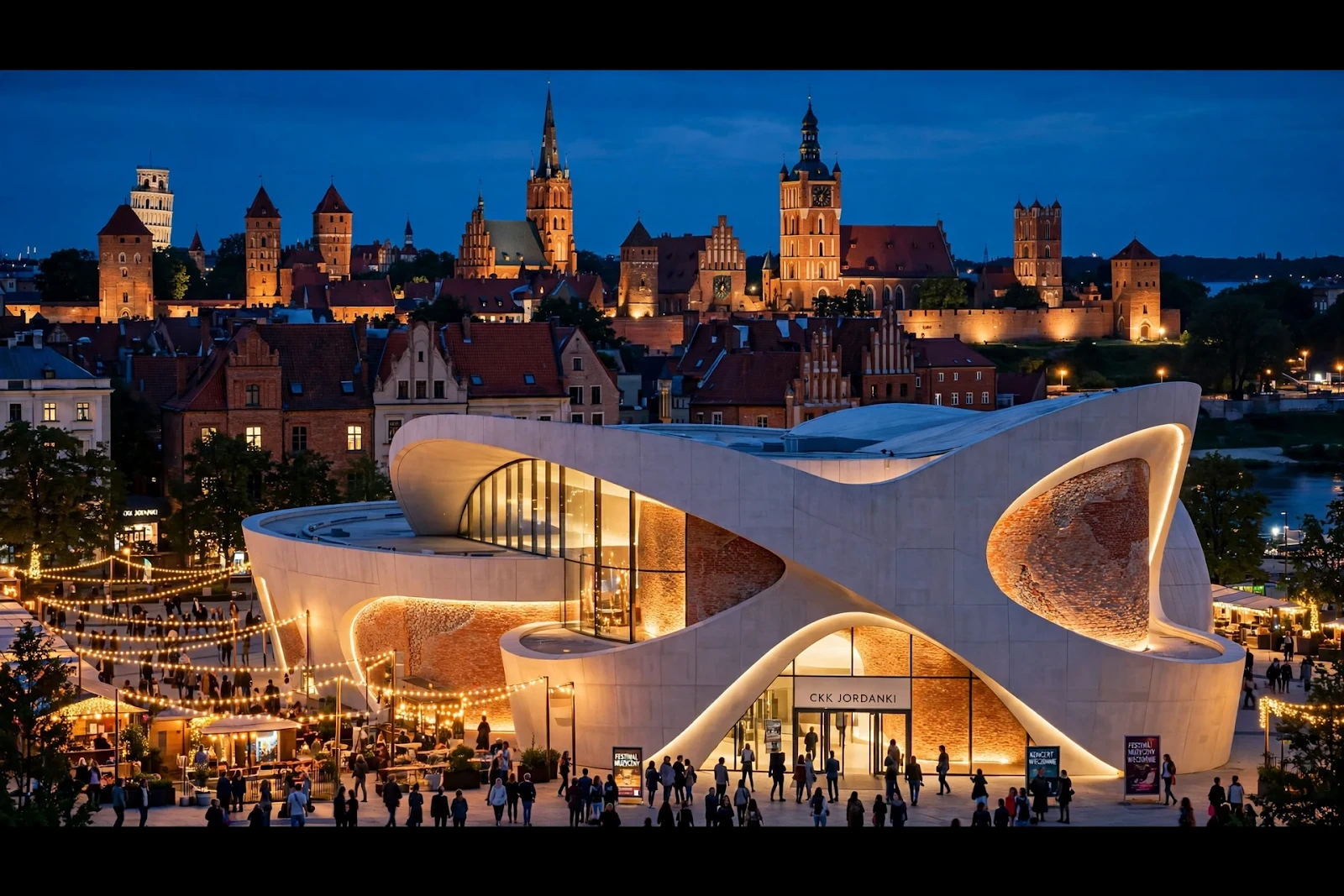
Illustration: Toruń's historic old town and the CKK Jordanki concert hall lit up at night as the Camerimage film festival takes over the city.
What Happens Next
The festival continues until Saturday, 14 November, with screenings, masterclasses, panel discussions and workshops across Toruń, including debates devoted to generative AI and its place in filmmaking. The Golden Frog and the festival’s other awards will be presented at the closing ceremony on 14 November, after which Simon Stone’s Elsinore will close the edition with a screening at 8:30pm at CKK Jordanki. Stone’s film, starring Andrew Scott as the British actor Ian Charleson and photographed by Mike Eley, dramatises Charleson’s final performance as Hamlet at the National Theatre in London in the late 1980s, after an AIDS diagnosis — a closing choice that returns the festival, after a week of arguing about machines, to a story about a human performer on a stage.
Attention will now focus on the main competition, where the Golden Frog race is wide open, and on whether the AI debates produce anything more concrete than position statements — on disclosure rules for AI-assisted imagery, on compensation for artists whose work trains generative models, and on whether audiences can tell, or care, when an image was never captured by a camera. Camerimage framed the question clearly by putting a robot on its stage; the answers will come from the humans in the room.
Sponsored: explore today's featured sponsored offers
FAQ
What is Camerimage?
Camerimage, formally the ToruńCAMERIMAGE International Film Festival, is the world’s leading film festival devoted to the art of cinematography. Founded in Poland in 1993 by Marek Żydowicz, it awards the Golden Frog for cinematography.
When and where is Camerimage 2026 taking place?
The 34th edition runs from 7 to 14 November 2026 in Toruń, Poland, opening on Saturday, 7 November, at the CKK Jordanki Culture and Congress Centre and closing on 14 November with Simon Stone’s Elsinore.
Why did a robot open the Camerimage 2026 ceremony?
Artificial intelligence is the central theme of this year’s festival. A Polish-speaking humanoid robot called “Edward Warchocki” took the stage first, before festival director Marek Żydowicz joined it to discuss the “hopes and threats” of AI in filmmaking.
What is Luca Guadagnino’s Artificial about?
Artificial is a drama about the creation of OpenAI, focusing on the November 2023 crisis in which chief executive Sam Altman, played by Andrew Garfield, was fired and then reinstated within days. Yura Borisov plays co-founder Ilya Sutskever. Guadagnino shot the film on 35mm; Neon will release it in the United States on 25 December 2026, and it reaches UK cinemas on 22 January 2027.
How did the Kraków shooting affect the festival’s opening?
The opening ceremony began with a minute of silence for the victims of the mass shooting in Kraków earlier on Saturday, 7 November, in which six people were killed and at least 15 wounded, according to police and officials. Poland declared two days of national mourning, on 8 and 9 November. The festival then continued with its scheduled programme.
Sources
- The Hollywood Reporter — “Camerimage Opens With a Robot, an AI Reckoning and a Minute of Silence for Kraków,” 8 November 2026.
- Deadline — “Camerimage Opens With Minute Of Silence For Kraków Mass Shooting; Darren Aronofsky Honored & Luca Guadagnino Introduces ‘Artificial’,” 8 November 2026.
- ToruńCAMERIMAGE (official programme, camerimage.pl) — “Luca Guadagnino’s Artificial to Open the 34th Edition of ToruńCAMERIMAGE,” 2 November 2026; “Elsinore to Close ToruńCAMERIMAGE 2026,” 6 November 2026.
- Reuters — “Poland mourns victims of Krakow mass shooting as security fears grow,” 8 November 2026.
- British Cinematographer — Camerimage 2026 coverage, including “Elsinore” closing announcement and Darren Aronofsky Director’s Award, November 2026.
- The Hollywood Reporter — “Camerimage Founder Marek Żydowicz on AI, Aronofsky and Why ‘Cinematographers Are Artists, Not Technicians’,” 8 November 2026.
Comments
Post a Comment