
GENEVA — Physicists working at CERN's Large Hadron Collider have found the first evidence from a single experiment of one of nature's rarest particle decays, a process so unlikely that the Standard Model of particle physics predicts it should happen only once in every ten billion beauty particles.
The result, announced at a seminar at CERN on Tuesday, November 3, 2026, ends a search that began in the early 1980s with the CLEO experiment at Cornell University in the United States. It comes from the Large Hadron Collider beauty experiment, known as LHCb, which studies particles containing beauty quarks — heavier relatives of the quarks that make up much of the visible matter in the universe.
The decay in question involves a neutral B0 meson, a short-lived particle made of a beauty quark and a down antiquark, transforming into a pair of muons, heavier cousins of the electron. According to the University of Birmingham, which plays a leading role in the LHCb collaboration, the measurement provides evidence for the rarest decay ever observed at the Large Hadron Collider.
"Physicists have been chasing this decay for more than forty years," said Marco Santimaria, a researcher at the Frascati National Laboratory of Italy's National Institute for Nuclear Physics (INFN) who co-led the analysis team. "Extreme precision is required to pick the muons out of the overwhelming background."

Illustration: The LHCb detector at CERN, where proton collisions produce the beauty particles studied in this result. (AI illustration)
What Happened
At the CERN seminar on November 3, the LHCb collaboration reported evidence for the B0 meson decaying into two muons. The signal reached a statistical significance of 3.2 standard deviations, meaning there is only about a one-in-1,500 chance that the result is a fluctuation of the background rather than a real signal, according to INFN.
In particle physics, 3.2 standard deviations counts as "evidence" for a process, though not yet a full "discovery," which conventionally requires five standard deviations. That distinction matters: the collaboration is reporting that it has seen a strong hint of the decay, not that the case is closed. More data, expected from future LHCb running, should sharpen the measurement further.
Crucially, the result is consistent with the prediction of the Standard Model — the theoretical "rulebook" that describes the particles making up matter and how they interact. The Standard Model has survived this extraordinarily rare test once again, even as physicists hope that ever-more-precise measurements of such decays might eventually reveal something beyond it.
The analysis combined newly recorded data from 2024 and 2025 with data collected during earlier running periods between 2011 and 2018. Advanced machine-learning techniques and sophisticated particle-identification methods allowed researchers to isolate the rare signal from billions of particle collisions, the University of Birmingham reported.
The LHCb experiment records hundreds of millions of proton collisions per second, corresponding to a data flux of four terabytes per second, according to INFN. Picking out a handful of genuine B0-to-two-muon decays from that torrent is, as Santimaria put it, an exercise in extreme precision.
Background: Why Beauty Particles Matter
Beauty particles — also known as bottom particles in some naming conventions — are produced in large numbers during high-energy collisions at the Large Hadron Collider, but they exist for only around one and a half trillionths of a second before decaying into lighter particles, the University of Birmingham said.
That fleeting lifetime is precisely what makes them powerful tools. Quantum physics describes how a decay process is influenced by other particles, including particles too heavy or too short-lived to be produced directly. The more unlikely a decay, the more sensitive it is to the influence of such new particles, INFN explained. A rare decay is therefore a kind of indirect telescope: it can reveal the fingerprints of undiscovered physics even when the new particles themselves remain out of direct reach.
The search for this particular decay began in the early 1980s with CLEO at Cornell. For more than four decades, successive experiments pushed the sensitivity further without ever gathering enough signal from a single experiment to claim evidence. The upgraded LHCb detector changed that arithmetic.
In 2022, a major upgrade to the LHCb experiment allowed it to collect data at five times the collision rate of its predecessor, INFN said. Since 2024, the experiment has been collecting data at up to five times its previous rate, enabling scientists to investigate rare particle processes with unprecedented precision, according to the University of Birmingham. INFN and Italian universities were key players in that transformation, especially in the particle-identification and data-acquisition systems.
Alongside the B0 result, the collaboration also reported the world's most precise measurements of the corresponding Bs-meson decay probability and lifetime, according to Dr Niladri Sahoo, a research fellow at the University of Birmingham and convener of the LHCb Very Rare Decays working group.
"Reporting the first evidence from a single experiment for the extremely rare decay of a neutral B meson into two muons, while achieving the world's most precise measurements of the corresponding Bs-meson decay probability and lifetime, provides a powerful new test of the Standard Model and a window into potential new physics," Sahoo said.
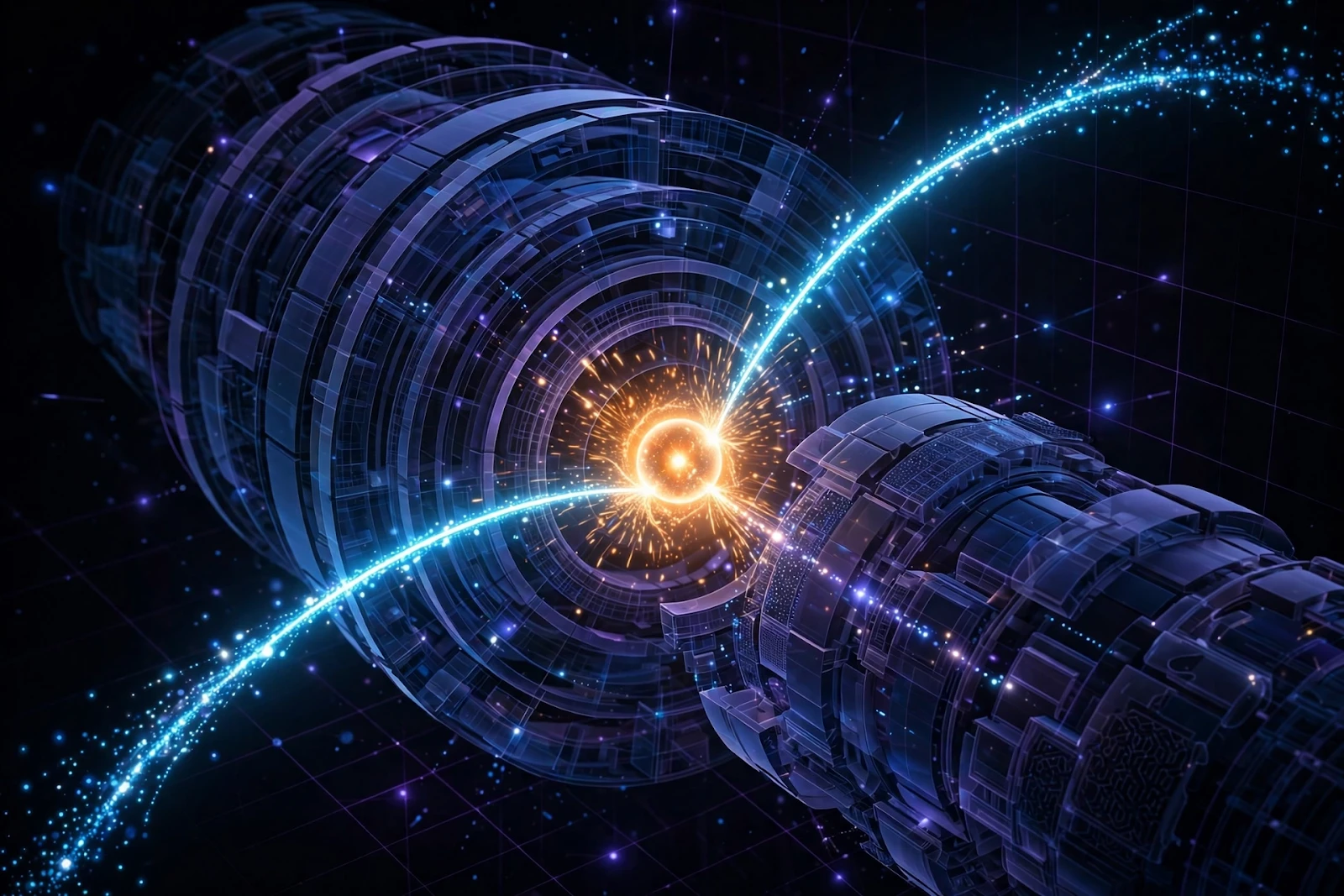
Illustration: A beauty meson decays into two muon tracks inside a particle detector. (AI illustration)
Why It Matters
The result matters for two reasons that pull in opposite directions — and both are good news for physics. First, the Standard Model holds up again, even for a process occurring once in ten billion decays. That is a remarkable triumph for a theory assembled decades ago: it continues to predict nature's behaviour at extraordinary precision.
Second, the measurement opens a new window. The LHCb results could help physicists probe the so-called "Zeptoverse" — a realm of extremely small distances, measured in zeptometres, where undiscovered particles and forces of nature may be hiding, the University of Birmingham said. Because rare decays are sensitive to virtual particles that never appear directly in a detector, studying them in ever greater detail is one of the few ways to explore energy scales beyond the direct reach of even the world's most powerful collider.
"Seeing evidence for this rare decay is incredibly exciting, opening up new possibilities to probe beyond the direct reach of the LHC," said Harry Cliff, LHCb's Rare Decays Convener and analysis co-lead. "The future LHCb Upgrade will allow us to observe many more of these decays, providing even greater sensitivity to undiscovered particles."
The result also showcases the scale of modern particle physics as a collaborative enterprise. The experiment brought together several UK research institutions including the Universities of Birmingham, Bristol, Cambridge, Edinburgh, Glasgow, Liverpool, Manchester, Oxford and Warwick, plus Imperial College London and the Science and Technology Facilities Council (STFC) Rutherford Appleton Laboratory. The data analysis was performed by an international team with a strong Italian presence, INFN said.
Professor Nigel Watson, former principal investigator for the LHCb-UK teams, said: "This stunning new result is the latest of many exciting measurements at LHCb that are only possible through the exceptional commitment and talent of a large international collaboration of scientists and engineers, who designed, built and now operate the experiment and analyse the data. It is a privilege that our group in Birmingham has key roles in this scientific adventure of discovery."
Dr Dan Johnson, assistant professor at the University of Birmingham and physics coordinator for the LHCb-UK teams, added: "UK leadership has been critical to this remarkable feat, from the data analysis to construction of the ultra-precise silicon detectors upon which it relied."
What Happens Next
The immediate next step is more data. As the upgraded LHCb experiment continues to collect vast amounts of data, researchers plan to explore the Zeptoverse in even greater detail, searching for clues that could help answer some of the biggest questions in modern physics, including whether undiscovered particles or forces exist beyond the Standard Model, the University of Birmingham said.
A further upgrade is already in preparation. The Italian LHCb community is working on an upgrade of the experiment that will increase the data collection rate by a factor of ten in the next decade, according to Pasquale Di Nezza, who is responsible for the Italian LHCb collaboration. That tenfold increase should turn today's evidence into a precise measurement — and, if any deviation from the Standard Model is lurking in these rare decays, give physicists their best chance yet of seeing it.
Physicists will also scrutinise the result itself. Independent checks, additional data and refined analyses are the normal path from evidence at 3.2 standard deviations toward either a full discovery or a revised understanding. For now, the collaboration's message is measured: a forty-year hunt has produced its first single-experiment evidence, the Standard Model has passed another severe test, and a new, more sensitive probe of the Zeptoverse is now open.
For a field often asked when it will find something entirely new, the B0 result is a reminder of how discovery usually works in practice: not always as a sudden breakthrough, but as decades of patient improvement in precision until nature finally gives up a signal that has been hiding in plain sight — once in ten billion times.

Illustration: Physicists monitor collision data in a CERN control room as LHCb collects data at five times its previous rate. (AI illustration)
Sponsored: explore today's featured sponsored offers
FAQ
What decay did LHCb find evidence for?
A neutral B0 meson — made of a beauty quark and a down antiquark — decaying into a pair of muons. The Standard Model predicts this happens only about once in every ten billion B0 particles.
Why did the search take more than 40 years?
The decay is extraordinarily rare and buried in an overwhelming background of other particle collisions. It took the upgraded LHCb detector, collecting data at up to five times its previous rate, plus advanced machine learning, to isolate the signal. The search began in the early 1980s with the CLEO experiment at Cornell.
Is this a discovery or evidence?
Evidence. The signal has a significance of 3.2 standard deviations, or roughly a one-in-1,500 chance of being a background fluctuation. A full discovery in particle physics conventionally requires five standard deviations.
Does the result contradict the Standard Model?
No. The measurement is consistent with the Standard Model's prediction. Its value lies in pushing tests of the theory to new precision — future, more precise measurements could still reveal deviations pointing to new particles or forces.
What is the Zeptoverse?
A term used by the University of Birmingham for the realm of extremely small distances where undiscovered particles and forces may hide. Rare decays can probe this realm indirectly, because quantum effects let unseen particles influence how known particles decay.
Sources
University of Birmingham, "Physicists find evidence of nature's rarest particle decays," November 3, 2026; Istituto Nazionale di Fisica Nucleare (INFN), "LHCb finds evidence of one-in-ten-billion particle decay," November 3, 2026; CERN LHCb collaboration seminar announcement, November 3, 2026, as reported by both institutions.
Comments
Post a Comment