
SAN FRANCISCO — Text generated by Grok through xAI's developer API has carried an invisible watermark by default since Saturday, as the company behind the chatbot moves to comply with the European Union's AI Act — and Anthropic will follow next week, extending the same kind of marking to four older Claude models on Monday 16 November.
The two changes mean that a growing share of the text produced by leading commercial AI models now carries a hidden, machine-readable signal identifying it as machine-generated. Readers will notice nothing: the watermark adds no characters, no symbols and no visible label. It lives in the pattern of the words a model chooses, and only the company that built the model can check for it.
The timing is not a coincidence. Under the EU AI Act, providers of generative AI systems must mark synthetic text, audio, images and video in a machine-readable format that can be detected as artificially generated. The transparency rules took effect on 2 August 2026, and systems that were already on the market before that date have until Wednesday 2 December 2026 to comply. With three weeks left, the industry's biggest names are switching the marking on — some of them worldwide, not only for European users.

Illustration: A glowing fingerprint formed from flowing text characters, symbolising the invisible watermark woven into AI-generated text. (AI-generated illustration)
What Happened
According to xAI's developer documentation, under the heading "Output Watermarking", text responses from seven Grok models have included an invisible watermark since 7 November 2026. The models are grok-4.7, grok-4.6, grok-4.5, grok-4.3 and three variants of grok-4.20 — reasoning, non-reasoning and multi-agent. The watermark is switched on by default, and developers do not need to change anything in their requests: there is no new parameter to send, and the response format is unchanged apart from one addition, a response header called x-watermark.
The documentation, last updated on 31 October 2026, states the reason in a single line: xAI watermarks text model output "to comply with the EU AI Act". The marking applies on every xAI API endpoint, including the global endpoint at api.x.ai and the regional endpoints, and it covers the Responses API and the Chat Completions API. It applies to the generated text a developer receives in a response — ordinary text, structured outputs, and the arguments a model generates for tool calls.
Developers can tell whether a given response was watermarked by reading the x-watermark header. A value of true means the output for that request was generated with the watermark; any other value, or no header at all, means it was not. Team administrators can switch the watermark off per model in the xAI Console, for every API key on the team, with changes taking effect on new requests within five minutes. Opting out is not a free choice: administrators must confirm that a legal exception applies and that they take sole responsibility for any marking or disclosure. Some models may be locked on, and every opt-in and opt-out is recorded in the team's audit log.
Crucially, the change covers the developer API only. The documentation says nothing about the Grok consumer apps or Grok on X, and nothing in it suggests that text typed into the chatbot on grok.com is watermarked. Nor is this about pictures: images and videos made with Grok Imagine already carry a separate, older watermark under a different policy, and the new marking applies to text output only.
Anthropic is moving on a similar timetable. According to a customer notice reported by specialist outlets, the company will start watermarking text from four older Claude models — Claude Opus 4.6, Claude Opus 4.5, Claude Sonnet 4.5 and Claude Haiku 4.5 — on Monday 16 November 2026, with the rollout on Amazon Bedrock taking a few more days. For those four models, the watermark applies only when a developer leaves the sampling settings — temperature, top_p and top_k — at their default values. Models launched after 2 August 2026 already carry the watermark from the day they were released.
Anthropic had already begun extending the marking to other older models. The Decoder, a German technology publication, reported that in an email to API customers Anthropic said it would watermark Claude Mythos 5, Claude Opus 4.7, Claude Opus 4.6 and Claude Sonnet 4.6 from Tuesday 3 November 2026. As of Monday 9 November, Anthropic's help centre table lists text watermarks for the models launched on or after 2 August 2026, plus Opus 4.7, Sonnet 4.6 and Mythos 5. Anthropic, like xAI, gives the EU AI Act as its reason: the company has signed the EU AI Act's Article 50(2) Code of Practice on Transparency of AI-Generated Content. The Grok change, meanwhile, has so far been covered mainly by specialist technology outlets; a search on Monday found no coverage of it from Reuters, the Associated Press, the BBC or The Verge.
Background
The rule driving both companies is Article 50(2) of the EU AI Act, Regulation (EU) 2024/1689. It requires providers of AI systems that generate synthetic audio, image, video or text content to ensure that their outputs are "marked in a machine-readable format and detectable as artificially generated or manipulated". The aim is to give readers, platforms and regulators a technical way to tell machine-made content apart from human writing. The transparency obligations have applied since 2 August 2026, and for systems already on the market before that date a transition period runs until 2 December 2026 under Article 111 of the Act, as amended by the EU's Digital Omnibus package, Regulation (EU) 2026/1744. That is the deadline both companies are now racing: xAI switched its marking on 25 days before it, and Anthropic's 16 November date for its older models lands 16 days ahead of it.
How does an invisible watermark work? A language model, when it writes, repeatedly chooses between words that would all fit — "grey" or "overcast", "big" or "large". With a watermark, a secret key held by the model provider replaces the usual random choice, so the sequence of choices forms a statistical pattern that only the key holder can test for. Nothing is inserted into the text: there are no hidden characters, no extra tokens and no metadata for a reader to find. Anthropic says its method is a version of SynthID-Text, an approach published by Google DeepMind in a Nature paper in 2024.
Anthropic explained its system in a post published on Friday 14 August 2026, updated on 1 September with details of detection access. The company says the watermark does not change the meaning, quality or readability of a response, and because it is part of the text itself, it travels with the text when it is copied and pasted elsewhere and "may persist through some editing".

Illustration: The European Union flag beside a stylised Brussels skyline, with streams of AI-generated text flowing across the scene, symbolising the EU AI Act's transparency rules. (AI-generated illustration)
Why It Matters
The change matters first for the developers and companies that build on these APIs. From 7 November, any product that calls a covered Grok model — a customer-service chatbot, a writing assistant, an automated agent — is receiving watermarked text by default, whether or not its builders asked for it. If that product serves users in the European Union, the watermark may help its builders meet their own transparency duties under the AI Act. If they switch it off, the responsibility for marking or disclosing the content falls squarely on them. Anthropic, by contrast, offers no opt-out: its watermark applies at the model level across the API, the apps and Claude Code.
It matters, too, for readers and for the information environment. A watermark that only the model provider can check is a limited tool. Neither xAI nor Anthropic offers a public checker: xAI grants access to its detection service by application, and Anthropic's detection is in private preview for eligible organisations such as regulators, law enforcement, media, fact-checkers, independent researchers, educational organisations and EU civil society groups. An ordinary reader has no way to test a single passage. Both companies are candid about that limit. Anthropic says detection is "a signal, not proof", and that a detected mark means only that Claude "may have" processed the text — it could, for example, simply have proofread it. xAI's three-way answer — watermarked, not watermarked, or uncertain — carries the same caution.
The limits do not stop there. Heavy rewriting, paraphrasing and translation weaken the statistical signal, and Anthropic says only that its mark "may persist through some editing". Neither company claims its watermark survives determined editing. And the absence of a watermark proves nothing: older models, edited text and text produced before the marking began may carry no detectable mark at all.
Its real audience is regulators, platforms and researchers who need a technical basis for identifying synthetic content at scale. For them, the mark is useful precisely because it is invisible and hard to remove by accident: copying and pasting does not strip it, and it cannot be deleted by a find-and-replace, because there is nothing visible to delete. What it does not do, at least for now, is affect search rankings: neither Google nor Microsoft has said it uses AI watermarks as a ranking signal.
What Happens Next
The next milestone comes on Monday 16 November, when Anthropic's watermarking reaches the four older Claude models, with the Amazon Bedrock rollout finishing a few days later. After that, attention turns to the 2 December deadline, when the transition period expires and every provider of a generative AI system operating in the EU will be expected to have machine-readable marking in place.
Several questions remain unanswered. xAI has not said whether the Grok consumer apps or Grok on X will carry the same mark, or when — its documentation covers the API only. Anthropic has not given a date for watermarking on Google Cloud or Microsoft Foundry for the older models, and has not said when detection will move beyond private preview. Google's Gemini has in fact carried a SynthID text watermark in its app and web experience since 2024 — the first such deployment by a major provider — and OpenAI began watermarking eligible ChatGPT and Codex text in the EU in October 2026. What is new about the xAI and Anthropic moves is the extension of default marking to the developer API, where builders previously received unmarked text.
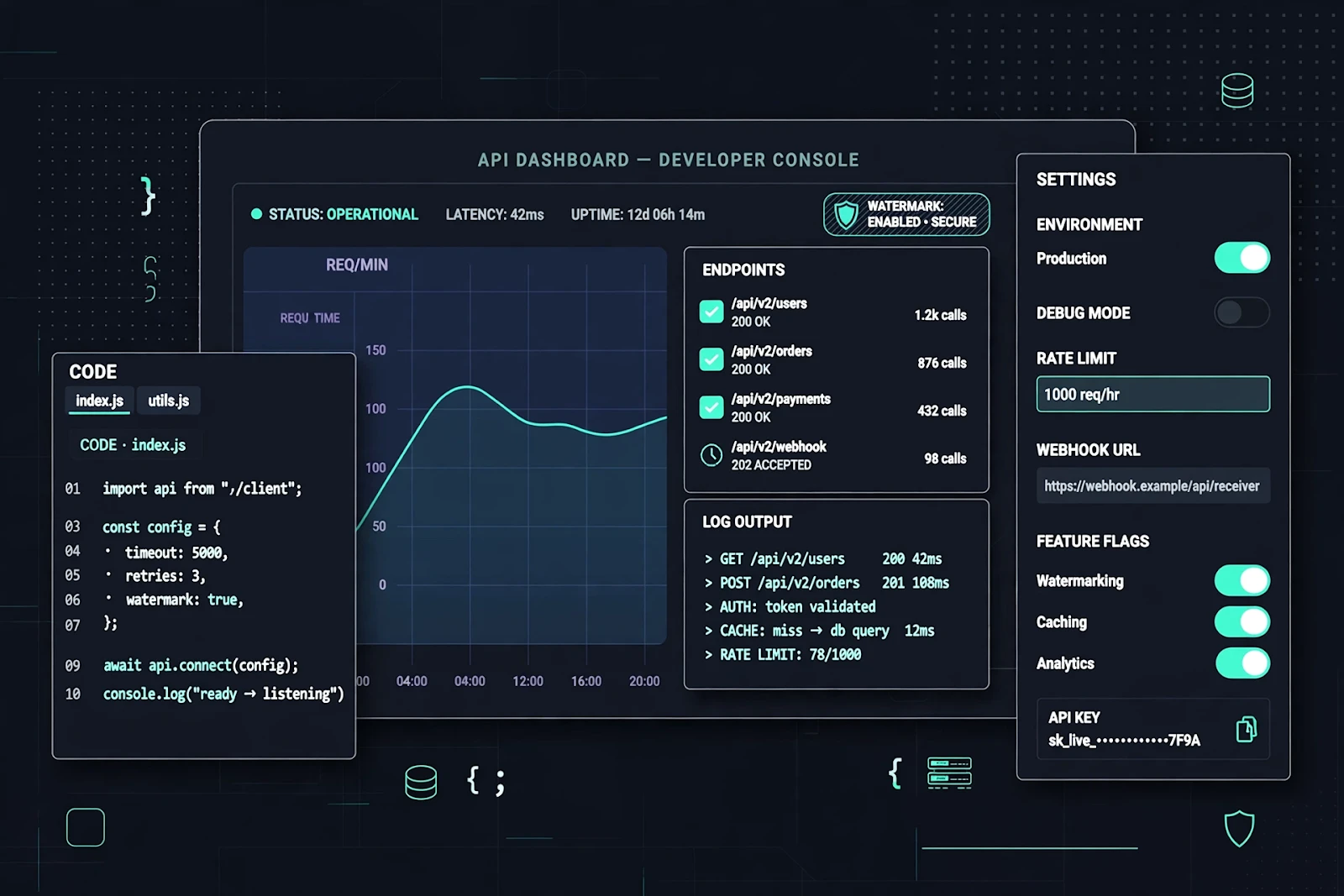
Illustration: A developer console and API dashboard showing a watermark badge and settings controls, symbolising how developers manage the new marking. (AI-generated illustration)
Sponsored: explore today's featured sponsored offers
FAQ
What is the Grok API text watermark?
It is an invisible, statistical pattern woven into the words a Grok model chooses when it generates text through xAI's developer API. According to xAI's developer documentation, the watermark has been switched on by default since 7 November 2026 for seven Grok models. It adds no characters, markup or hidden text, and it does not change the meaning of the response. Developers can see whether a response was watermarked by reading the x-watermark response header.
Which Grok models are watermarked, and can it be switched off?
The watermark applies to grok-4.7, grok-4.6, grok-4.5, grok-4.3 and three grok-4.20 variants (reasoning, non-reasoning and multi-agent), across the Responses API and the Chat Completions API on every xAI endpoint. Team administrators can switch it off per model in the xAI Console, but must confirm that a legal exception applies. Some models may be locked on and cannot be turned off.
Does the watermark apply to the Grok app or to Grok on X?
Not according to anything xAI has published. The documentation covers the developer API only. Images and videos made with Grok Imagine already carry their own older watermark under a different policy.
What is Anthropic doing, and when?
Anthropic will start watermarking text from Claude Opus 4.6, Claude Opus 4.5, Claude Sonnet 4.5 and Claude Haiku 4.5 on Monday 16 November 2026, with the rollout on Amazon Bedrock taking a few more days. For those four models the watermark applies only when the sampling settings — temperature, top_p and top_k — are left at their defaults. Models launched after 2 August 2026 are already watermarked, and Anthropic reported that it began watermarking Mythos 5, Opus 4.7, Opus 4.6 and Sonnet 4.6 from 3 November.
Can anyone check whether a piece of text is watermarked?
No — not the general public. Detection is statistical and needs the provider's secret key. xAI grants access to its detection service by application, and it reports whether text is watermarked, not watermarked, or uncertain. Anthropic's detection is in private preview for eligible organisations such as regulators, law enforcement, media, fact-checkers and researchers. Both companies warn that detection is a signal, not proof, and that short passages, heavy editing, paraphrasing and translation can weaken or remove the signal.
Sources
- xAI developer documentation, "Output Watermarking", updated 31 October 2026 — https://docs.x.ai/developers/advanced-api-usage/watermarking
- Anthropic Help Center, "How Claude marks AI-generated content" (support.claude.com), read 9 November 2026.
- Anthropic, "How Claude's text watermark works", published 14 August 2026, updated 1 September 2026 (anthropic.com).
- ParsonsHosting, "AI Text Watermarks and Your Website or SEO", published 4 November 2026 — https://www.phhelp.com/blog/ai-text-watermarks/
- Maccus, "Grok will watermark API text from November 7. Opting out leaves marking to the customer" — https://maccus.fr/en/grok-text-watermark/
- Dotsbot, "Claude text watermark coming to Opus 4.6 and Sonnet 4.6", reporting The Decoder's account of Anthropic's customer email — https://dotsbot.co/news/claude-text-watermark-older-models
- Regulation (EU) 2024/1689 (EU AI Act), Article 50, EUR-Lex (eur-lex.europa.eu).
- AI Detectors, "Does Gemini Watermark Its Text? SynthID Explained (2026)", updated 18 August 2026 — https://www.aidetectors.io/blog/detect-ai-watermarks-gemini
- ClaudeClean, "ChatGPT vs Claude Watermark: Gemini SynthID and textGrain (2026)", updated October 2026 — https://www.claudeclean.co/chatgpt-vs-claude-watermark
Comments
Post a Comment