
AFCON at a Crossroads: CAF to Vote on Keeping the Biennial Tournament or Switching to a Four-Year Cycle
On November 21, football federations from across Africa will gather in Nigeria for the CAF General Assembly, where they are set to vote on whether to abandon plans to move the Africa Cup of Nations to a four-year cycle from 2028 — a potential reversal that would keep the continent's biggest tournament on its traditional two-year rhythm after nearly a year of fierce pushback from federations and coaches, Inside World Football reported on October 23.

Illustration: The Africa Cup of Nations is the continent's biggest money earner and its players' greatest shop window — a major reason federations want to keep it biennial.
What Happened
CAF, the Confederation of African Football, will put the future of its flagship tournament to a formal vote next month, Inside World Football reported on October 23, 2026. The General Assembly, meeting in Nigeria on November 21, will decide whether to scrap the planned shift to a four-year cycle and retain the current two-year rhythm.
The controversy began last December, when CAF president Patrice Motsepe announced — shortly before AFCON 2025 in Morocco — that the tournament would move to a four-year cycle starting in 2028. Almost a year later, the plan is being reconsidered after what the report described as a wave of opposition from national federations and high-profile coaches across the continent.
According to Afrik-Foot, Motsepe addressed the issue at the recent CAF Strategy Conference in Praia, Cape Verde, and confirmed that the format would go to a vote at the November General Assembly. The decision to hold a vote itself signals how seriously the opposition is being taken at the top of African football's governing body.
Support for keeping the two-year cycle has been strong and unusually public. Comoros federation president Saïd Ali Athouman told reporters: "We were surprised to learn about this reform that would change the final tournament to every four years. You know that in Africa, there is a strong attachment to AFCON and to the fact that it is held every two years."
Ivory Coast coach Hervé Renard, one of the most decorated coaches on the continent, added his voice: "I think it is an excellent thing to return to an AFCON every two years and keep things as they were. An AFCON every four years is far too infrequent in my opinion, but that is my personal view."
DR Congo coach Sébastien Desabre tied the debate to another controversial CAF decision — the scrapping of the CHAN, the tournament reserved for home-based players. "Africa needs an AFCON every two years because it allows national teams to improve," Desabre said. "With the abolition of CHAN, which I believe was a mistake because it showcased the work being done on the continent and gave local players and coaches an opportunity to demonstrate their abilities, holding AFCON every four years was not a good idea."
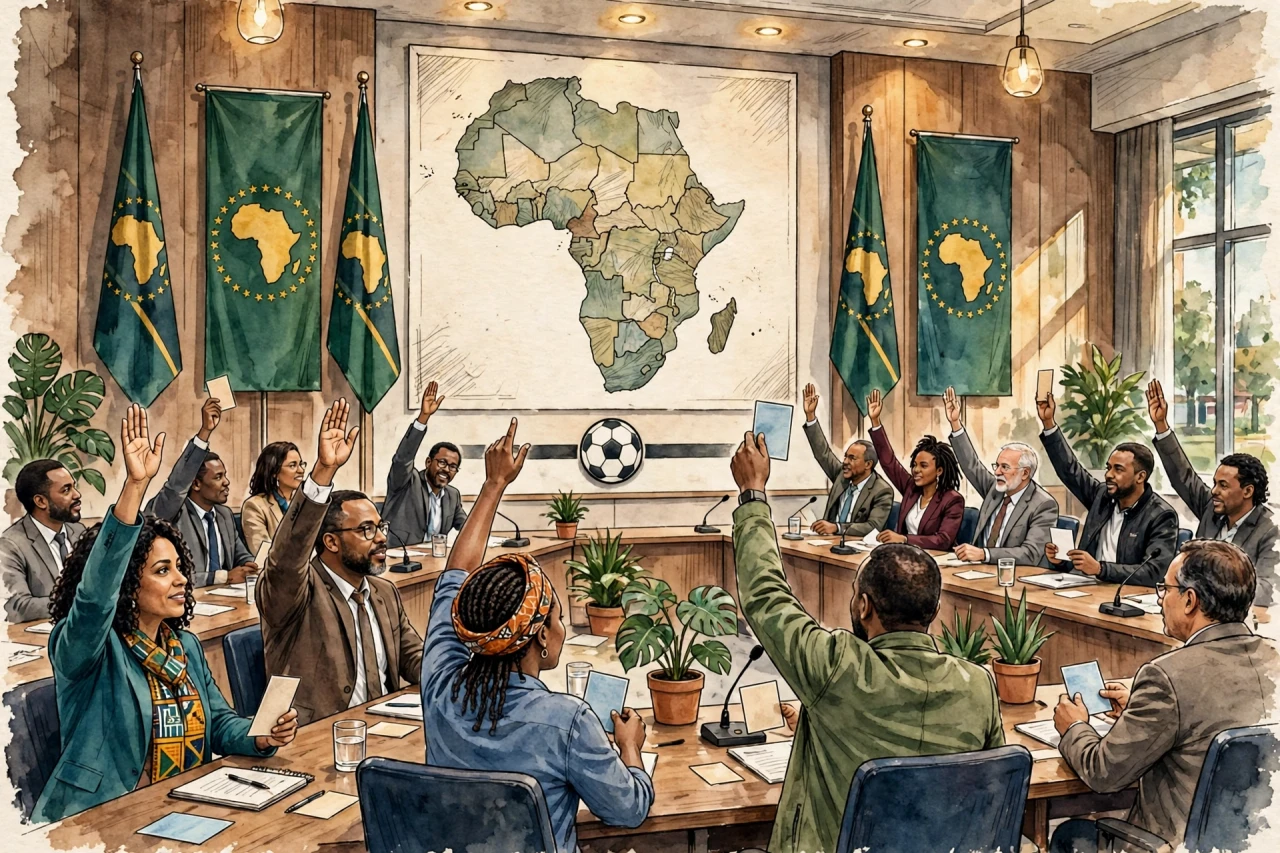
Illustration: The November 21 vote at the CAF General Assembly in Nigeria will settle the format question — at least for now.
Background
The Africa Cup of Nations has run on a biennial rhythm for most of its history, making the tournament one of the most frequent major international football competitions in the world. That frequency is precisely what critics of the four-year plan say gives African football its pulse: every odd year, the continent's best players return home to represent their countries, and millions of fans tune in.
The move toward a four-year cycle did not originate in Africa. According to Inside World Football, it followed pressure from FIFA to realign the international calendar to create space for FIFA's own events — both commercially and for the benefit of players. A quadrennial AFCON would free calendar slots for FIFA's expanding competition portfolio, easing club-versus-country tensions for African stars playing in Europe.
But for Africa, the trade-off looks very different. As the report noted, AFCON is the continent's biggest money earner and its principal shop window for players seeking moves to bigger leagues. Losing half of those tournaments — going from one every two years to one every four — would hit many federations and players hard financially, while removing the regular showcase that has launched countless African careers.
The debate has echoes of earlier calendar battles. The biennial format has survived decades of lobbying from European clubs and from FIFA, which has long sought a more harmonized global calendar. What is new this time is that the proposal came from CAF's own leadership, making the grassroots backlash particularly striking — and, according to the reporting, forcing the reconsideration now heading to a vote.
Desabre's intervention adds a development dimension to the argument. The CHAN, open only to players active in their domestic leagues, was designed to nurture local talent and give home-based coaches a competitive platform. Its abolition removed one of the few regular stages for domestic football; pairing that loss with a halved AFCON schedule, in the coaches' view, would narrow the pipeline for developing national teams across the continent.
Why It Matters
The vote is about more than a calendar date — it is a test of who sets the terms for African football. If the federations defeat the four-year plan, it will mark a rare instance of the continent's football community successfully pushing back against the combined weight of FIFA's calendar ambitions and its own president's reform agenda.
The financial stakes are concrete. AFCON broadcast rights, sponsorships, and ticket revenue fund development programs across Africa's member associations. Halving the tournament's frequency would halve its revenue-generating occasions, with the pain falling hardest on smaller federations that depend most on the continental showcase and on qualification campaigns to sustain fan engagement.
There is also a sporting cost to consider. National teams develop through competitive matches, and a four-year gap between tournaments would leave many African sides with long fallow periods. Coaches like Renard and Desabre argue that regular high-stakes competition is what has driven the improvement of teams such as Ivory Coast and DR Congo — and that young players emerging now could wait half a career for a single continental final tournament.
Finally, the episode underscores the emotional bond between African fans and the tournament. Athouman's remark about "a strong attachment" to the biennial AFCON is not nostalgia — it reflects a football culture in which the Cup of Nations is the defining national ritual, the event around which rivalries, identities, and shared memories are built. Four years is a long time between rituals.
Illustration: Coaches including Hervé Renard and Sébastien Desabre have argued that a two-year cycle is essential for national teams to improve.
What Happens Next
All eyes now turn to the CAF General Assembly in Nigeria on November 21. If the vote goes against the four-year plan, the Africa Cup of Nations will remain on its two-year cycle — but the question is unlikely to disappear. FIFA's calendar pressure is structural, and future CAF administrations could revive the idea.
Watch for the margin of the vote. A decisive rejection of the quadrennial plan would strengthen the hand of federations and coaches in future calendar negotiations with FIFA; a narrow vote would leave the door ajar for a renewed push after the current cycle plays out.
The fate of the CHAN may also re-enter the conversation. Desabre's linkage of the two issues suggests coaches will keep pressing for more competitive opportunities for home-based players, not fewer — and a vote to preserve AFCON's frequency could embolden calls to revisit the CHAN decision as well.
Beyond the assembly, the broader calendar war continues. FIFA is expected to keep pressing continental confederations to align around its own events, and Africa's stance on November 21 will be read in Zurich as a measure of how much resistance the global calendar faces from the regions it affects most.
Sponsored: explore today's featured sponsored offers
FAQ
What is the AFCON format vote about?
On November 21, the CAF General Assembly in Nigeria will vote on whether to abandon plans to hold the Africa Cup of Nations every four years from 2028, potentially keeping the tournament on its traditional two-year cycle.
Who proposed the four-year cycle?
CAF president Patrice Motsepe announced the move last December, shortly before AFCON 2025 in Morocco, citing the need to realign with the international calendar.
Why do federations and coaches oppose it?
They argue AFCON is Africa's biggest money earner and its players' main shop window, that a two-year cycle helps national teams improve, and that losing half the tournaments — especially after the CHAN was scrapped — would hurt development across the continent.
What role does FIFA play in this debate?
According to Inside World Football, the shift to four years followed pressure from FIFA to realign the international calendar to create space for FIFA's own events, both commercially and for players' workloads.
When is the vote and what happens if the plan is rejected?
The vote takes place at the CAF General Assembly in Nigeria on November 21. A rejection would keep AFCON biennial, but the calendar pressure from FIFA is structural, so the debate could return under future leadership.
Sources
- Inside World Football — "Africans maintain pressure to keep AFCON biennial," October 23, 2026.
- Afrik-Foot — reporting on CAF president Patrice Motsepe's remarks at the CAF Strategy Conference in Praia, Cape Verde (cited by Inside World Football).
Comments
Post a Comment