
PARIS — The artificial-intelligence buildout has a new hidden bottleneck: cable. The finance chief of Nexans, one of the world's largest cable makers, told Reuters this week that production capacity for industrial cable is emerging as a constraint on AI data center construction — because building a new cable manufacturing line takes around three years, while demand is rising far faster than suppliers can expand.
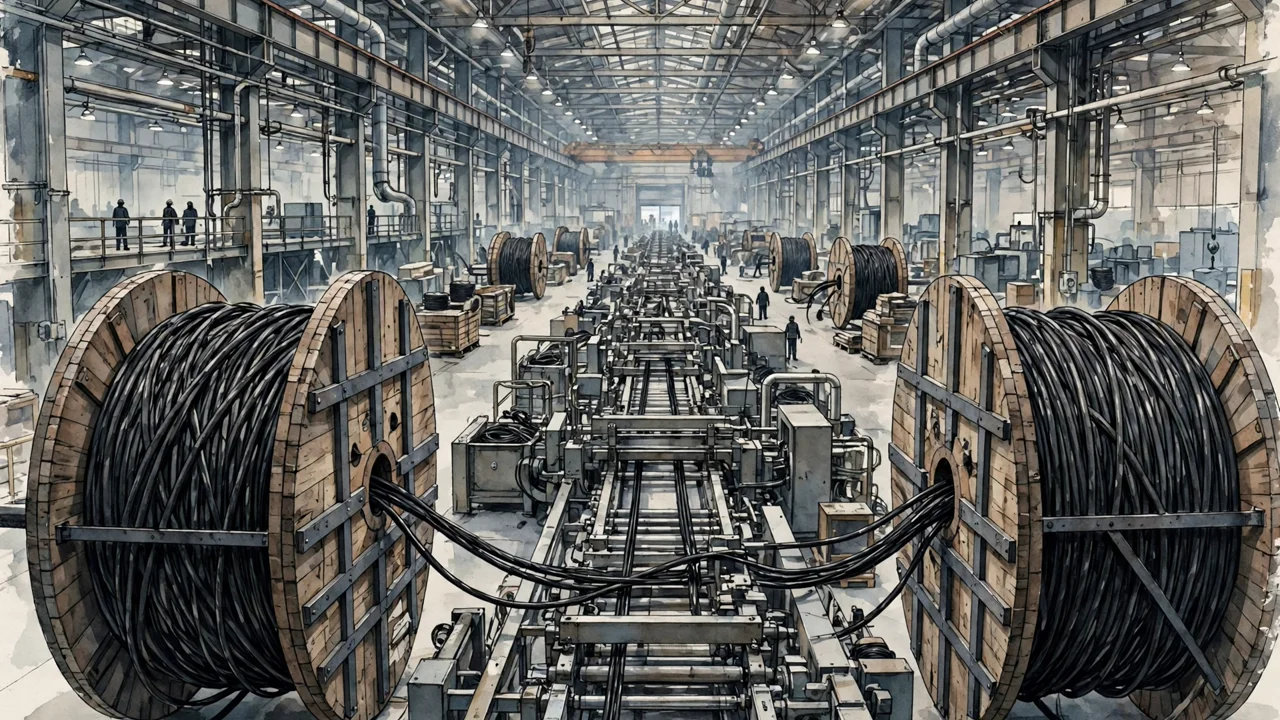
Illustration: Giant spools of industrial cable in a factory — Nexans says production capacity is becoming a bottleneck for AI data centers (AI-generated illustration).
What Happened
Global cable capacity is tight, and a new cross-linked polyethylene (XLPE) cable production line — known in the industry as a CV line — takes about three years to build, Nexans chief financial officer Vincent Piquet told Reuters. That long lead time is limiting how quickly suppliers can respond to surging demand.
"Things can't move quickly and the people building these data centres are in a great hurry," Piquet said. Data centres require large amounts of low- and medium-voltage cable to connect power infrastructure, with larger facilities consuming proportionately more medium-voltage cable.
The strain on power infrastructure is already delaying some projects. In September, Oracle issued a force majeure notice to a Blue Owl unit developing a large data centre in New Mexico, citing potential difficulties securing sufficient power for the site, according to Reuters reporting.
Utilities are responding by locking in supply years in advance: French distribution network operator Enedis has moved from annual procurement agreements to contracts lasting six or seven years in order to secure cable supply, Piquet told Reuters.
Background
The AI infrastructure race has collided with a power-grid reality check. The people building data centres have spent the past two years competing for chips and electricity connections — but cable, the unglamorous metal-and-plastic link between the grid and the server hall, was supposed to be the easy part. It is turning out not to be.
Because demand is rising faster than the industry's ability to expand manufacturing capacity, the constraint is becoming a commercial advantage for the cable makers themselves. Piquet said grid constraints, while slowing some projects, were supporting demand for Nexans' products and allowing the company to be more selective when allocating capacity — in effect, suppliers can now pick which data center projects get wired first.
The bottleneck lands unevenly across regions. Europe generally faces fewer grid-connection challenges than the United States and benefits from stronger electricity networks in some northern countries, Piquet said — though lengthy regulatory processes are delaying certain European projects.
The Oracle–Blue Owl force majeure notice was an early warning sign of how the power side of the AI race can seize up: a project can have land, money and chips lined up, and still be stalled because the physical links to deliver electricity — or now the cables themselves — are not available in time.
The power crunch showed up in Britain too: Microsoft pulled out of a deal with London-based AI cloud provider Nscale that would have seen it rent computing capacity from a planned data centre in Loughton, Essex, Nscale said on October 18 — after Britain's Telegraph newspaper reported that national power grid officials told Nscale they did not expect a power supply for the facility until the 2030s. "Our relationship with Microsoft remains strong and long-term," an Nscale spokesperson told Reuters, adding that the company is exploring alternative power sources for the site.
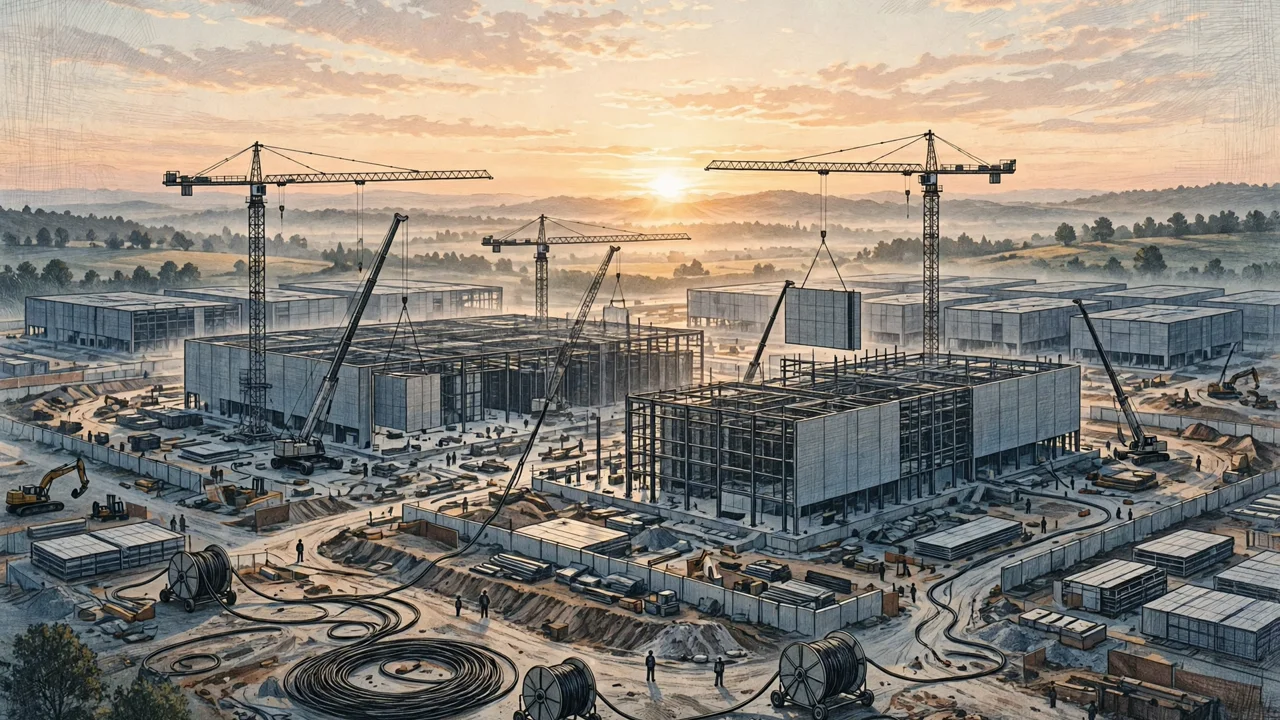
Illustration: A data center under construction at sunrise — projects can have land and funding lined up yet stall without cables and power (AI-generated illustration).
Why It Matters
The cable warning marks a new phase of the AI buildout. First the constraint was chips, then electricity connections — now the humble power cable is flashing as the next limiting factor. Each bottleneck adds years of lead time that no amount of capital can shorten, because a factory takes three years to build regardless of how much money is thrown at it.
That is good news for Nexans and other cable manufacturers, who can now be selective about which projects they supply. It is worse news for developers: data center projects can be delayed not by a lack of land, money or servers, but by the wire itself — and the six-to-seven-year procurement contracts utilities are now signing show the industry expects the tightness to persist.
The regional split also matters for where the next wave of construction goes. Europe's generally stronger grids and fewer grid-connection headaches could shift some investment toward its northern countries, though regulatory delays bite there too — and Piquet cautioned that Europe's data-centre expansion is likely to be less pronounced than in the United States, because private investment capacity is smaller and public funding plays a larger role.
What Happens Next
Piquet said he did not expect demand linked to artificial intelligence to slow — which means the cable shortage is likely to be a multi-year feature of the AI economy rather than a passing hiccup. Manufacturers will add capacity, but with three-year build times, relief is years away.
In the meantime, expect more multi-year supply contracts like Enedis's, more selectivity from suppliers on which projects get served first, and potentially more force majeure-style delays of the kind Oracle issued in New Mexico — projects that look fully financed on paper but cannot be energized on schedule.
Demand-side momentum, meanwhile, keeps building: Reuters reported on October 19 that Nscale was in talks with Anthropic on a second, roughly $45 billion cloud-computing agreement — for computing capacity from a second data-center building at Nscale's Monarch campus in West Virginia, powered by Nvidia Vera Rubin chips. A possible deal worth about $45 billion for 460 megawatts of capacity shows that even as builders hit physical limits, the appetite for AI compute keeps growing.
For the AI industry, the lesson of the cable bottleneck is that the physical world sets the pace: the chips, the software and the capital are moving at digital speed, while the infrastructure underneath still arrives one three-year factory build at a time.
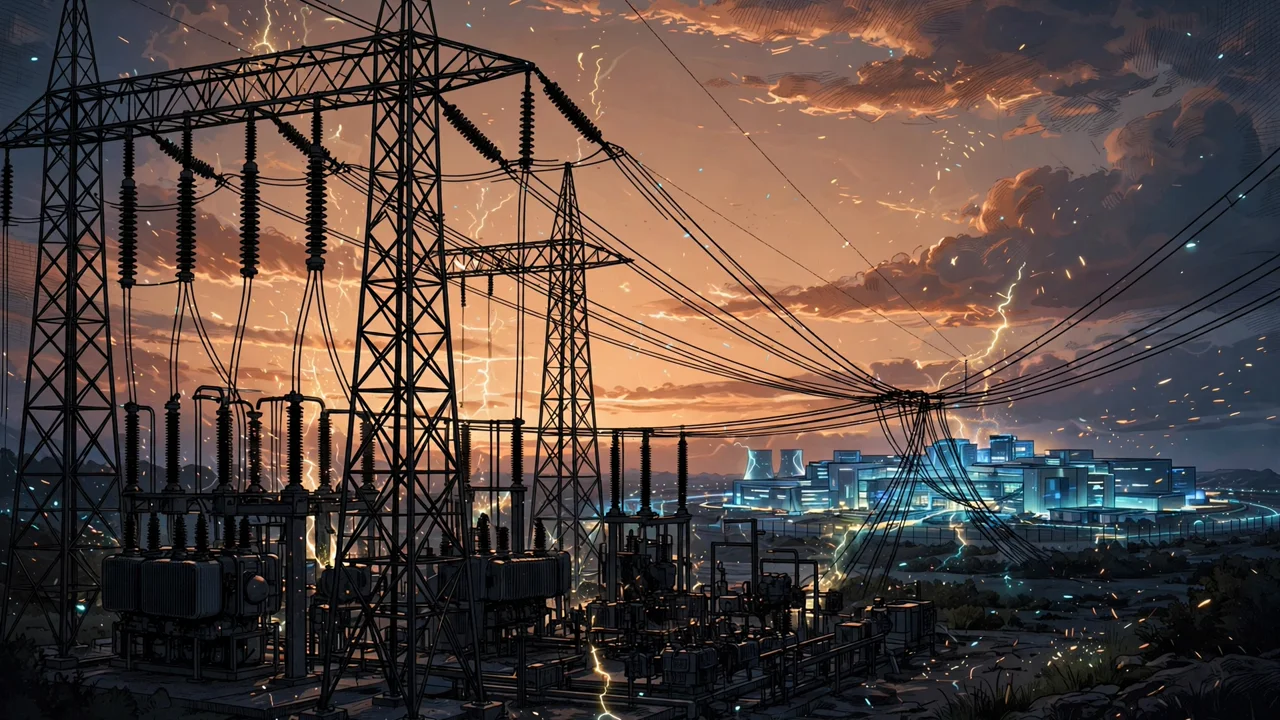
Illustration: A high-voltage substation at dusk — the physical links between the grid and data centers are becoming the AI boom's newest constraint (AI-generated illustration).
Sponsored: explore today's featured sponsored offers
FAQ
Why is cable a bottleneck for AI data centers?
Data centers need huge amounts of low- and medium-voltage cable to connect power infrastructure. Demand is rising faster than the industry can add manufacturing capacity — and building a new XLPE cable production line takes about three years, so supply cannot catch up quickly.
Who raised the alarm?
Vincent Piquet, the chief financial officer of Nexans, one of the world's largest cable makers, told Reuters that cable production capacity is emerging as a bottleneck for AI-driven data center construction.
Are projects already being delayed?
Yes. In September, Oracle issued a force majeure notice to a Blue Owl unit building a large data center in New Mexico, citing potential difficulties securing sufficient power — an early sign that the physical side of the AI race can seize up.
How are utilities responding?
By signing much longer supply contracts. French grid operator Enedis has moved from annual procurement agreements to contracts lasting six or seven years to secure its cable supply.
Is this affecting Europe or the US more?
The US faces more grid-connection challenges than Europe, which benefits from stronger networks in some northern countries — though lengthy regulatory processes are delaying European projects too, and Europe's data center expansion is expected to be less pronounced than America's.
Sources
- Reuters — "Cable capacity emerges as bottleneck for AI data centres, Nexans says" (Oct 22, 2026): https://www.reuters.com/technology/cable-capacity-emerges-bottleneck-ai-data-centres-nexans-says-2026-10-22/
- Reuters (Breakingviews) — "Nscale setback lights up weak spots in AI rollout" (Oct 19, 2026): https://www.reuters.com/commentary/breakingviews/nscale-setback-lights-up-weak-spots-ai-rollout-2026-10-19/
Comments
Post a Comment