
TIRANA, Albania, 29 October 2026 — Opposition lawmakers in Albania disrupted a parliamentary session on Thursday by setting off flares, turning a vote on a Central Bank law into a dramatic showdown after weeks of student-led street protests demanding the resignation of Prime Minister Edi Rama.
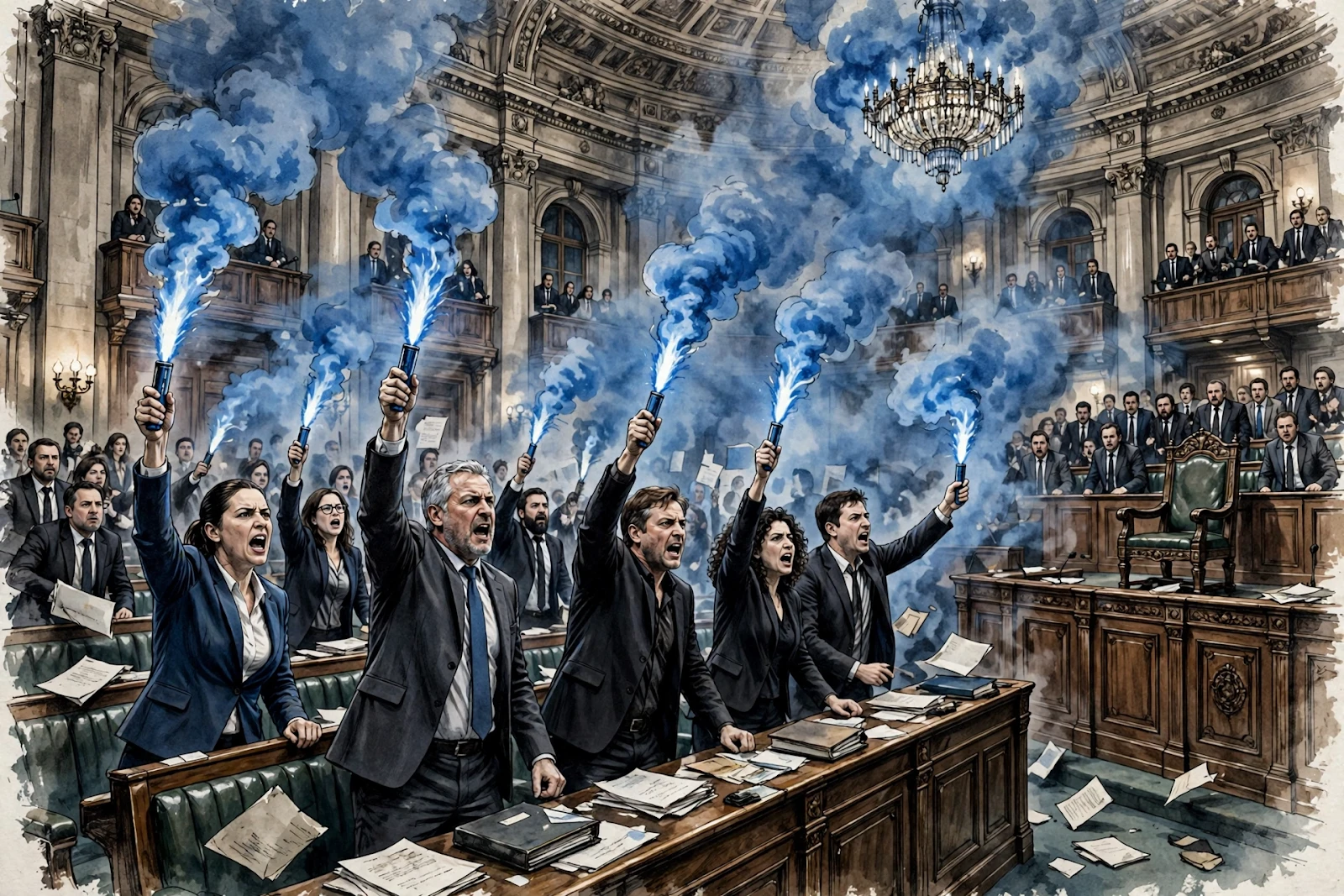
Illustration: Opposition lawmakers set off blue flares inside a parliament chamber.
What Happened
Members of the opposition Democratic Party of Albania blocked access to the podium in parliament as a law on the Central Bank was being voted on, according to Reuters reporting from Tirana on Thursday, 29 October 2026. Some opposition members held blue flares aloft — the colour of their party — while others surrounded their leader during his speech, holding photographs of protesters injured by rubber bullets.
Opposition leader Sali Berisha used his speech to attack the ruling lawmakers in blunt terms. "These (ruling lawmakers) are criminals and they deserve tear gas, rubber bullets, cracked skulls and broken bones, not the young people," Berisha said, according to Reuters, before his microphone was cut off.
The flare protest inside parliament came after weeks of demonstrations outside it. Student-led protests have engulfed central Tirana since mid-October and spread to other cities, Reuters reported, fuelled by anger over perceived government corruption, a lack of jobs and poor education standards. Demonstrators demanding Rama's resignation have, at times, set fire to government buildings and banks, smashed shop windows and pulled up paving stones to throw at police.
Reuters noted that protests this week had been mainly peaceful, and that another protest is planned for Saturday. The contrast between the calmer streets this week and the confrontation inside parliament on Thursday underlines how the political standoff has moved from the boulevard into the chamber itself.
Background
The current unrest did not begin in mid-October. It followed months of largely peaceful summer protests against a luxury coastal development backed by Jared Kushner, the son-in-law of United States President Donald Trump, Reuters reported. Those summer demonstrations, focused on development and corruption concerns, gave way in mid-October to a student-led movement with a sharper and more direct demand: that Rama leave office.
Rama has governed Albania since 2013 and won a fourth term in office last year, Reuters noted. That long tenure is part of why the present unrest is being described as his biggest challenge yet. A government that has survived more than a decade in power, and secured a fresh mandate in 2025, now faces a sustained, youth-driven movement that shows no sign of dispersing after two weeks on the streets.

Illustration: Student protesters march in central Tirana, Albania.
The students' grievances, as reported by Reuters, are broad but concrete: perceived corruption in government, too few jobs for young graduates, and education standards they consider poor. Those themes connect the street protests to everyday life in a way that abstract political arguments rarely do. For many young Albanians, the question is not only who governs, but whether staying in the country offers a viable future.
The government has responded with a mix of penalties and offers. On Sunday, Rama introduced new measures to curb violence, including fines of 500,000 lek — about $6,200 — for anyone who participates in a protest that turns violent, even if they do not personally commit acts of violence, according to Reuters. At the same time, Rama has again called on students for dialogue and introduced new economic measures, such as cheaper fuel and more money for poor families, in an attempt to stop the violence in the streets.
That dual approach — tougher penalties on one hand, dialogue and economic relief on the other — is a familiar pattern for governments facing prolonged protests. Its success depends on whether protesters see the economic measures as a genuine response to their demands, or as an attempt to buy time while the penalties deter further mobilisation.
Why It Matters
The parliament disruption matters for three reasons. First, it shows that the protest movement now has an organised parliamentary echo. Street protests alone can be dismissed by a government as disorder; when opposition lawmakers bring the same confrontation into the legislature, and block a vote in the process, the crisis becomes a governing crisis, not just a policing problem.
Second, the episode raises the stakes for public order. Flares inside a parliament building, photographs of injured protesters held up during a speech, and a microphone cut off mid-sentence are images designed to travel. They are likely to harden positions on both sides: supporters of the opposition will see a parliament willing to silence dissent, while supporters of the government will see an opposition willing to disrupt democratic institutions.
Third, the unrest tests Albania's political stability at a sensitive moment. A country seeking to consolidate democratic institutions and deepen its European integration cannot easily absorb weeks of violent street protests and parliamentary disruption without reputational cost. How the government handles the planned Saturday protest — with restraint, with force, or with a genuine opening to dialogue — will shape that judgement.
What Happens Next
Several things will be watched closely in the coming days. The first is the protest planned for Saturday: whether it remains peaceful, as protests this week largely have been, or returns to the violence seen in earlier days, will influence both public opinion and the government's next moves.
The second is whether Rama's call for dialogue produces a meeting with student representatives, and whether any such meeting goes beyond general assurances to address the specific complaints about corruption, jobs and education. Without a concrete agenda, dialogue offers risk being read as a delaying tactic.

Illustration: Students and officials sit down for dialogue in Albania.
The third is the fate of the Central Bank legislation whose vote was disrupted. Parliament will need to return to it, and the manner of that return — orderly, or amid renewed disruption — will signal whether Thursday's flare protest was a one-off gesture or the start of a sustained opposition strategy inside the chamber.
Finally, the fines announced on Sunday will face their first real test. If they are applied broadly to participants in protests that turn violent, critics are likely to argue they punish peaceful demonstrators caught in a crowd; if they are not applied, supporters of the government may argue the measures were empty. Either way, the policy will become part of the argument itself.
For now, the central fact is unchanged: a student movement that began in mid-October has survived into its third week, spread beyond Tirana, and now disrupted parliament itself. The government has offered dialogue and economic measures alongside tougher penalties. Neither side has yet found a way out — and Saturday's planned protest will be the next test of whether one emerges.
Sponsored: explore today's featured sponsored offers
FAQ
What happened in Albania's parliament on 29 October 2026?
Opposition lawmakers from the Democratic Party of Albania disrupted a parliamentary session by setting off blue flares and blocking access to the podium during a vote on a Central Bank law, according to Reuters.
Why are students protesting in Albania?
Student-led demonstrations since mid-October have been fuelled by anger over perceived government corruption, a lack of jobs and poor education standards, Reuters reported. The protesters are demanding the resignation of Prime Minister Edi Rama.
Who is Edi Rama?
Edi Rama is Albania's prime minister. He has governed since 2013 and won a fourth term in office last year, according to Reuters.
What has the government done in response?
Rama has called on students for dialogue, introduced economic measures such as cheaper fuel and more money for poor families, and announced fines of 500,000 lek (about $6,200) for anyone who participates in a protest that turns violent, even if they do not personally commit acts of violence, Reuters reported.
What happens next?
Another protest is planned for Saturday. Observers will watch whether it stays peaceful, whether dialogue with students produces a meeting, and how parliament handles the disrupted Central Bank vote.
Sources
Reuters, "Albania opposition disrupts parliament session after violent street protests," 29 October 2026.
Comments
Post a Comment