
ALMA Spots a 'Dragon Egg': Possible Embryo of a Massive Star, 16,300 Light-Years Away
ATACAMA, Chile — Astronomers have cracked open one of the rarest objects in star formation: an exceptionally compact, cold core of gas and dust that may be the embryo of a future giant star, glowing faintly inside a dark cloud nicknamed the Dragon Cloud. Observed with the Atacama Large Millimeter/submillimeter Array (ALMA) in Chile, the object — dubbed the "dragon egg" — could help settle a long-standing debate about how the universe's most massive stars are born. The findings were reported by phys.org on October 23, 2026, ahead of publication in the journal Astronomy & Astrophysics.
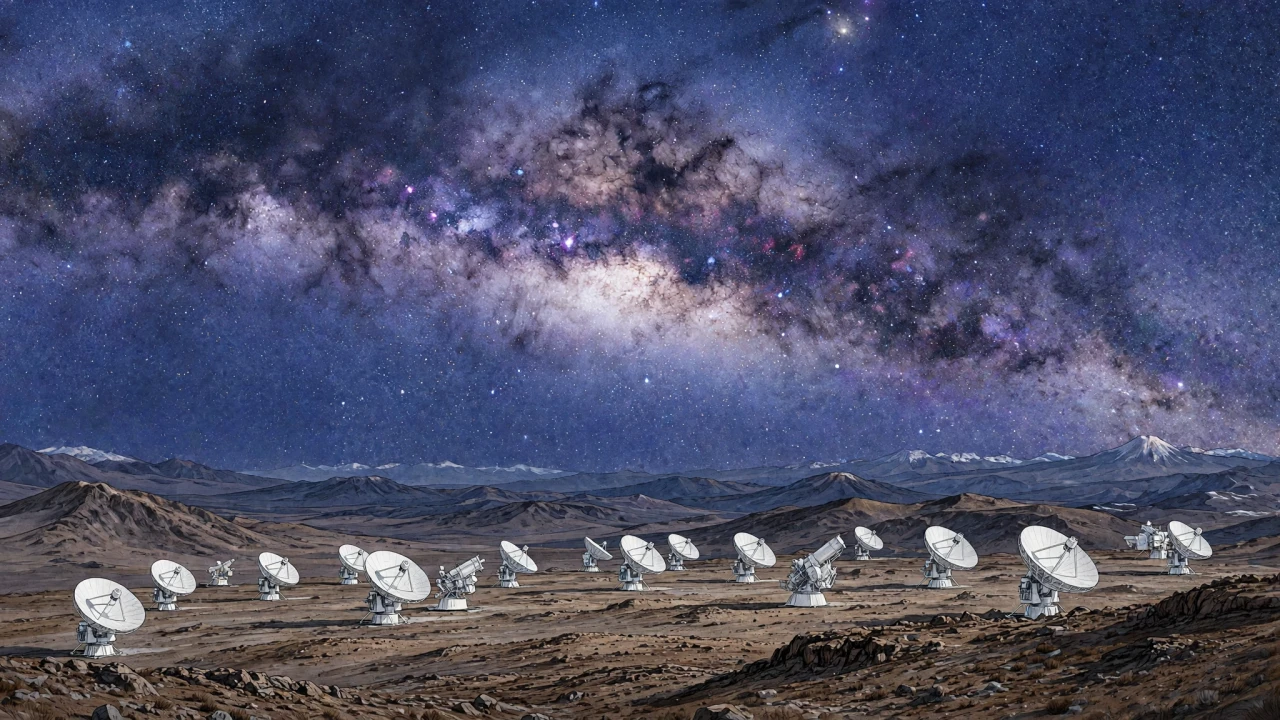
Illustration: A concept illustration of the ALMA telescope array in Chile.

Illustration: A concept illustration of the dragon egg core inside its dark cloud.

Illustration: A concept illustration of a massive star being born.
What Happened
The team, led by Ashley Thomas Barnes of the European Southern Observatory (ESO), used new ALMA Band 6 observations — among the highest-resolution and most sensitive ever obtained for such targets, the researchers say — to obtain a detailed view of a compact source called C2c1a in the C2c1 region, embedded in an infrared-dark cloud known as the Dragon Cloud, about 16,300 light-years from Earth.
The core appears to contain some 20 to 30 times the mass of the Sun, packed into an exceptionally small volume. It sits inside a much larger reservoir of cold gas and dust — at least 110 times the Sun's mass in the immediate envelope, within a parent clump holding roughly 1,061 solar masses — that could supply the material needed to grow a massive star.
But the most striking finding is how quiet the object is. Spectral analysis revealed little glowing gas at its center, and the team found no signs of the energetic jets or outflows that young stars typically blow as they form. The core is also remarkably dim for its size — a low luminosity-to-mass ratio of about 0.5, which researchers say places it firmly among young, unevolved clumps. "A weak, deeply embedded, or unfavorably oriented outflow cannot be excluded," the researchers cautioned, "but the present data reveal no clear outflow signature from the compact source." The high-resolution data resolved the main region into six components — the central C2c1a(a), C2c1b, and four fainter structures — with most of the emission coming from the centrally concentrated core. The paper, "Cracking open the 'dragon egg': ALMA 1.3mm observations of a compact, young high-mass core candidate at 30mas resolution," was posted to the arXiv preprint server on October 5, 2026 (DOI 10.48550/arxiv.2610.07138) and accepted for publication in Astronomy & Astrophysics.
Background
How giant stars — those with masses at least eight times the Sun's — come into existence is still debated. There are two main ideas. One says a dense cloud of gas first condenses into a massive "pre-stellar" core, which then collapses monolithically into a single giant star. The other says the star begins small and grows by continuously pulling in material from the larger clump around it.
Theorists have argued that directly observing a compact, massive, yet young concentration of mass would help decide between the two scenarios. Such cores are, however, extraordinarily hard to detect: they are cold, dark and distant, and candidate objects are often muddied by nearby star formation and stellar activity that complicate interpretation.
Earlier data on C2c1a could not confirm whether it was one compact object, where exactly its mass was concentrated, or whether a protostar had already formed inside. That made it impossible to place the object in the formation sequence — until the new ALMA observations cracked it open.
Why It Matters
The dragon egg's properties, even without signs of strong stellar activity, fit what researchers describe as the "initial conditions of monolithic core-accretion models" — the idea that massive stars begin as heavy, compact seeds. If confirmed, it would be one of the youngest, coldest, most promising massive pre-stellar core candidates ever found: a rare snapshot of the earliest stages of collapse and mass assembly inside a possibly cold cloud.
But the team is careful to say the observations are not decisive. Because the dust temperature of the core is not accurately known, its nature is ambiguous: it could be a cold core with lots of mass, or a warmer, less massive object sitting inside a larger reservoir of cold gas and dust. The data cannot yet distinguish between a core that formed monolithically and one that will keep gaining mass from its surroundings. As with all frontier science, the authors frame their result as evidence, not a verdict.
Massive stars matter far beyond their rarity. Though few in number, they forge the heavy elements, drive the winds and radiation that sculpt galaxies, and end their lives as supernovae and black holes. Understanding how the first heavy seeds form is therefore a question about how the universe built everything from planets to people.
What Happens Next
To settle the ambiguity, astronomers will need to pin down the core's dust temperature and watch for the telltale signs of a hidden protostar: faint outflows, chemical signatures of warming gas, or eventually a glowing embryo. Deeper ALMA observations, along with observations from other facilities such as the James Webb Space Telescope, could supply those diagnostics.
The Dragon Cloud itself remains a promising hunting ground. Infrared-dark clouds — so dense they blot out the background glow of the galaxy — are among the few places cold enough to shelter the earliest stages of star birth. Systematic surveys of such clouds with ALMA are likely to turn up more candidates, letting astronomers test whether dragon eggs like C2c1a are rare exceptions or a common first chapter in massive-star formation.
For now, the dragon egg sits quietly in its dark cloud, 16,300 light-years away — possibly on its way to becoming a star dozens of times heavier than the Sun, or possibly something subtler. Either way, astronomers say, it is exactly the kind of object they have been waiting decades to find.
Sponsored: explore today's featured sponsored offers
FAQ
What is the 'dragon egg'?
It is the nickname astronomers gave to a compact, cold core of gas and dust called C2c1a, located in an infrared-dark cloud known as the Dragon Cloud about 16,300 light-years away. It may be the embryo of a future massive star.
How massive is it?
The core appears to hold 20 to 30 times the mass of the Sun, and it is embedded in a much larger reservoir of cold gas and dust of at least 110 solar masses — enough raw material to form a truly massive star.
Why are astronomers excited?
Such cores are extraordinarily hard to find and to interpret. The dragon egg's quiet, cold, centrally concentrated structure fits the predicted initial conditions of models in which massive stars form from heavy, compact seeds — but the team stresses the evidence is not yet decisive.
What did ALMA see?
Using high-resolution ALMA Band 6 observations, the team led by Ashley Thomas Barnes of ESO resolved the region into six components, found little glowing gas at the center and no clear outflow signatures — signs of a very early, unevolved stage.
What happens next?
Follow-up observations will try to measure the core's dust temperature and search for faint signs of a hidden protostar, which would tell astronomers which formation pathway the dragon egg is on.
Sources
- phys.org — "ALMA spots 'dragon egg' that may represent the earliest stages of massive star formation" — October 23, 2026
- A. T. Barnes et al. — "Cracking open the 'dragon egg': ALMA 1.3mm observations of a compact, young high-mass core candidate at 30mas resolution" — Astronomy & Astrophysics (accepted); arXiv, October 5, 2026 (DOI 10.48550/arxiv.2610.07138)
- 15 Minute News — "ALMA spots 'dragon egg' that may represent the earliest stages of massive star formation" — October 23, 2026
Comments
Post a Comment