
Finance ministers from the Asia-Pacific Economic Cooperation forum concluded a two-day meeting in Hong Kong on Wednesday, October 21, 2026, agreeing to strengthen macroeconomic policy communication and coordination as the region confronts energy-driven inflation, tariff tensions and financial market volatility. Chaired by Chinese Minister of Finance Lan Foan, the meeting produced a joint statement plus a package of outcome documents on digital infrastructure financing, fiscal support for households and financial inclusion — setting the economic agenda for the APEC leaders' summit in Shenzhen next month.
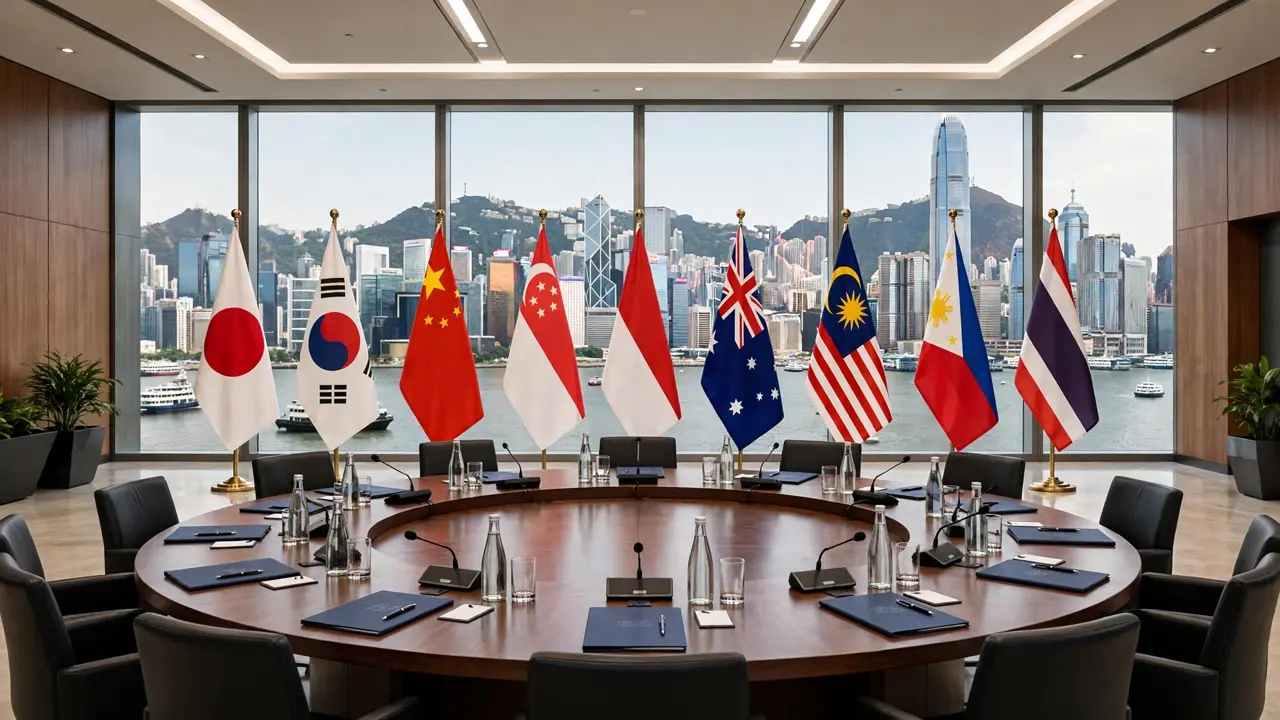
Illustration: a finance ministers' meeting hall with Asia-Pacific nations' flags. This is an AI-generated illustration, not a real photograph of the event.
What Happened
At the close of the ministers' meeting in Hong Kong, Lan told a press briefing that all members had agreed on the need to enhance the soundness of their macroeconomic policies and to strengthen fiscal and financial systems "to better handle uncertainty and safeguard regional economic and financial stability," according to Reuters. The ministers also reached consensus on promoting practical financial-sector cooperation focused on supporting people's livelihoods, digital infrastructure financing and locally adapted measures for inclusive finance.
The meeting approved and issued the APEC Finance Ministers' Joint Statement alongside the Asia-Pacific Regional Digital Infrastructure Financing Policy Statement. It also produced two specialized outcome documents: the report Supporting Livelihood Development and Investing in People: Fiscal Policies for Promoting Sustainable Growth in the Asia-Pacific, and a Compendium of Innovative Practices in Financial Inclusion in the Asia-Pacific. A summary of the APEC Youth Finance Talent Exchange and Cooperation Project rounded out the package.
The digital infrastructure statement encourages member economies to "develop reliable, accessible, scalable, trusted, secure and resilient digital infrastructure; enhance digital literacy and skills; promote interoperability; and cross-border digital connectivity to accelerate the digital transformation in the Asia-Pacific region." It also calls for deeper collaboration between the public sector, the private sector and multilateral development banks to foster innovation and risk mitigation.
Lan added that artificial intelligence and other emerging technologies could raise productivity and support new sources of growth, while stressing that governments needed to maintain fiscal discipline and ensure sustainable public finances. Support for households and investment in people, he said, could lift household spending, domestic demand and productivity.
Background
APEC brings together 21 Pacific Rim economies — including the United States, China, Japan, South Korea, Canada, Mexico, Australia and Indonesia — and 2026 is China's APEC host year, with the leaders' summit scheduled for Shenzhen on November 18–19. The finance ministers' meeting is the forum's main annual economic-policy checkpoint, where treasurers and finance chiefs align on the language and commitments their leaders will inherit.
The coordination call lands in a difficult moment for the global economy. Brent crude has been trading near $108–110 a barrel as Middle East supply risks and Red Sea shipping threats keep energy prices elevated, feeding inflation that has kept major central banks hawkish: markets are pricing a strong chance of a December rate hike from the US Federal Reserve, which meets October 27–28, while gold has hovered near $4,100 an ounce and the US dollar index has been under pressure. The IMF's October World Economic Outlook has warned that higher energy prices and long-term interest rates will weigh on growth, with global headline inflation projected at 4.7 percent for 2026.
Trade policy adds another layer of uncertainty. The United States imposed 25–50 percent tariffs on selected Canadian goods this summer, collapsing formal talks in August, and Washington's tariff posture toward China remains a standing source of friction across the Pacific — the very tensions the APEC process was built to manage.
Why It Matters

Illustration: Hong Kong's financial district skyline with digital connectivity motifs. This is an AI-generated illustration, not a real photograph.
The Hong Kong package matters less for what it decided — ministerial statements rarely move markets by themselves — than for the signal it sends. Twenty-one of the world's largest economies publicly agreeing that macroeconomic coordination must intensify is a concession that the era of each central bank and finance ministry going it alone is over, at least for the region that produces the bulk of global growth.
The digital infrastructure statement is the most substantive piece. Cross-border digital connectivity, interoperable payment systems and shared standards for "trusted" digital infrastructure are where the next decade of Asia-Pacific trade integration will actually be negotiated — in fibre cables and data rules rather than tariff schedules. APEC's embrace of the agenda gives cover for national governments to spend on it, and creates a framework in which multilateral development banks can co-finance projects.
The fiscal-policy strand is politically revealing. Lan's dual emphasis — support households and invest in people, but keep fiscal discipline — mirrors the dilemma facing nearly every APEC government: voters demand relief from high energy costs and living costs, while bond markets punish profligacy. The report on fiscal policies for sustainable growth effectively endorses targeted, time-bound household support over broad subsidies — the position the IMF has been urging.
What Happens Next
The ministers' package now moves up the chain. The APEC leaders' summit in Shenzhen on November 18–19 will be the stage where heads of government adopt, ignore or upgrade the finance ministers' work — and where the Trump–Xi bilateral expected on the sidelines could overshadow the institutional agenda. Shenzhen will also host the Quad leaders' summit in Manila just before it, concentrating an unusual amount of the year's diplomacy into a single week of November.
Between now and then, the documents approved in Hong Kong — the joint statement, the digital infrastructure financing policy statement, the fiscal-policy report and the financial-inclusion compendium — become reference points for bilateral negotiations across the region. Watch for which economies cite the digital infrastructure statement in upcoming trade talks, and whether the multilateral development banks named in it announce dedicated financing facilities.
The deeper test is whether coordination survives contact with the next shock. APEC ministers have pledged closer communication "to address external risks and challenges" before — the record is mixed. If energy prices spike further or a new tariff escalation lands before Shenzhen, the Hong Kong language will be judged not by its ambition but by whether any member actually changed course because of it.

Illustration: digital infrastructure networks across the Asia-Pacific region. This is an AI-generated illustration, not a real photograph.
Sponsored: explore today's featured sponsored offers
FAQ
What did APEC finance ministers agree to in Hong Kong?
Ministers agreed to strengthen macroeconomic policy communication and coordination to address external risks, and issued a joint statement plus outcome documents on digital infrastructure financing, fiscal policies supporting households, financial inclusion and a youth finance talent exchange.
When and where did the meeting take place?
The two-day APEC Finance Ministers' Meeting concluded on Wednesday, October 21, 2026, in Hong Kong, hosted by China's Hong Kong Special Administrative Region and chaired by Chinese Minister of Finance Lan Foan. 2026 is China's APEC host year.
What is the digital infrastructure financing statement?
It is a policy statement encouraging APEC economies to build reliable, accessible, scalable, trusted, secure and resilient digital infrastructure, improve digital literacy, promote interoperability and cross-border digital connectivity, and deepen collaboration between governments, the private sector and multilateral development banks.
Why does policy coordination matter now?
The region faces energy-driven inflation with Brent crude near $108–110 a barrel, expectations of further central-bank tightening, and trade tensions including the US–Canada tariff dispute. The IMF projects global headline inflation of 4.7 percent for 2026, making coordinated fiscal and financial responses more important.
What comes after the Hong Kong meeting?
The package goes to the APEC leaders' summit in Shenzhen on November 18–19, 2026, where heads of government will adopt or build on the ministers' work. A Trump–Xi bilateral is expected on the sidelines, and the Quad leaders' summit in Manila takes place just before.
Sources
- Reuters (Yantoultra Ngui and Shi Bu) — "APEC finance ministers agree to boost policy coordination, China's Lan says," Hong Kong/Beijing, October 21, 2026
- BusinessWorld Online — "APEC finance ministers agree to boost policy coordination, China's Lan says," October 21, 2026
- Devdiscourse (Reuters wire) — "APEC finance ministers agree to boost policy coordination, China's Lan says," October 21, 2026
Comments
Post a Comment