
ARTE TOKYO Turns the Whole City Into a Gallery: Inside the Capital's First Three-Month Arts Festival
Tokyo, Japan — Tokyo has turned itself into a gallery, a stage and a light show all at once. ARTE TOKYO, the capital's first citywide arts festival, is running from 10 October to 31 December 2026, spreading contemporary art, theatre, music, circus and illuminations across the waterfront, Hibiya and Marunouchi, and Yoyogi and Shibuya — with much of it free and outdoors. Organised by the Tokyo Metropolitan Government and the Tokyo International Festival of Arts and Culture Executive Committee, the inaugural festival replaces the idea of a single venue with a network of events across the whole city.
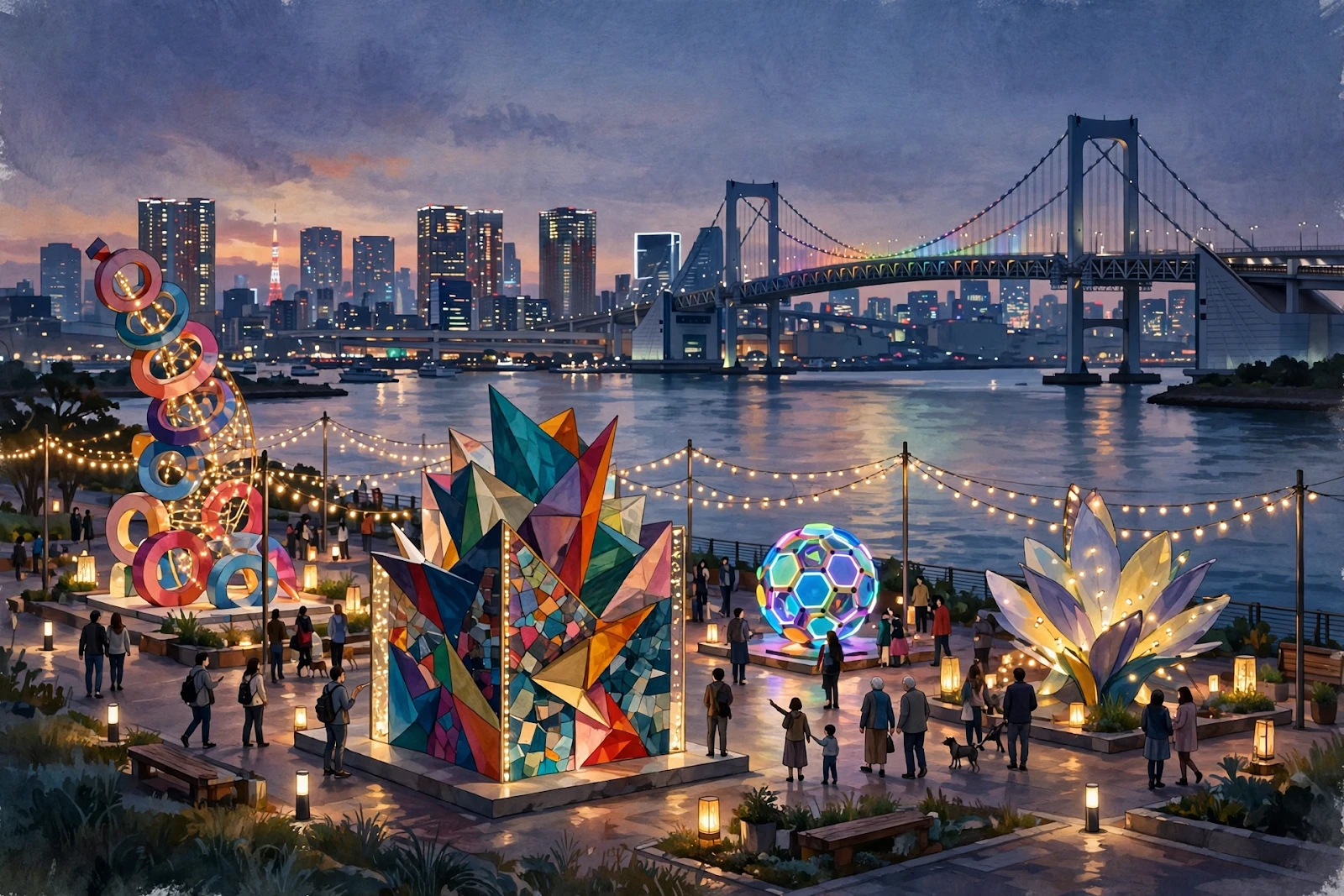
Illustration: Colourful public art and illuminations along Tokyo's waterfront promenade at dusk.
What Happened
ARTE TOKYO opened on 10 October 2026 as a new festival with an unusually long run: nearly three months, stretching through autumn and into the winter illuminations season. Rather than centring on one site, it is built around three core areas, according to the Tokyo Metropolitan Government's programme announcement of 15 September 2026, which also confirmed 113 participating partner programmes.
The three areas are the waterfront — Odaiba, Aomi and Tennozu — Hibiya and Marunouchi in the city centre, and Yoyogi and Shibuya to the west. Programming spills well beyond those three districts, with partner events across Tokyo's 23 wards and out into the Tama area, so a visitor's experience of the festival depends entirely on which neighbourhood they choose to explore.
Among the headline programmes, the TOKYO ATLAS international art exhibition opened on 10 October along the waterfront, linking Daiba, Aomi and Tennozu, with free admission to its main exhibition areas. The ARTE TOKYO CIRCUS, a free contemporary circus staged on the Odaiba waterfront, performed on 10 and 11 October and returns for a final date on 14 November 2026, with two shows a day at 1:10 p.m. and 3:10 p.m. The Tokyo Aqua Symphony fountain show runs daily at Odaiba Marine Park, and the Illumination Island Odaiba waterfront illumination is expected from mid-November to late December.
In the city centre, the T3 PHOTO FESTIVAL TOKYO ran from 3 to 26 October across Yaesu, Nihonbashi, Kyobashi and Ginza, turning indoor and outdoor spaces into a free photography route, while the Meguro River Autumn Promenade ran from 10 to 31 October. The Tokyo Night and Light projection-mapping show on the Tokyo Metropolitan Government Building runs nightly, weather permitting, giving the festival a permanent nightly anchor in the west of the city.

Illustration: An open-air contemporary circus performance beside Tokyo Bay at sunset.
Background
ARTE TOKYO is the public name for the Tokyo International Festival of Arts and Culture, and its structure deliberately goes beyond a normal arts festival. According to programme guides published during the festival's first weeks, it is organised into core programmes produced around the three focal areas, highlight programmes linked to major events and places, and partner programmes run by public and private organisations across Tokyo.
The festival also carries forward elements of the cultural programme developed for the Tokyo 2020 Games, Japan Airlines' travel coverage noted, giving the event a sense of continuity with the city's last great cultural moment. That heritage matters: the 2020 Games were meant to showcase Japanese culture to the world, and ARTE TOKYO revives that ambition in a more diffuse, city-shaped form, where art appears in parks, on waterfronts and on building facades rather than only inside galleries and theatres.
Tokyo is no stranger to large cultural events — the Tokyo International Film Festival, which opens on 26 October 2026, is a separate and long-established fixture on the city's calendar — but ARTE TOKYO is different in scale and shape. It is not a festival that a visitor attends for a weekend; it is a season that a resident or a long-stay visitor can dip into repeatedly over almost three months, with free events lowering the barrier to entry and outdoor settings making the art part of everyday city life.
The timing is deliberate too. The festival opens in the autumn foliage season, runs through the build-up to winter, and closes on New Year's Eve, capturing both the autumn tourism peak and the winter illuminations season, when Tokyo's streets are at their most photogenic. For a city that already draws millions of visitors a year, the festival gives returning travellers a new reason to come back — and a new way to see neighbourhoods they thought they already knew.
Why It Matters
ARTE TOKYO matters because it tests a different model for what a city arts festival can be. The traditional model concentrates prestige in a few venues and a few weeks; the Tokyo model disperses it across a metropolis of 14 million people and nearly three months. If it works, it offers a template for other megacities that want culture to reach residents where they live, rather than asking residents to travel to culture.
It also matters for access. A striking share of the programme is free — the circus, the photography festival, the public art installations, the fountain show and the nightly projection mapping all cost nothing to watch — which means the festival is not only for the art-world crowd. Families, students and casual passers-by become part of the audience simply by walking through the right neighbourhood at the right time, and that accidental encounter is often how a lifelong interest in art begins.
For Tokyo's cultural economy, the festival is a bet on the shoulder seasons. By stretching from October to December, it gives hotels, restaurants, transport operators and local shops a cultural draw across months that might otherwise be quieter, and it gives the city's artists and performers a longer, more stable platform than a short festival burst. The 113 partner programmes suggest the bet is already paying off in participation, even before the final attendance figures are counted.

Illustration: A Tokyo tower at night covered in colourful projected light patterns.
What Happens Next
The festival's remaining highlights give visitors plenty to plan around. The ARTE TOKYO CIRCUS returns to Odaiba on Saturday, 14 November 2026, for its final performances of the season, with no reservation required and admission free. The waterfront illuminations, including Illumination Island Odaiba, are expected to light up from mid-November to late December, and the public art installations along the waterfront, including works on Odaiba Beach and the West Promenade, run into December.
Visitors are advised to check the official ARTE TOKYO programme directory before travelling, since individual event dates, times and any weather-related changes are updated there, and some installations require advance timed booking — notably one underground venue in the TOKYO ATLAS route. The Tokyo Night and Light show, by contrast, runs nightly, weather permitting, and needs no booking at all.
When the festival closes on 31 December 2026, the question will be whether it returns — and in what form. A first edition that draws crowds across three months and 113 partner programmes would make a strong case for a second, and Tokyo's cultural planners will be watching closely. For now, though, the city itself is the exhibition, and it will stay open until the last night of the year.
Sponsored: explore today's featured sponsored offers
FAQ
What is ARTE TOKYO?
ARTE TOKYO is Tokyo's first citywide arts festival, formally the Tokyo International Festival of Arts and Culture, organised by the Tokyo Metropolitan Government and its festival executive committee.
When does ARTE TOKYO run?
The first edition runs from 10 October to 31 December 2026, nearly three months, across Tokyo.
Which areas of Tokyo does the festival cover?
Three core areas — the waterfront (Odaiba, Aomi, Tennozu), Hibiya and Marunouchi, and Yoyogi and Shibuya — plus partner events across the 23 wards and the Tama area.
Is ARTE TOKYO free?
Much of it is free, including the ARTE TOKYO CIRCUS, the T3 photo festival, public art installations, the Tokyo Aqua Symphony fountain show and the nightly Tokyo Night and Light projection show, though some programmes vary.
What is still to come in the festival?
The ARTE TOKYO CIRCUS returns to Odaiba on 14 November 2026, and the waterfront illuminations run from mid-November to late December, with the festival closing on 31 December.
Sources
- Japan Airlines / Japan Travel, "Tokyo Launches a New Citywide Arts Festival", October 2026.
- Tokyo Cheapo, "Arte Tokyo 2026: Tokyo's New Autumn Arts Festival, Oct 10–Dec 31, 2026", October 2026.
- Awesome Tokyo, "ARTE TOKYO 2026 Opens 10 October Across Three Core Areas", September 2026 (15 September programme announcement; 113 partner programmes).
- Babylon International, "ARTE TOKYO 2026: the best arts events for international residents", updated 14 October 2026.
- Ad-hoc News, "Odaiba hosts ARTE TOKYO CIRCUS on 14 November 2026", October 2026.
Comments
Post a Comment