
Beyond Chatbots: ASI Hits $3 Billion Valuation as Investors Bet Big on AI That Runs the Physical World
Boston-based artificial intelligence startup ASI announced on Tuesday, October 20, 2026, that it has raised $325 million in a Series C funding round valuing the company at $3 billion, according to Reuters, marking one of the year's most significant bets on a fast-growing corner of the AI industry: software designed not to chat, write or generate images, but to keep the physical world running — forecasting disruptions in air traffic, power grids and military operations hours, days or even weeks before they happen.
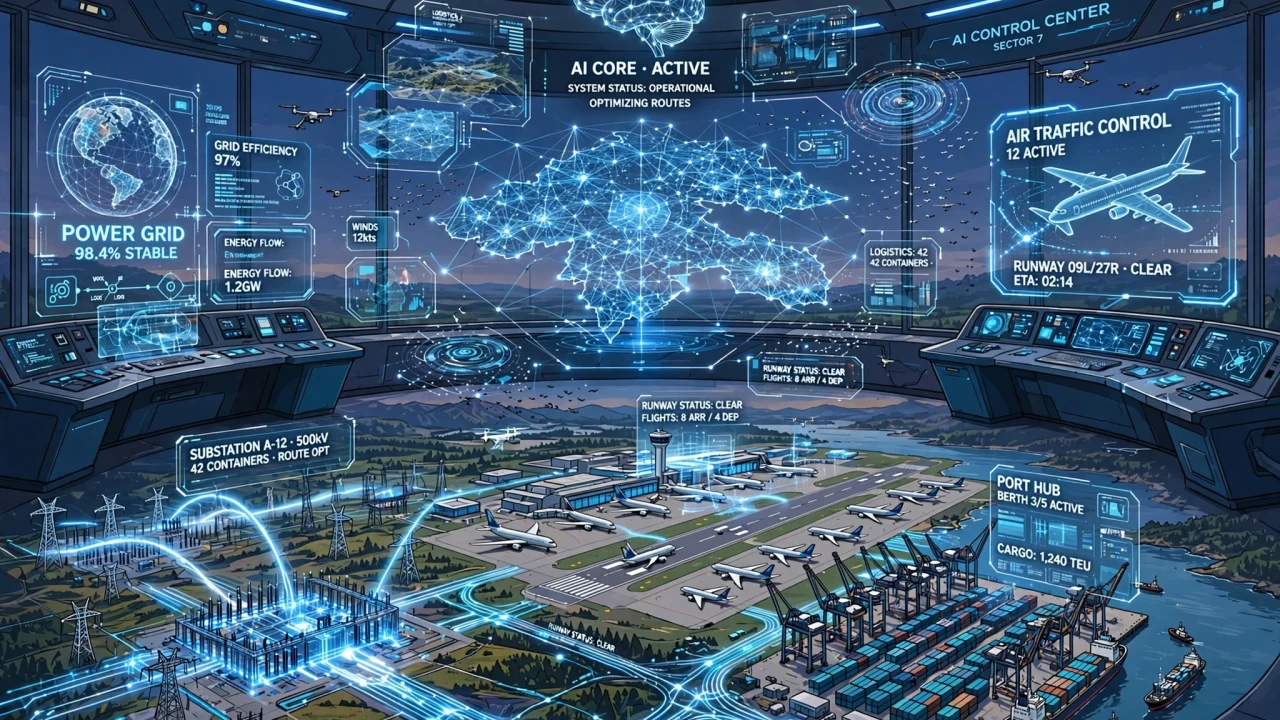
Illustration: an AI control center overlooking a power grid, airport and shipping port connected by glowing digital networks. This is an AI-generated illustration, not a photograph of a real facility.
What Happened
ASI said the Series C round was led by Spark Capital, with participation from affiliates of Citadel Securities, Meritech Capital and Craft Ventures, among other investors. The raise follows what Reuters described as "growing investor appetite for AI software used in real-world applications" — a marked shift in where venture capital is flowing in 2026, away from the crowded field of chatbots and language models toward systems that touch concrete, real-world infrastructure.
The company's pitch is deliberately framed against the generative-AI wave. "While the broader tech ecosystem spent hundreds of billions teaching AI to manipulate words and generate text, ASI is deeply focused on AI systems that can manage and control physical assets," founder and CEO Phillip Buckendorf told Reuters. The line captures the strategic positioning: while most AI attention has gone to large language models, ASI builds simulation and monitoring software that models how interconnected physical systems behave, helping operators anticipate disruptions before they cascade.
ASI said it would use the new capital to expand deployments across energy, logistics and military environments, and to grow its research and engineering teams in Boston. The funding announcement landed on the back of two major US government contract wins this year, giving the young company an unusually solid revenue footing for a startup: a five-year, $99 million US Army contract secured this October covering military command systems, and a 12-year, $875 million Federal Aviation Administration contract awarded in June covering air traffic management. Together, the two agreements represent roughly $974 million in stated contract value — a significant validation of the company's technology in some of the most demanding operational environments on the planet.
Background
The raise arrives during an extraordinary year for AI investment. Across 2026, hundreds of billions of dollars have poured into AI infrastructure — from data centers to chips to cloud capacity — and investors have been hunting for the next frontier after large language models. One of the leading answers emerging in boardrooms and venture firms is what industry observers have started calling "physical AI": machine intelligence applied to moving, sensing and managing things in the real world, from robots and autonomous vehicles to the software brains that keep grids, airports and supply chains humming.
ASI sits squarely in the software branch of that movement. According to the company's description, reported by citybiz alongside the funding news, its platform combines continuous simulations, multidimensional monitoring and optimization techniques to evaluate how infrastructure systems may behave over periods ranging from hours to weeks. It uses deterministic modeling — evaluating outcomes under defined conditions — alongside probabilistic modeling that accounts for uncertainty, giving operators a way to rehearse scenarios before real-world failures strike. Applications include managing air traffic, coordinating military logistics, planning electricity grid operations and optimizing airline networks.
The timing also matters for government buyers. Air traffic systems in the United States and elsewhere have faced staffing strain and aging technology, and grid operators are juggling surging electricity demand from AI data centers themselves — an ironic loop in which AI's own appetite for power is one of the problems this kind of software is designed to help manage. The FAA's 12-year, $875 million award, which citybiz described as tied to modernizing the National Airspace System, signals how seriously US agencies are taking that challenge.

Illustration: an AI data center with glowing servers feeding visualized energy flows into a city power grid. This is an AI-generated illustration, not a photo of a real facility.
Investor composition is also telling. Spark Capital leading the round puts ASI in the portfolio of a firm known for early bets on category-defining technology companies, while participation from Citadel Securities affiliates suggests interest from the trading world — where firms live and die on microsecond-scale simulation and prediction — alongside Meritech Capital, Craft Ventures, and, according to citybiz, Energy Impact Partners and Andreessen Horowitz. That mix of deep-tech venture capital and finance-linked investors reflects the bet: that operational AI for critical infrastructure is becoming an asset class of its own.
Why It Matters
The significance of ASI's raise goes beyond one startup's balance sheet. It is a concrete data point in a broader rotation of AI investment: after years in which funding chased bigger and bigger language models, capital is now flowing to companies that promise AI for the physical economy — the power plants, runways, warehouses and battlefields where mistakes are measured in blackouts, collisions and lives rather than awkward chatbot answers.
For operators of critical infrastructure, the appeal is straightforward. A simulation system that can flag a looming grid bottleneck days in advance, or rehearse air-traffic disruptions before they happen, could translate into real savings and real safety gains. Utilities are already grappling with extreme weather and demand spikes; airlines and airports with chronic congestion; militaries with the complexity of modern command and control. ASI's government contracts suggest buyers are willing to pay for foresight.
There is also a geopolitical dimension. The same week ASI announced its raise, the AI race between the United States and China continued to dominate technology headlines, from chip export controls to multibillion-dollar data center deals. AI that manages physical assets — power grids, airspace, military logistics — sits at the intersection of economic competitiveness and national security, which helps explain why a startup can command a $3 billion valuation with significant US defense and aviation contracts already in hand.
At the same time, the deal underscores how the AI funding boom has matured. Investors are no longer just funding potential; ASI arrives with nine-figure government contracts and a defined deployment pipeline in energy, logistics and military environments. Whether that maturity insulates it from the boom-and-bust cycles of venture capital remains an open question — but for now, the market has spoken: the next big AI bet is on software that runs the world you can touch.
What Happens Next
ASI said the fresh capital will fund an expansion of its deployments across energy, logistics and military settings, along with hiring in Boston. Watch for announcements of new utility or logistics customers in the coming quarters — commercial deals, beyond the headline government contracts, will be the real test of whether physical-AI software can scale beyond defense and aviation.

Illustration: a futuristic command center with operators monitoring holographic air-traffic and logistics simulation screens. This is an AI-generated illustration, not a real scene.
The company will also be watched as a bellwether for the physical-AI investment thesis more broadly. If ASI can convert its $3 billion valuation into operating deployments that demonstrably reduce disruptions — fewer flight delays, more resilient grids, smoother military logistics — expect a wave of copycat funding rounds. If deployments stall, it could chill investor enthusiasm for the category.
Regulatory questions loom as well. AI systems that "manage and control physical assets," as Buckendorf puts it, carry higher stakes than chatbots: a bad forecast about a poem is an embarrassment; a bad forecast about grid load or air-traffic separation is a disaster. Expect scrutiny from aviation and energy regulators — and from safety researchers — over how these systems are validated, and what happens when the simulation is wrong.
Sponsored: explore today's featured sponsored offers
FAQ
What is ASI and what does its software do?
ASI is a Boston-based AI startup whose simulation and monitoring software helps operators forecast disruptions — hours, days or weeks in advance — across complex physical systems such as air traffic networks, power grids and military operations, according to Reuters.
How much did ASI raise and what is it worth now?
ASI raised $325 million in a Series C round led by Spark Capital, with participation from affiliates of Citadel Securities, Meritech Capital, Craft Ventures and others, valuing the company at $3 billion, as reported by Reuters on October 20, 2026.
What is "physical AI"?
Physical AI is the industry's emerging term for artificial intelligence applied to the real world — robots, autonomous vehicles, and software that manages physical assets and infrastructure — as distinct from language models that manipulate text and generate content.
Which government contracts does ASI hold?
ASI holds a five-year, $99 million US Army contract for military command systems, secured in October 2026, and a 12-year, $875 million FAA contract for air traffic management, awarded in June 2026, according to Reuters.
Why are investors shifting toward AI for physical infrastructure?
After years of investment in language models, investors are hunting for the next growth frontier. Operational AI promises measurable returns — fewer disruptions, lower costs, safer infrastructure — and sits at the intersection of economic competitiveness and national security, making it attractive to both venture and government-linked capital.
Sources
- Reuters — "AI startup ASI valued at $3 billion in latest funding round" (October 20, 2026)
- citybiz — "ASI Raises $325 Million Series C at $3 Billion Valuation to Expand Infrastructure AI" (October 20, 2026)
Comments
Post a Comment