
Eight Years to Mercury: BepiColombo Marks Its Launch Anniversary as the Final Countdown to Orbit Begins
On October 20, 2026, one of the most ambitious journeys in the history of planetary exploration turned eight. The European Space Agency and Japan's JAXA launched the BepiColombo mission from Kourou exactly eight years ago today, sending two spacecraft toward Mercury — the smallest, least explored rocky planet in the solar system. After a 9.9-billion-kilometer odyssey of nine planetary flybys, the mission has shed its propulsion module and is now in the final arrival phase, with Mercury orbit insertion scheduled for November 21, 2026. If all goes to plan, BepiColombo will become the first mission ever to operate two spacecraft in orbit around Mercury at the same time.
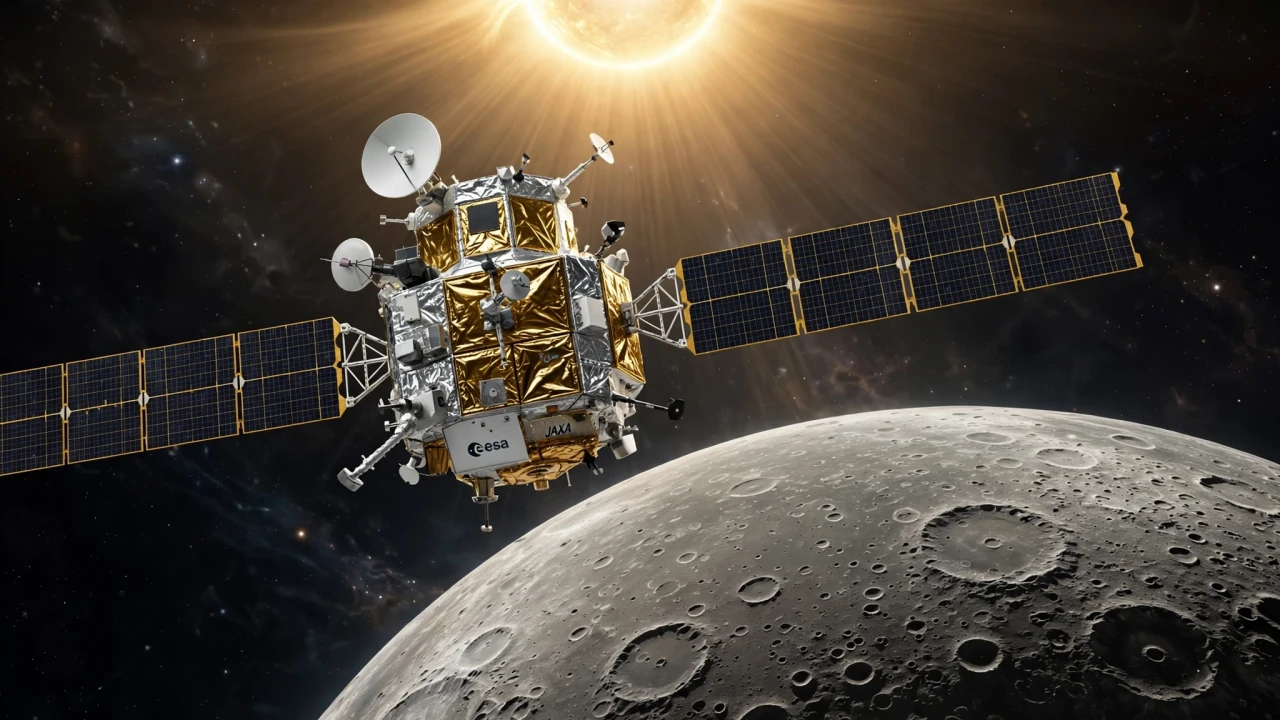
Illustration: the BepiColombo spacecraft approaching Mercury, with the Sun blazing behind. This is an AI-generated illustration, not an image of the real spacecraft.
What Happened
The anniversary itself was marked by ESA with a celebratory video released on October 20, 2026, in which mission team members described BepiColombo in just three words — "complex, collaborative and transformative" were among the answers chosen, according to ESA's announcement. The timing is no coincidence: after eight years of travel through the inner solar system, the mission's long-awaited arrival at Mercury is now just about a month away.
BepiColombo's final approach is already underway. In June 2026, engineers permanently switched off the Mercury Transfer Module's solar-electric propulsion system after completing the final planned thrust arc. On September 3, 2026, that transfer module — which had carried the two science orbiters across the inner solar system — separated from the rest of the spacecraft stack, marking the beginning of what ESA calls the Mercury Arrival Phase. ESA's Mercury Planetary Orbiter is now responsible for the propulsion maneuvers needed to enter orbit.
September also brought encouraging technical milestones. ESA's BELA laser altimeter successfully fired more than 700,000 laser pulses during a 21.5-hour test, while the MERTIS thermal imaging spectrometer completed a performance check that collected approximately one gigabit of data — strong evidence, according to mission updates, that the instruments survived years in deep space in working order. On September 24, the remaining spacecraft stack performed an 11.4-meter-per-second trajectory correction, testing the Mercury Planetary Orbiter's propulsion system ahead of the planned orbit insertion.
And there is more good news for the science teams: the Italian Space Agency (ASI) reported that the SIMBIO-SYS imaging system — the Italian-led camera suite aboard the Mercury Planetary Orbiter, supported by 118 scientists and engineers from twelve countries — has achieved "first light." According to ASI's October 2026 update, first light marks a major step toward the mission's scientific phase, when SIMBIO-SYS's images and data will help reveal Mercury's history in unprecedented detail. The next milestones are now firmly in sight: orbit insertion on November 21, 2026, separation of the two orbiters on December 9–10, 2026, and the start of routine science operations in April 2027.
Background
BepiColombo launched on an Ariane 5 rocket from the European spaceport in Kourou on October 20, 2018. It is named after Giuseppe "Bepi" Colombo, the University of Padua scientist, mathematician and engineer who pioneered the interplanetary gravity-assist maneuver used by NASA's Mariner 10 mission — the same technique this mission relied on to reach its destination.
The mission is a joint undertaking: ESA built the Mercury Planetary Orbiter (MPO) and the Mercury Transfer Module, while JAXA built the Mercury Magnetospheric Orbiter, known as Mio. During the eight-year cruise, all four components — including the sunshield protecting Mio — flew together as one stack. Once captured by Mercury's gravity, ESA's orbiter will supply power to JAXA's Mio and fly the pair into orbit together.
Why did it take eight years? Because reaching Mercury is, as ESA puts it, remarkably difficult. The Sun's gravity makes inward journeys treacherous: a spacecraft must constantly brake to avoid being pulled toward the star. By ESA's own account, reaching Mercury requires more energy than reaching the distant dwarf planet Pluto. BepiColombo managed it through a carefully choreographed sequence of nine gravity assists — one at Earth, two at Venus and six at Mercury itself, the last on January 8, 2025 — combined with years of gentle thrusting from its solar-electric propulsion system.
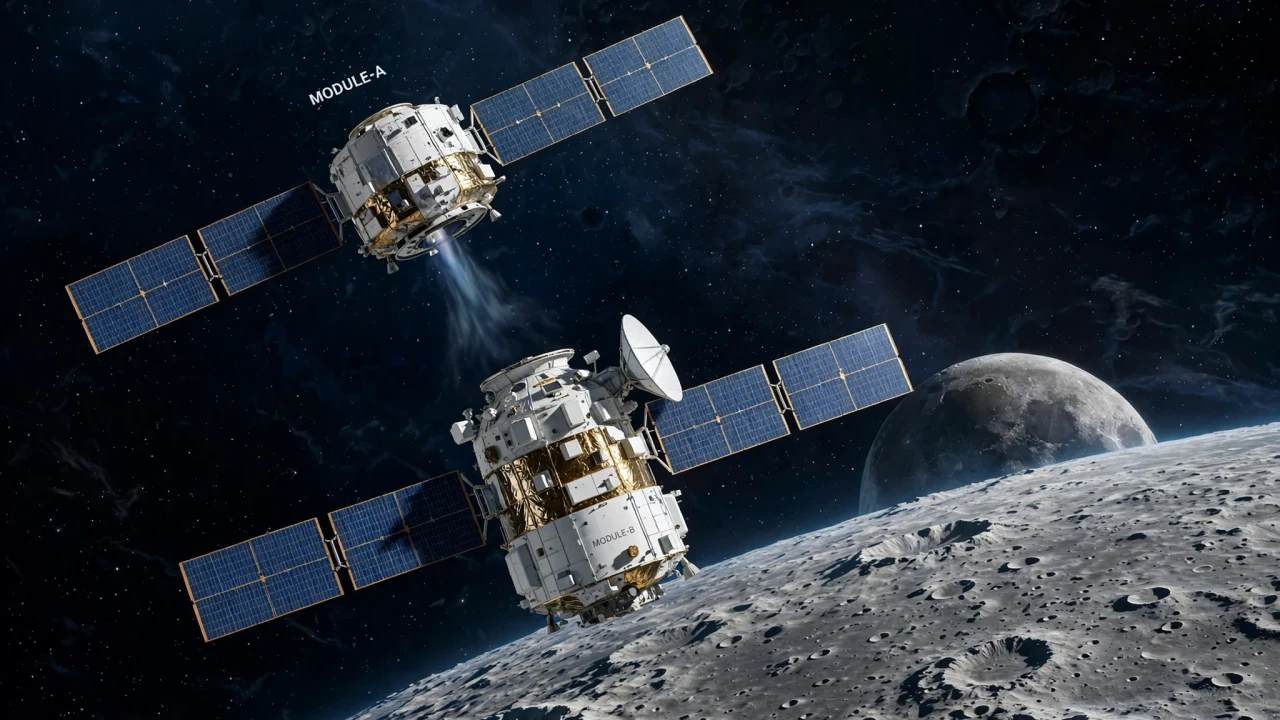
Illustration: the two science orbiters of BepiColombo — ESA's Mercury Planetary Orbiter and JAXA's Mio — stacked together near Mercury. This is an AI-generated illustration, not an image of the real spacecraft.
The journey was not without setbacks. In April 2024, ESA reported an issue that prevented the spacecraft's thrusters from operating at full power, and in September 2024 the agency announced a revised trajectory to compensate — adding 11 months to the cruise and delaying the expected arrival from December 2025 to November 2026. The mission adapted, and the full science program was preserved.
Mercury remains the least explored of the solar system's rocky planets. Only two missions have visited it before: NASA's Mariner 10, which flew by three times in 1974–75, and NASA's MESSENGER, which orbited the planet from 2011 to 2015. Despite their discoveries — including evidence of water ice hiding in permanently shadowed craters at the poles — Mercury's big mysteries persist: how a planet so small ended up with such an enormous iron core, whether its interior is still molten, and why it retains a global magnetic field at all.
Why It Matters
BepiColombo is the most comprehensive assault ever mounted on Mercury's mysteries. ESA's Mercury Planetary Orbiter will map the entire planet at different wavelengths, chart its minerals and chemistry, and probe the structure of its interior. JAXA's Mio will study Mercury's magnetosphere and how it interacts with the solar wind. Having two orbiters working together — in complementary orbits — is expected to deliver a far richer picture than any single spacecraft could.
The SIMBIO-SYS instrument suite illustrates the depth of the planned science. According to ASI, the instrument — with Italian industry as the industrial partner and INAF leading the scientific component — is designed to address fundamental questions about Mercury's history: its volcanic and tectonic activity, the giant impacts that shaped its surface, the nature of the materials on the ground, and the interactions between the surface and the surrounding space environment.
The mission also matters as a proof point for long-haul planetary exploration. Eight years of operations, a thruster anomaly survived, a trajectory redesigned on the fly — and the instruments are arriving healthy. "Complex, collaborative and transformative," in the team's three words, is also a fair description of what it takes to do big science across continents and decades.
What Happens Next
The countdown is now precise. Mercury's weak gravity is expected to capture the spacecraft in November 2026, with only a small maneuver needed to settle it into an orbit around the planet — the formal orbit-insertion sequence begins on November 21, according to ASI. The two orbiters will then separate and adjust their orbits using chemical thrusters: ESA's Mercury Planetary Orbiter will guide JAXA's Mio into a high elliptical orbit before descending into its own lower mapping orbit.
Then comes the moment ESA has been teasing: on December 9–10, 2026, MPO and Mio will part ways for good, separating onto independent orbital paths. From that point on, BepiColombo will be the first mission in history to operate two spacecraft in orbit around Mercury simultaneously. Commissioning activities are planned through early 2027, with routine scientific operations expected to begin in April 2027.
The nominal mission calls for the two orbiters to study Mercury in collaboration for one year, with the possibility of an extension depending on spacecraft health and fuel. For planetary scientists, the wait is almost over: after Mariner 10's flybys and MESSENGER's pioneering orbit, the innermost planet is about to get its most thorough examination yet — eight years in the making.
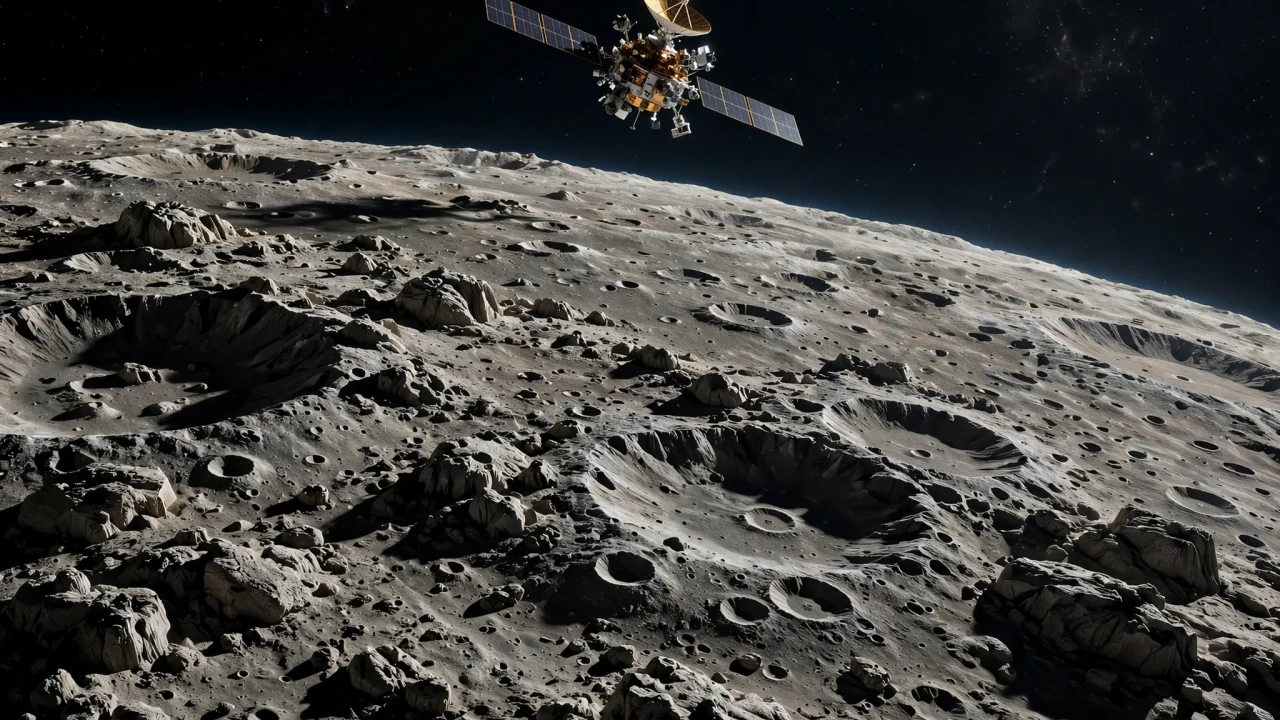
Illustration: Mercury's cratered surface seen from orbit, with a probe flying overhead. This is an AI-generated illustration, not an image of the real planet.
Sponsored: explore today's featured sponsored offers
FAQ
What is BepiColombo?
BepiColombo is a joint ESA-JAXA mission to Mercury launched in October 2018. It carries two science orbiters — ESA's Mercury Planetary Orbiter and JAXA's Mercury Magnetospheric Orbiter (Mio) — that will operate in complementary orbits around the innermost planet, a first in space exploration history.
Why did it take eight years to reach Mercury?
The Sun's gravity makes Mercury one of the hardest destinations in the solar system — ESA notes the journey requires more energy than reaching Pluto. BepiColombo used nine gravity assists (one at Earth, two at Venus, six at Mercury) plus years of solar-electric propulsion to shed enough energy to be captured into orbit.
What will BepiColombo study at Mercury?
ESA's orbiter will map the planet's surface composition, chart its minerals and chemistry, and probe whether its interior is still molten. JAXA's Mio will study Mercury's magnetic field and its interaction with the solar wind. Together they will investigate how such a small planet formed with such a large iron core.
When does the science mission begin?
Orbit insertion is scheduled for November 21, 2026, with the two orbiters separating onto independent orbits on December 9–10, 2026. Commissioning activities run through early 2027, and routine science operations are expected to start in April 2027, with a nominal one-year mission that could be extended.
Who was Bepi Colombo?
Giuseppe "Bepi" Colombo (1920–1984) was an Italian scientist, mathematician and engineer at the University of Padua who pioneered the interplanetary gravity-assist maneuver — the technique NASA's Mariner 10 used and this mission relied on. The mission was named in his honor.
Sources
- ASI (Italian Space Agency) — "BepiColombo: First Light for SIMBIO-SYS" (October 2026)
- ESA — "Celebrating BepiColombo, three words at a time" (October 20, 2026)
- Airbus — "BepiColombo" mission overview (updated October 2026)
Comments
Post a Comment