
ASTANA — Manisha Bhanwala became the first Indian woman ever to win a wrestling world title on Friday, October 30, 2026, fighting back from 6-0 down to beat American Abigail Nette 8-6 in the women's 59kg freestyle final at the World Wrestling Championships in Astana, Kazakhstan.
The 29-year-old, who won the Asian title last year, produced one of the great comebacks in Indian wrestling history. Competing at her fourth senior World Championships, Bhanwala had never previously reached the podium at the event. On Friday, she left it as a world champion — and as only the second Indian wrestler ever to win a senior world crown.
The result capped a landmark championships for India's women's team. Bhanwala's gold lifted India's haul at the event to four medals — one gold, two silvers and a bronze — with all four coming in women's freestyle events, according to Reuters.

Illustration: A wrestler celebrates on the mat in a packed arena after a historic world-title win. This is an AI-generated illustration, not a real photograph.
What Happened
The final began in the worst possible way for Bhanwala. Nette, the Pan American champion, scored early and built a commanding 6-0 lead, leaving the Indian trailing by six points and in danger of watching the gold slip away before the bout had truly settled.
Bhanwala refused to fold. She got on the scoreboard with a stepout, then kept pressing, scoring a takedown and turning Nette with a gut-wrench to claw her way back into the contest. From 6-4 down, she continued to apply pressure, found another takedown to move ahead 8-6, and then defended that lead until the final whistle to secure the historic gold.
It was, by any measure, a remarkable turnaround: a six-point deficit erased, point by point, against an opponent who had started the final in complete control. Reports of the bout described Bhanwala's composure under pressure as the decisive factor — she did not chase the match wildly, but worked her way back through sustained attacks until the momentum had fully changed hands.
Her run to the final had already shown her form. Earlier in the tournament she recorded a 6-2 win over Canada's Laurence Beauregard, and she arrived in the gold-medal bout as part of a historic Indian contingent: three Indian women reached gold-medal bouts at the same edition of the World Championships, a first for the country.

Illustration: Two wrestlers grapple during a championship final bout under arena lights. This is an AI-generated illustration, not a real photograph.
Background
Indian wrestling has waited a long time for a moment like this. Before Friday, only one Indian wrestler had ever won a senior world title: Sushil Kumar, the twice Olympic medallist, who claimed the men's 66kg freestyle crown in 2010. Bhanwala's victory therefore ended a 16-year wait for another Indian world champion — and broke entirely new ground for Indian women.
Indian women had come close before. Anshu Malik reached a world final in 2021 but finished with silver, and at this year's championships in Astana, two more Indian women reached finals before Bhanwala's breakthrough. Neelam Sirohi took silver in the 50kg class and Kajal Dhochak took silver in the 76kg class, both losing their respective finals on Thursday. Their silver medals, together with a bronze elsewhere in the women's team, already made this one of India's strongest World Championships. Bhanwala's gold turned it into a historic one.
Bhanwala's own journey helps explain why Friday mattered so much. She has competed across several weight classes during her career, and she won the Asian title last year before arriving in Astana for her fourth senior World Championships. That she had never previously stood on the podium at the Worlds made the comeback in the final all the more striking: this was not a wrestler defending a familiar position, but one seizing a first world medal — and making it gold — in the most dramatic fashion possible.
The 59kg class is a non-Olympic weight category, which means Friday's gold does not by itself secure an Olympic place. But world titles are judged on their own terms, and no Indian woman had ever won one before. For a wrestling nation that has long produced Olympic medallists without ever producing a women's world champion, that distinction alone makes Bhanwala's win a landmark.
Why It Matters
First, the result changes the history books. "First Indian woman to win a wrestling world title" is a line that can only be written once, and Bhanwala now owns it. Every future Indian women's world champion will follow in her footsteps, and every young wrestler in India now has a domestic example at the very top of the sport.
Second, the manner of the victory matters as much as the medal. Coming back from 6-0 down in a world final, against a continental champion, requires not just technique but belief — the kind of belief that is often built over years of near-misses. Bhanwala's fourth World Championships appearance, after three without a podium finish, is a reminder that persistence at the elite level can eventually be rewarded in a single unforgettable evening.
Third, the wider team result points to depth, not just one star. Three Indian women in gold-medal bouts at the same championships, plus a bronze, suggests a women's programme producing contenders across weight classes rather than relying on a single athlete. That depth is what turns a breakthrough into a sustained presence at the top of world wrestling.
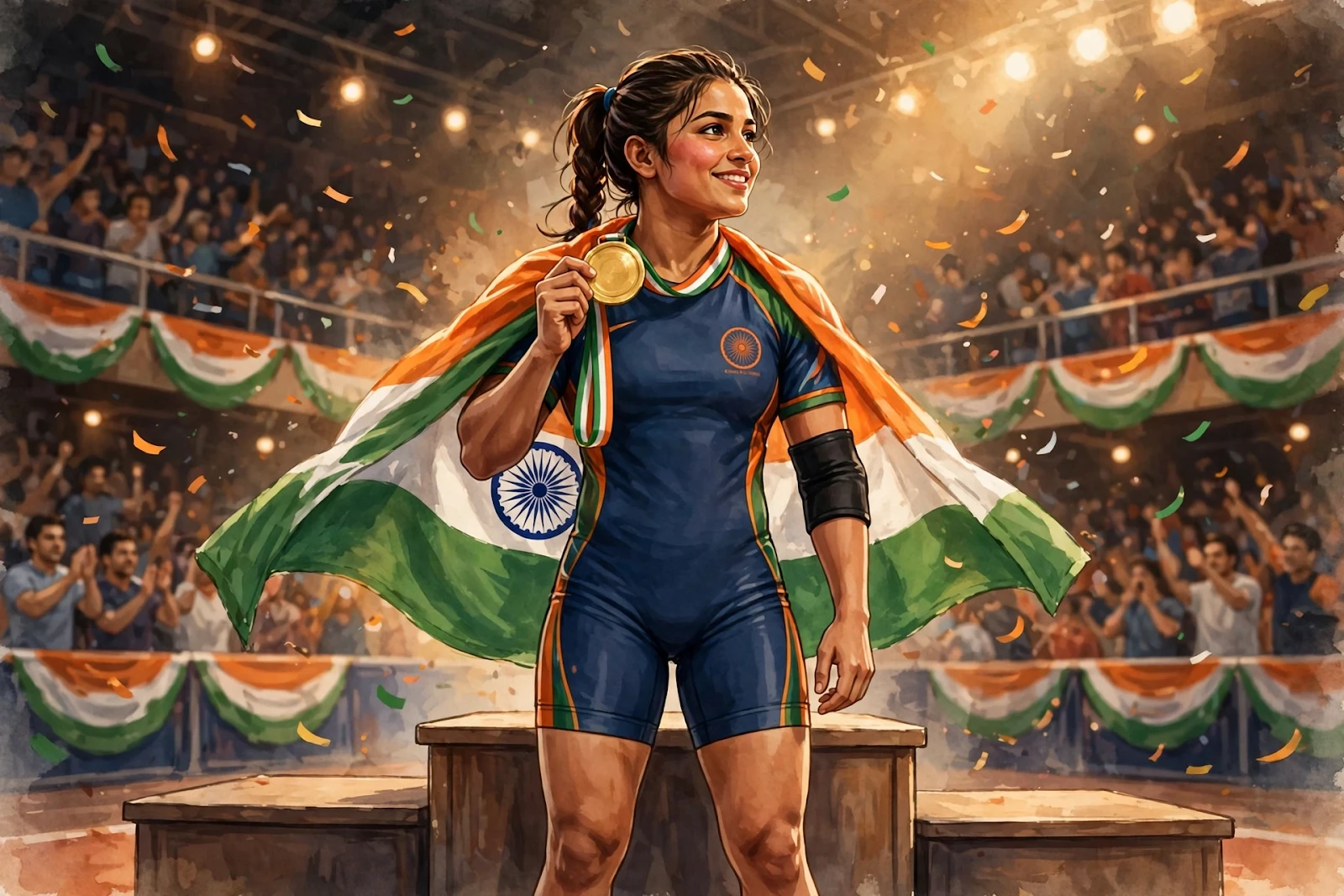
Illustration: A wrestler stands on the podium with a gold medal and an Indian flag draped over her shoulders. This is an AI-generated illustration, not a real photograph.
What Happens Next
Bhanwala will return home as a world champion, and the celebrations in India are likely to be considerable. Beyond the immediate acclaim, the result raises her profile sharply ahead of future global events, where she will now compete as a defending world champion rather than as a challenger chasing a first podium finish.
For Indian wrestling more broadly, the challenge now is to build on Astana. A championships that produced four women's medals — including a first women's world gold — sets a new benchmark, and the question for the federation, coaches and athletes will be whether that standard can be maintained and extended in the next cycle of major tournaments.
For Nette, the final will be a painful one to reflect on: a 6-0 lead, and a world title within reach, undone by a comeback she could not stop. For Bhanwala, though, Friday in Astana will always be the night she came back from the brink and made history for Indian wrestling.
Sponsored: explore today's featured sponsored offers
FAQ
Who is Manisha Bhanwala?
Manisha Bhanwala is a 29-year-old Indian freestyle wrestler who won the Asian title last year. On October 30, 2026, she became the first Indian woman to win a wrestling world title, beating Abigail Nette 8-6 in the 59kg final in Astana.
How did Bhanwala win the final?
She trailed 6-0 before fighting back with a stepout, a takedown and a gut-wrench turn, taking an 8-6 lead that she defended until the final whistle.
Why is this win historic for India?
Bhanwala is the first Indian woman ever to win a senior wrestling world title, and only the second Indian wrestler overall to do so after Sushil Kumar's men's 66kg gold in 2010.
How did the rest of India's women's team perform?
India finished with four medals, all in women's freestyle: Bhanwala's gold, silvers for Neelam Sirohi (50kg) and Kajal Dhochak (76kg), and a bronze. Three Indian women reached gold-medal bouts at the same edition, a first for the country.
Is the 59kg class an Olympic weight class?
No. The 59kg freestyle class is a non-Olympic weight category, so the world title is a historic achievement in its own right rather than a direct Olympic qualification.
Sources
- Reuters, "Bhanwala becomes first Indian woman to win wrestling world title," October 30, 2026.
- IANS, "Manisha Bhanwala makes history, clinches India's first gold in Senior World Championships," October 30, 2026.
- MyKhel, "Manisha Bhanwala Creates History, Becomes First Indian Woman to Win Wrestling World Championships Gold," October 30, 2026.
Comments
Post a Comment