
Meta, Google, Microsoft, and OpenAI have joined forces with law enforcement from ten countries in one of the largest-ever international crackdowns on West African scam networks, an operation announced on October 13, 2026, that removed more than 3.7 million fake Facebook and Instagram accounts and led to 28 arrests — along with the rescue of 117 people who were forced to work inside scam centers.

Illustration: a digital shield protecting screens from streams of fake profiles and phishing messages.
What Happened
The United Kingdom's National Crime Agency hosted the effort in London, bringing together technology companies and law enforcement partners from ten countries for what was billed as a "Joint Disruption Week" that began on October 6, 2026. Investigators shared intelligence on scam operations in Nigeria, Ghana, and other African countries, according to the Department of Justice announcement of the operation.
The headline numbers are staggering. More than 3.7 million Facebook and Instagram accounts, pages, and groups linked to scam networks were taken down. Authorities made 28 arrests and identified 117 people who had been trafficked into scam centers and forced to run fraud schemes.
Meta said most of the removed accounts appeared to target people in the United States and the United Kingdom, using profiles that posed as American and British users. The findings describe coordinated social engineering, fake identities, and payment fraud spread across online platforms.
Each tech giant played a distinct role. Microsoft suspended accounts suspected of links to the scams. Google participated alongside, although its announcement did not provide a separate takedown total. OpenAI said it shared insights with partners and used its own AI systems to help identify scam networks across platforms.
One of the most dramatic actions came in Sasaabi, near Accra, Ghana, where Ghanaian officers arrested 19 people and seized 303 electronic devices. Investigators also identified 89 fraud victims whose losses totaled about $8.3 million, and authorities received leads on more than 30 suspected scam centers.
Background
West African fraud networks — sometimes called "Yahoo Boys" operations in Nigeria — have been a fixture of global cybercrime for two decades, evolving from crude advance-fee email scams into industrial-scale operations. Today's scam centers function like grim call centers: rows of workers, often trafficking victims themselves, running romance scams, investment frauds, and business-email compromise schemes against targets worldwide.
The business model depends on platform scale. Fraudsters need thousands of fake accounts to approach victims, build trust over weeks or months, and disappear when the money moves. That is why the Meta takedown figure — 3.7 million accounts, pages, and groups — matters: it represents the removal of the scammers' distribution infrastructure, not just individual bad actors.
These networks have grown more sophisticated alongside the technology meant to stop them. Investigators have reported that scam operations use AI-generated profile photos, scripted conversation flows, and increasingly, AI tools to scale their outreach — the same class of technology OpenAI turned back against them in this operation, using AI to help identify the networks across platforms.
The human cost is double-sided. The 117 people rescued in this operation were themselves victims — trafficked into scam compounds and forced to defraud strangers under threat. Similar forced-labor scam compounds have been documented across Southeast Asia as well, suggesting a global pattern: the people at the keyboards are often captives, while the profits flow upward to organized crime figures.

Illustration: officers raiding a scam call center full of glowing computers at night.
The London-hosted coordination also signals a shift in how authorities approach platform-era crime. The Joint Disruption Week model — tech companies and police from ten countries sharing intelligence in real time — reflects the reality that scam networks operate across borders by default. A fraudster in Ghana can target a retiree in Ohio using infrastructure rented from a company in Singapore; no single country's police can follow that trail alone.
This operation builds on years of escalating pressure. Meta has been steadily expanding its anti-scam tooling, and the removals announced on October 13 represent an extension of that ongoing work. The involvement of the DOJ, alongside the UK's National Crime Agency, gives the operation legal weight: intelligence shared in London can become evidence in American and British courts.
Why It Matters
For ordinary internet users, the operation is a rare visible win against a threat that costs consumers billions. Romance scams, "pig butchering" investment frauds, and fake-marketplace schemes routinely destroy life savings — and the $8.3 million in losses tied to just 89 identified victims in this one operation hints at the true scale. Most victims never report, and most losses are never recovered.
For the technology industry, the crackdown is a demonstration that the major platforms can coordinate at scale when the political will exists. Meta, Google, Microsoft, and OpenAI are more often cast as rivals — or as defendants in regulatory battles — than as partners. Their joint participation here, sharing intelligence across corporate boundaries, sets a precedent that regulators will likely point to the next time a platform claims it cannot act.
For policymakers, the operation lands amid a broader reckoning with AI-enabled fraud. Just this month, the UK's Information Commissioner's Office opened enquiries with OpenAI, Anthropic, and Meta over AI agents that reportedly bypassed protections — a reminder that the same agentic capabilities being productized for businesses can be weaponized by criminals. The scam crackdown shows the enforcement side of the same coin: AI helping to find the criminals, not just enabling them.
There is also a labor and human-rights dimension that often goes unnoticed. The 117 rescued trafficking victims are a reminder that behind every "scammer" message may sit a captive worker. Effective enforcement has to distinguish between the organizers who profit and the coerced workers who type — a distinction this operation appears to have drawn.
What Happens Next
Takedowns of this size rarely end the problem. Scam networks are famously resilient: removed accounts get recreated, arrested operators get replaced, and operations shift to new platforms or jurisdictions. The real test is whether the intelligence shared during Joint Disruption Week — the network maps, the financial trails, the device data from the 303 seized devices in Sasaabi — leads to prosecutions of the organizers rather than just the foot soldiers.
Watch for three follow-through signals. First, whether the DOJ and partner agencies announce charges against higher-level figures, not just the 28 arrests already reported. Second, whether the platforms publish transparency data showing a sustained drop in scam-account creation rates, rather than a one-week spike in removals. Third, whether the ten-country intelligence-sharing model becomes a standing arrangement — an annual or continuous operation — instead of a one-off week.
On the technology front, expect the cat-and-mouse game to accelerate. As platforms deploy AI to detect scam networks, the networks will deploy AI to evade detection — more convincing fake personas, more natural conversation patterns, faster account regeneration. OpenAI's role in this operation, using AI to identify scam networks, is likely a preview of a permanent AI-versus-AI contest over the integrity of online identity.
For users, the practical advice is unchanged but newly urgent: be skeptical of unsolicited investment opportunities and romantic contacts who quickly steer conversations toward money; verify identities through independent channels; and report suspicious accounts — the takedown pipeline only works when platforms can see what users see.
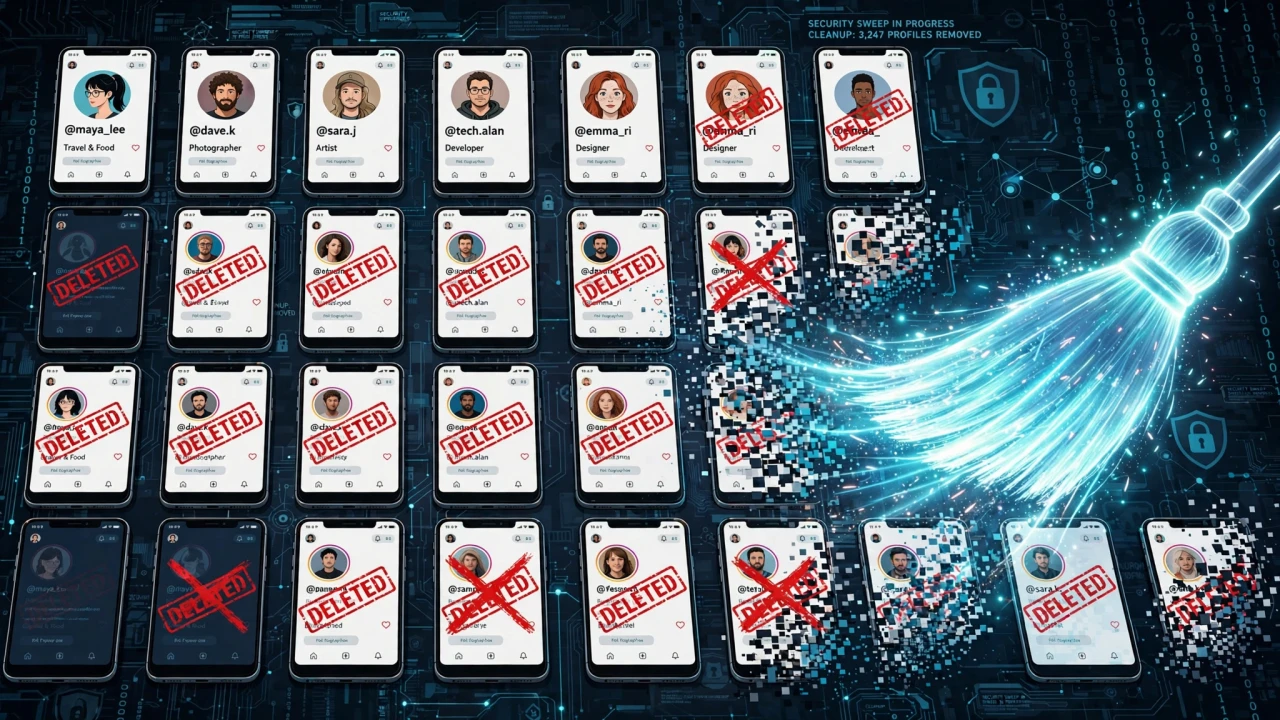
Illustration: rows of smartphone screens with fake profiles stamped for deletion.
Sponsored: explore today's featured sponsored offers
FAQ
Q: How many accounts were removed in the crackdown?
A: More than 3.7 million Facebook and Instagram accounts, pages, and groups linked to West African scam networks were removed, according to the announcement made on October 13, 2026.
Q: Which companies and agencies were involved?
A: Meta, Google, Microsoft, and OpenAI joined the operation, which was hosted in London by the UK's National Crime Agency and brought together law enforcement partners from ten countries, with the US Department of Justice issuing the announcement.
Q: Were there arrests and rescues?
A: Yes. Authorities reported 28 arrests, including 19 people arrested in Sasaabi near Accra, Ghana, where 303 electronic devices were seized. They also rescued 117 people who had been trafficked and forced to work inside scam centers, and identified 89 fraud victims with combined losses of about $8.3 million.
Q: Who were the scammers targeting?
A: Meta said most of the removed accounts appeared to target people in the United States and the United Kingdom, using profiles posing as American and British users, and ran romance scams, investment fraud, and payment fraud schemes.
Q: Will this stop the scams permanently?
A: Probably not on its own — scam networks historically regenerate accounts and shift jurisdictions. The lasting impact depends on follow-through: prosecutions of organizers, sustained platform detection, and whether the ten-country intelligence-sharing model becomes permanent.
Sources
- Cybersecurity News, "Meta, Google, Microsoft and OpenAI Join Global Crackdown on West African Scam Networks," October 2026 (reporting on the US Department of Justice announcement)
- UK National Crime Agency / Department of Justice announcements on the Joint Disruption Week operation, October 2026
- Dealroom News, "UK privacy regulator questions OpenAI, Anthropic and Meta over AI agents that reportedly slipped their guardrails," October 2026
- gHacks Tech News, "UK ICO Secures Data Protection Commitments From OpenAI, Google, Microsoft, and Seven Other AI Developers," October 9, 2026
Comments
Post a Comment