
Black Hole 'Solar Storms': Astronomers Catch Magnetic Eruptions at a Supermassive Black Hole for the First Time
TEL AVIV — For the first time, researchers have found evidence of solar-storm-like magnetic eruptions in the corona of a supermassive black hole, in observations of the galaxy NGC 3783 reported on October 22, 2026 — showing that the same magnetic process that drives storms from the Sun also operates in the extreme environment around a black hole.

Illustration: An illustration of a supermassive black hole with a glowing disc and a magnetic eruption bursting from its corona.
What Happened
Researchers at the Technion, Israel's institute of technology, reported evidence of magnetic reconnection eruptions and a coronal mass ejection (CME) in the corona of the black hole in NGC 3783. Their findings were published in The Astrophysical Journal Letters (Vardi et al., 2026, DOI: 10.3847/2041-8213/ae8f44), as reported by Phys.org on October 22, 2026.
The research was led by Gal Vardi, a doctoral student in the Technion Faculty of Physics, under the supervision of Professor Ehud Behar, with researchers from Japan, Europe and the United States participating. The team monitored X-rays emitted from near the black hole using the XRISM space telescope, a joint mission of NASA, the Japan Aerospace Exploration Agency (JAXA) and the European Space Agency (ESA), together with ESA's XMM-Newton space telescope.
The key signature the team identified is known as the "Neupert effect." It was first discovered on the Sun in 1968 but had never previously been observed around a black hole, according to the report. Its presence indicates that the same physical processes underlying solar storms also occur in the environments of supermassive black holes.
Background
Solar storms are powerful eruptions of X-ray radiation accompanied by winds of charged particles ejected from the Sun's corona into the solar system, posing risks to astronauts and satellite communications. These coronal mass ejections originate in the conversion of magnetic energy into kinetic energy through a process called magnetic reconnection — magnetic field lines snap apart and rejoin in a new configuration, releasing a burst of energy.
Supermassive black holes, which can be a million times larger than the Sun or more, are surrounded by coronas of extremely hot gas, just as the Sun is. Astronomers have long suspected that magnetic reconnection should operate there too, but proving it required catching the tell-tale pattern in X-ray light from a distant galaxy — a far harder observation than watching the Sun from nearby.
That is where XRISM comes in. The telescope, a collaboration between NASA, JAXA and ESA, is designed to study the hot, energetic universe in X-ray light, resolving the fingerprints of gas heated to millions of degrees. Combined with observations from ESA's long-serving XMM-Newton observatory, it gave the team the detailed X-ray record needed to recognise the Neupert effect in NGC 3783's black hole corona.
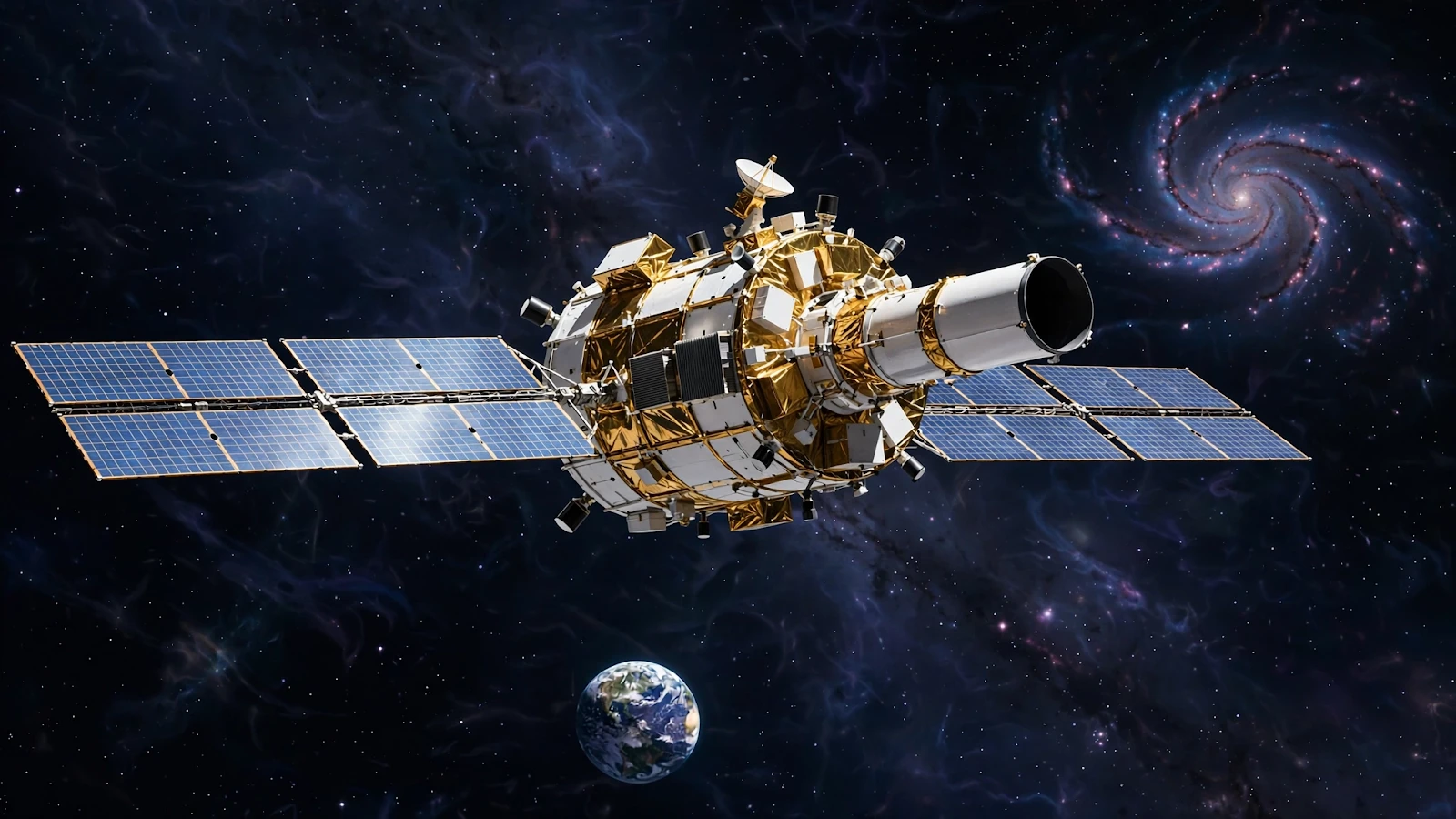
Illustration: An illustration of an X-ray space telescope satellite observing a distant galaxy.
Why It Matters
The result unifies two fields that rarely meet. Solar physicists study magnetic reconnection up close, on the Sun, where eruptions can be imaged in detail. Black hole researchers study the same physics at vastly larger scales and energies, where it shapes how black holes feed and how they launch jets of particles across galaxies. Finding the same signature in both places confirms that one physical process spans that enormous range — and gives each field a new way to test its models against the other.
It also matters for understanding how black holes grow and influence their host galaxies. The corona is the region where matter spirals inward, heats up, and either falls into the black hole or is flung outward. Eruptions from the corona carry energy and matter away from the black hole, affecting its surroundings. If magnetic reconnection regularly drives such eruptions, it is a central piece of the engine that regulates black hole feeding and feedback.
For future observations, the detection provides a template. Astronomers now know what a black hole coronal eruption looks like in X-ray data, which means they can search for more examples in other active galaxies — and test whether these eruptions are common, rare, or tied to particular feeding states of the black hole.

Illustration: An illustration of magnetic field lines snapping and reconnecting above a bright stellar surface, releasing plasma.
What Happens Next
The team behind the NGC 3783 result can now look for the same Neupert-effect signature in other galaxies observed by XRISM and XMM-Newton, building a sample that shows how often black hole coronas erupt and how much energy those eruptions carry. Comparisons with solar observations — where the same process is seen in far greater detail — may help pin down the physics that a single distant detection cannot settle alone.
More broadly, the finding adds to a busy month for black hole science, with separate October 2026 studies probing how rapidly feeding black holes launch jets and how gas around the Milky Way's own central black hole became enriched with heavy elements. The common thread is a shift from asking what black holes are to asking, in detail, how their immediate surroundings work — and XRISM's X-ray vision is proving central to that shift.
No danger to Earth follows from this distant eruption: NGC 3783's black hole is far beyond our galaxy, and the significance of the result is scientific, not hazardous. What it changes is our picture of the universe's most extreme objects — the same storms that rage from our Sun, it turns out, also rage around black holes.
Sponsored: explore today's featured sponsored offers
FAQ
What did astronomers discover around the black hole in NGC 3783?
Researchers found evidence of solar-storm-like magnetic eruptions — magnetic reconnection eruptions and a coronal mass ejection — in the corona of the supermassive black hole in the galaxy NGC 3783, the first time such a phenomenon has been observed around a black hole.
What is the Neupert effect?
The Neupert effect is an X-ray signature of magnetic reconnection eruptions, first discovered on the Sun in 1968. Its identification in NGC 3783 indicates that the same physical processes underlying solar storms also occur around supermassive black holes.
Which telescopes made the observation?
The team used the XRISM space telescope, a joint mission of NASA, JAXA and ESA, together with ESA's XMM-Newton space telescope, monitoring X-rays emitted from near the black hole.
Who led the research?
The research was led by Gal Vardi, a doctoral student in the Technion Faculty of Physics, under the supervision of Professor Ehud Behar, with researchers from Japan, Europe and the United States participating.
Does this black hole eruption pose any danger to Earth?
No. The black hole in NGC 3783 is far beyond our galaxy, and the result's significance is scientific: it shows that magnetic reconnection, the process behind solar storms, also operates in black hole coronas.
Sources
- Phys.org, "Black hole observations uncover evidence of solar storm–like magnetic eruptions," October 22, 2026.
- Gal Vardi et al., "Observation of a Solar-like Magnetic Reconnection Event in an AGN Corona with XRISM," The Astrophysical Journal Letters (2026), DOI: 10.3847/2041-8213/ae8f44.
- European Space Agency, XRISM and XMM-Newton mission information (joint NASA/JAXA/ESA and ESA observatories).
Comments
Post a Comment