
SAN FRANCISCO — Block, the payments company led by Jack Dorsey, has unveiled Dessa, a voice artificial intelligence model it says was trained from scratch on nothing but human conversation — no text, no pretrained models — and that can listen and talk at the same time, like a person in a real conversation.

Illustration: A person talking naturally to a voice assistant on a laptop, with sound waves between them.
What Happened
Block's in-house AI research lab announced Dessa on 23 October 2026, releasing live demo recordings, a public waitlist, and early access for a small group of AI safety researchers, according to Unite.AI and TechCrunch reporting on 23–24 October. Dorsey posted the announcement on X on 23 October, writing: "We believe voice is the most natural way to interact with intelligence, so we created Dessa, the most authentic full-duplex speech model ever built. Talking with it feels like talking with a person… full of emotion, nuance, pauses, and a natural cadence."
Dessa is a full-duplex, speech-to-speech model: audio goes in and audio comes out, with no transcription step in between. Because it listens while it speaks, it can be interrupted, can cut in, and can backchannel with short responses such as "yeah" or "got it" — the small signals people use to show they are following a conversation. Block says the model natively hears and produces emotion, sarcasm, laughter, a frustrated sigh, and a voice cracking with sadness, and that its replies arrive faster than real time, without an awkward pause.
The lab behind Dessa is small. It was founded by former members of Dessa, the Toronto deep-learning startup, is led by Ragavan Thurairatnam, and reports directly to Dorsey, according to TechCrunch and Unite.AI. Thurairatnam described the release as "a GPT3 moment for speech," Unite.AI reported. The company has not published a parameter count, API, pricing, weights or formal benchmark results, so the evidence so far is its own demo recordings — a point every major report on the launch has stressed.
Background
Most voice assistants work in steps: they turn speech into text, send the text to a language model, then turn the answer back into speech. Each step loses something. Tone, timing, hesitation and laughter are hard to represent in text, so the result can sound correct but feel flat. Block's argument, in its announcement, is that this pipeline is the problem: "Interacting with current voice AI can just plain suck. It turns your voice into text and throws away an incredible amount of information text alone can't carry. The most powerful AIs in the world can't hear how you feel."
Dessa skips the text entirely. Block says it trained the model from scratch on human conversation alone, learning language the way a child does — by listening. The company claims Dessa learned from "hundreds of times fewer words" than large language models see, and that training ran on a single NVIDIA GB200 NVL72 rack — a large system, but small compared with the huge clusters used for frontier text models. Block also says inference runs locally on a MacBook Pro with an M4 Max chip or better, faster than real time.
Full-duplex speech is not entirely new. Kyutai's Moshi already offered full-duplex conversation in 2024, but it started from a text model, according to Gnosis reporting on the launch. Block's claim, as far as the company says it knows, is narrower and more striking: Dessa is the first AI that can hold a realistic live conversation after being trained only from human speech. That claim has not been independently verified, and independent testing has not yet been possible because the model is not publicly available.
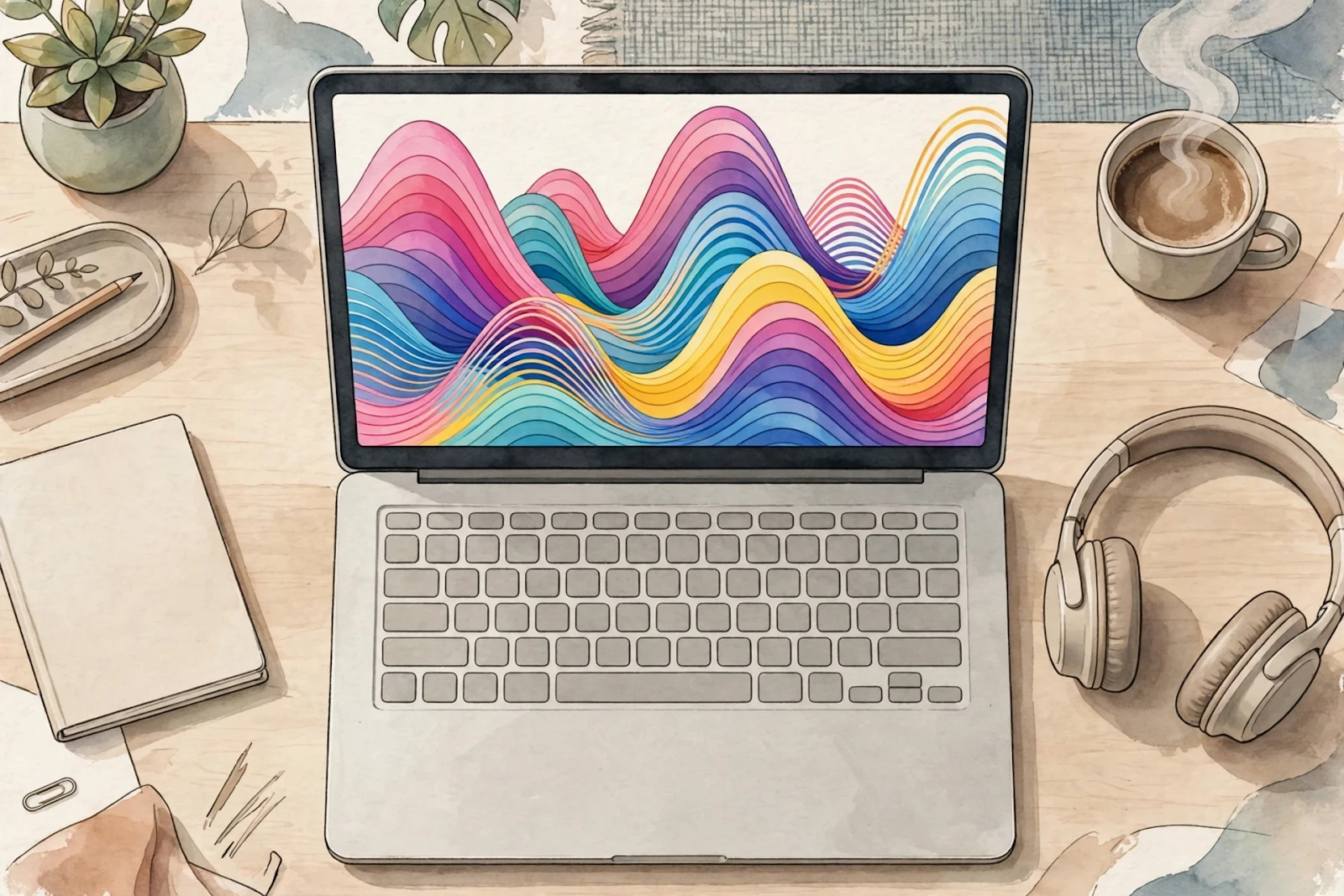
Illustration: A laptop displaying audio waveforms, representing a voice model that works with sound alone.
Why It Matters
Dessa matters because it challenges a core assumption of the AI boom: that bigger text models, trained on ever-larger piles of written words, are the only route to smarter machines. If a model trained only on conversation can hold a natural, emotional dialogue — and run on a laptop rather than a data centre — then the economics and the geography of AI change. Voice assistants could work offline, keep conversations private on a device, and respond with the timing of a human conversation rather than the turn-taking of a phone call.
It matters for businesses too. A voice that can interrupt, laugh and hesitate convincingly could transform customer service, tutoring, accessibility tools and hands-free computing. But the same realism raises the stakes for trust and safety: a voice that sounds human can also mislead, impersonate or socially engineer. That is presumably why Block is opening Dessa first to a small group of AI safety researchers rather than to the general public.
Early impressions underline both the promise and the limits. The Verge found the demos mostly natural but occasionally awkward, Dealroom reported, noting one demo in which the model mistook the speaker for someone named "Ronaldo." TechCrunch likewise noted that it was not clear how the model's emotion was steered. Those are normal caveats for a research preview — but they are also a reminder that demo recordings, chosen by the company, are not the same as independent benchmarks.
What Happens Next
The next steps are concrete and worth watching. Safety researchers with early access will test Dessa's behaviour, including how it handles sensitive conversations and whether its human-like voice creates new risks. The public waitlist will show how much demand there is for a speech-only model, and whether Block moves from a research preview to a product with an API, pricing and published weights.
Independent evaluation will be the real test. Researchers will want to know how Dessa performs on standard speech tasks, how it handles multiple languages and accents, and whether its training-data claims hold up under scrutiny. Until then, the honest summary is the one Block itself invites: an intriguing, well-demoed research model whose boldest claims — trained on speech alone, running on a laptop, more authentic than any full-duplex model before it — await outside verification.
If those claims survive contact with independent testers, Dessa could mark a genuine fork in AI development: not bigger text models, but models that learn the way people do — by listening. If they do not, it will still have shown how far speech-only training has come, and how close machines are getting to the most human interface of all: a conversation.

Illustration: A studio microphone in a recording lab, where human conversation becomes a voice model's only training data.
Sponsored: explore today's featured sponsored offers
FAQ
What is Dessa?
Dessa is a full-duplex, speech-to-speech voice model announced by Block's AI research lab on 23 October 2026. It takes audio in and gives audio out, listening and talking at the same time.
How was Dessa trained?
Block says Dessa was trained from scratch on nothing but human conversation, with no text and no pretrained models, on a single NVIDIA GB200 NVL72 rack. These are company claims, not independently verified results.
What does "full-duplex" mean?
Full-duplex means the model can listen while it speaks, so it can be interrupted, cut in, or backchannel with responses like "yeah" or "got it," much like a person in conversation.
Can the public use Dessa now?
Not yet. Dessa is a research preview behind a public waitlist, with early access for a small group of AI safety researchers. Block has not published weights, an API, pricing or benchmarks.
Why does a speech-only model matter?
If it works as claimed, it could run locally on a consumer laptop, keep conversations private on-device, and respond with human-like timing and emotion — without the text pipeline that most voice assistants rely on.
Sources
- TechCrunch, "Block's new voice model sounds eerily human," 24 October 2026.
- Unite.AI, "Block Unveils Dessa, a Full-Duplex Speech Model Trained on Conversation," 24 October 2026.
- Dealroom, "Jack Dorsey's Block unveils Dessa, a full-duplex voice AI trained only on human speech," 24 October 2026.
- Gnosis, "Block says Dessa voice model runs on a MacBook," 24 October 2026.
Comments
Post a Comment