
BRASÍLIA, Brazil — Senator Flávio Bolsonaro's lead over President Luiz Inácio Lula da Silva has narrowed to a statistical dead heat just six days before Brazil's October 25 presidential runoff, two new polls released on Monday, October 19, 2026, showed — setting up one of the closest finishes in the country's democratic history, Reuters reported.
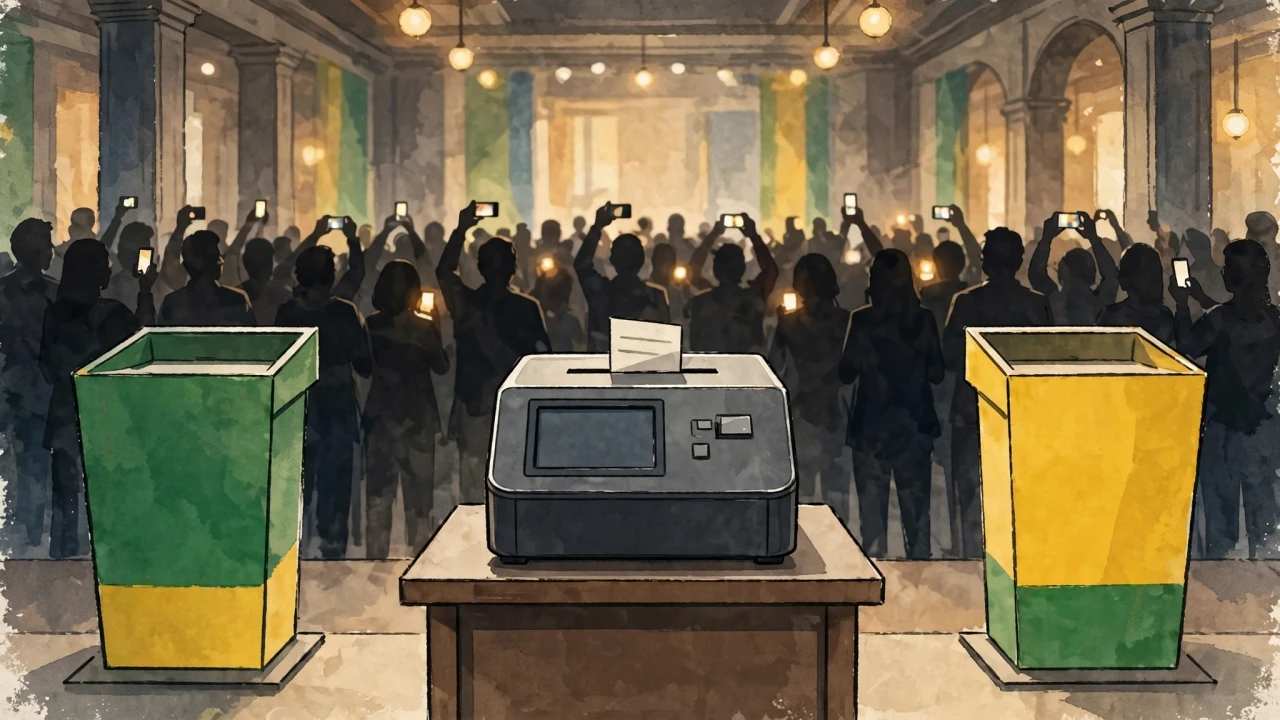
Illustration: an electronic ballot box on a podium between two campaign-colored podiums in a voting hall, crowd silhouettes beyond.
What Happened
A Nexus poll commissioned by BTG Pactual found Bolsonaro would take 46.5% of the vote against 45.9% for Lula, down from 47.9% versus 45.1% in an October 13 survey — a sharp tightening inside the two-point margin of error. In valid votes, which exclude blank ballots and undecided voters, Bolsonaro led 50.3% to 49.7%. The poll surveyed 2,002 people between October 16 and 18, Reuters reported.
A separate AtlasIntel/Bloomberg poll told a similar story: Bolsonaro at 49.8% against Lula's 47.6%, with valid votes at 51.1% to 48.9% — also a narrower margin than the same pollster's October 9 reading of 51.1% to 45.7%. AtlasIntel surveyed 4,998 people from October 13 to 18, with a one-point margin of error.
The tightening follows a first round on October 4 in which Bolsonaro — the 45-year-old son of former president Jair Bolsonaro — unexpectedly finished first with 47.03% of valid votes (56.1 million) against Lula's 45.16% (53.88 million), according to Brazil's Superior Electoral Court. Neither reached the 50%-plus-one threshold, forcing the October 25 runoff.

Illustration: two large campaign rally crowds facing each other across a Brazilian city avenue at dusk, green-and-yellow and red banners.
Background
Brazil uses a two-round presidential system: a candidate must win more than half of valid votes to take the presidency outright in round one, otherwise the top two finishers advance to a runoff. The 2026 race has become a rematch of the Lula–Bolsonaro rivalry in generational form — this time the incumbent faces the former president's son rather than Jair Bolsonaro himself, who is serving a 27-year sentence for plotting a coup after losing the 2022 election.
Bolsonaro's first-round performance exceeded expectations, powered by a right-wing wave in the concurrent congressional elections: his Liberal Party emerged as the largest single force in both chambers, increasing its Senate representation from 15 to 28 seats — the strongest result for any party since Brazil's return to democracy in 1985 — and winning a projected 121 lower-house seats, up from 98. The legislative races, held alongside the first-round presidential vote, renewed all 513 lower-house seats and two-thirds of the 81-seat Senate, giving the result unusual weight as a signal of the country's political direction.
The runoff campaign has been shaped by endorsements from eliminated candidates. Ronaldo Caiado and Romeu Zema, right-wing rivals who won 2.18% and 0.27% respectively, endorsed Bolsonaro, as did third-place finisher Augusto Cury (2.89%), who shared a video announcing his support after earlier saying he would stay neutral. Renan Santos (2.24%) declined to endorse either candidate, Reuters reported. Cury — an author and psychiatrist who campaigned under the slogan "Centered on what matters" and avoided identifying with left or right — is a particularly notable catch, since his voters are the least ideologically committed of the eliminated pool.
The rhetoric has been sharp on both sides. Bolsonaro declared after the first round: "Brazil wants change. I just need a mandate to put Brazilians at the center of my government, to tackle and solve Brazil's real problems." He also celebrated the congressional results: "I was very happy to see how many Brazilians went to the polls to make their voices heard and didn't stay on the sidelines because they want change." Lula, speaking in São Paulo, acknowledged he had expected a first-round win but called the result a lesson from voters, pledging to campaign on economic development and social inclusion and urging first-round abstainers to turn out: "We have a second round, and it's time for the test, time to show the true picture of Brazil," Xinhua reported.
Why It Matters
Brazil is Latin America's largest economy and democracy, and the outcome will set the country's direction on everything from Amazon protection and trade policy to the future of its democratic institutions. A Bolsonaro victory would hand the presidency to a 45-year-old political heir backed by the strongest right-wing congressional bloc in four decades — a combination that would reshape Brazilian politics for a generation.
The stakes are especially high for Brazil's institutions. The younger Bolsonaro has campaigned on granting amnesty to his father, and the pro-Bolsonaro Senate bloc may approach the 54-vote threshold needed to impeach Supreme Court justices — including those who convicted the former president. Lula, seeking a fourth non-consecutive term, has framed the runoff as a choice for democracy, urging first-round abstainers to vote.
For global markets, the narrowing polls add uncertainty to a race that once looked like a Bolsonaro edge. Currency and commodity traders will be watching the final polls — and the October 25 result — as a signal for Brazilian assets into 2027.
The congressional arithmetic sharpens every scenario. Combined with other center-to-right parties and blocs — projected to hold close to 250 lower-house seats and more than 30 Senate seats — the Bolsonaro agenda would enjoy a healthy working majority in the next Congress, Reuters reported. Most consequentially, the Senate's pro-Bolsonaro bloc may even approach the 54-vote threshold needed to impeach the Supreme Court justices who convicted the former president — a prospect that would put Brazil's highest court directly in the political crossfire regardless of who wins the presidency.

Illustration: the Brazilian National Congress building under a dramatic sunrise sky with a rising election-results chart beside it.
What Happens Next
Voting takes place on Sunday, October 25, using Brazil's electronic ballot system, with results typically known within hours of polls closing. Both campaigns are now in the final sprint: expect a flood of late endorsements, televised debates, and last-minute polling before a likely media blackout in the campaign's final days.
Two scenarios dominate the forecasts. If Bolsonaro's coalition holds its first-round edge plus the endorsed minor-candidate vote, he becomes Brazil's youngest-ever president. If Lula's late momentum — visible in both new polls — continues, the incumbent could complete one of the great comebacks in Brazilian electoral history by consolidating center-left voters and first-round abstainers.
Either way, the congressional map guarantees a divided government: whoever wins the Planalto will face a Congress shaped by the right-wing surge, setting up years of hard bargaining in Brasília. The world will get its answer on the night of October 25.
Sponsored: explore today's featured sponsored offers
FAQ
When is Brazil's presidential runoff?
The runoff between Flávio Bolsonaro and President Luiz Inácio Lula da Silva takes place on Sunday, October 25, 2026, after neither candidate won a first-round majority on October 4.
What do the latest polls show?
Two polls released October 19 show the race tightening: Nexus/BTG Pactual has Bolsonaro at 46.5% vs Lula's 45.9% (valid votes 50.3–49.7); AtlasIntel/Bloomberg has Bolsonaro 49.8% vs Lula 47.6% (valid votes 51.1–48.9). Both are within or near the margins of error.
Who is Flávio Bolsonaro?
The 45-year-old senator and eldest son of former president Jair Bolsonaro. He finished first in the October 4 first round with 47.03% of valid votes (56.1 million).
What is at stake beyond the presidency?
The concurrent congressional elections gave Bolsonaro's Liberal Party its strongest result since 1985, meaning the next president will govern alongside a powerful right-wing Congress — with implications for amnesty debates, the Supreme Court, and economic policy.
Sources
- Reuters, October 19, 2026 — Bolsonaro's lead over Lula narrows ahead of Brazil runoff, polls show (Nexus/BTG Pactual 46.5% vs 45.9%, valid 50.3–49.7, n=2,002; AtlasIntel/Bloomberg 49.8% vs 47.6%, valid 51.1–48.9, n=4,998; comparisons to Oct 13 and Oct 9 surveys).
- Reuters, October 8, 2026 — Third-place finisher Augusto Cury endorses Bolsonaro for runoff (2.89% of valid votes).
- Reuters, October 19, 2026 — polls narrow (repeated for citation completeness).
- Reuters, October 5, 2026 — Right-wing wave in Brazil's Congress: Liberal Party 28 Senate seats, 121 lower-house seats; amnesty and impeachment stakes.
- Naija Daily News / Xinhua via People's Daily, October 4–5, 2026 — First-round results: Bolsonaro 47.03% (56.1M votes), Lula 45.16% (53.88M); runoff set for October 25.
Comments
Post a Comment