
Small-Market World Series: Brewers Await Rays or Guardians as MLB's Cheapest Fall Classic Since 1991
Small-Market World Series: Brewers Await Rays or Guardians as MLB's Cheapest Fall Classic Since 1991
On Thursday, October 15, 2026, the Milwaukee Brewers completed a stunning four-game sweep of the two-time defending champion Los Angeles Dodgers to reach the World Series for the first time since 1982 — setting up a best-of-seven Fall Classic, beginning October 23, in which both clubs will sit in the bottom half of Major League Baseball payrolls, the first such pairing since the 1991 Minnesota Twins beat the Atlanta Braves.
Illustration: Illustration of a baseball stadium at night packed with cheering fans under bright floodlights
What Happened
Milwaukee sealed its place in the 2026 World Series on October 15 with a win at Dodger Stadium in Los Angeles, sweeping the National League Championship Series in four games and ending the Dodgers' bid for a third consecutive title, according to an Associated Press photo report carried by Sportsnet. It is only the second World Series appearance in Brewers franchise history — the first came in 1982, when Milwaukee, then an American League club, lost to the St. Louis Cardinals in seven games.
The Brewers also won their first National League pennant in franchise history and will hold home-field advantage in the Fall Classic thanks to their league-best regular-season record, according to the tournament overview published on Wikipedia. All seven games are scheduled to begin at 8 p.m. ET on Fox, starting with Game 1 on October 23 and running through a possible Game 7 on October 31, MLB announced in a schedule release reported by theScore on October 16.
Milwaukee's opponent will be the winner of the American League Championship Series between the Tampa Bay Rays and the Cleveland Guardians, which was scheduled to go to a winner-takes-all Game 7 on Tuesday, October 20, according to Sportradar's playoff schedule. The Brewers will host Games 1 and 2 at American Family Field in Milwaukee before the series shifts to the American League champion's ballpark for Games 3, 4 and a possible Game 5.
Background
What makes this Fall Classic genuinely historic is the money — or rather, the lack of it. The Brewers ranked 19th in MLB payroll as of August 31; Tampa Bay ranked 25th and Cleveland 30th, according to analysis by The Madison Focal published October 17. On Opening Day, Milwaukee's payroll was $125.9 million, compared with $90.5 million for the Rays and $75.5 million for the Guardians. For comparison, the New York Mets ($358.4 million), Dodgers ($323.3 million) and New York Yankees ($302.8 million) each spent more than the combined Opening Day payrolls of all three World Series contenders.
Whichever American League club advances, both World Series teams will have ranked in the lower half of MLB payrolls — the first such matchup since 1991, when Minnesota defeated Atlanta, The Madison Focal reported. Wikipedia's tournament overview adds that the 122nd World Series will feature the lowest combined payrolls among World Series teams since the 1994–95 work stoppage, and that the winner will have the lowest payroll of any champion since the 2015 Kansas City Royals.
The payroll story matters because it is unfolding against a looming labor fight. MLB owners have proposed a salary cap paired with a minimum spending level, while players' union officials say the players will not accept a cap. The Madison Focal reported that a lockout is expected to begin December 2, threatening the 2027 season. The 2026 World Series — with its three small-market contenders — will inevitably become evidence in that negotiation, cited by owners as proof that spending does not buy titles and by players as proof that revenue sharing and minimum spending are what actually need fixing.
The Brewers' run has been a case study in efficiency. They were the top seed in the National League and entered the postseason with one of the sport's best records, yet their Opening Day payroll sat barely a third of the Mets'. They swept a Dodgers team that had won the previous two World Series and outspent them nearly three-to-one — a result that instantly became one of the most lopsided payroll upsets in modern playoff memory.
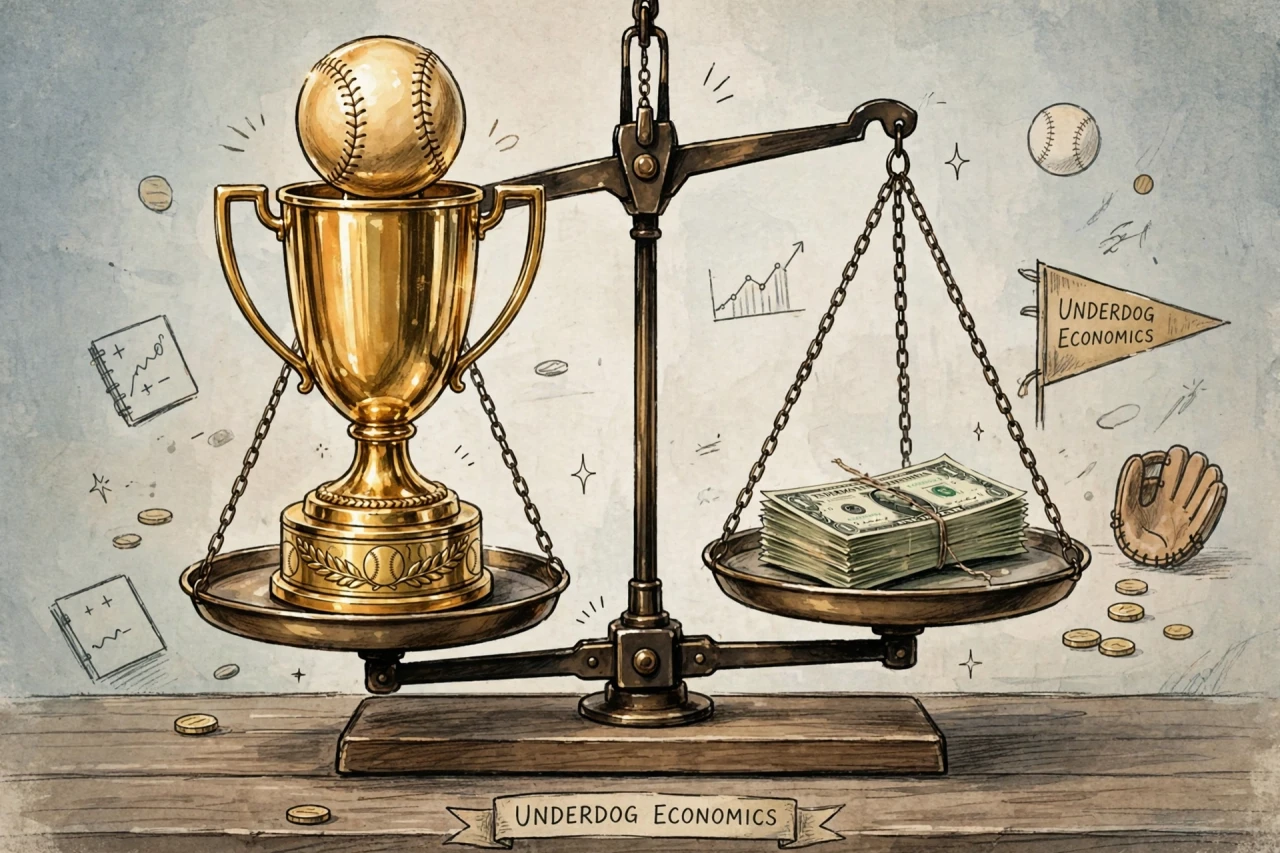
Illustration: Illustration of a golden baseball championship trophy balanced on a weighing scale against dollar bills
Why It Matters
For the sport's competitive balance debate, this World Series is a landmark. Decades of rising payrolls and super-teams concentrated in the largest media markets have fed a persistent narrative that championships are bought, not built. A Fall Classic between two of the lowest-spending clubs in baseball — contested while the previous two champions, who outspent them by hundreds of millions, watch from home — is the strongest possible counterargument, and it arrives at exactly the moment labor negotiations are about to begin.
It also guarantees a first-time champion in one scenario and a drought-ender in all of them. The Brewers and the Rays have never won a World Series, theScore reported, while the Guardians own MLB's longest title drought at 77 years, having last won in 1948. Whichever team lifts the Commissioner's Trophy, the celebration will be for a fan base that has waited generations — or, in two cases, forever. The series also marks the first World Series since 2016 in which neither team is based in California or Texas, a geographic shake-up that should energize television audiences across the Midwest and beyond.
There is a commercial dimension too. The 2026 World Series, branded as presented by Capital One, will feature a USA 250 patch on the jerseys in recognition of the United States Semiquincentennial, according to Wikipedia — a small detail that underscores how MLB is positioning this series as a national event rather than a regional one. And with the Dodgers eliminated, the league gets a narrative that writes itself: the underdogs finally get their stage.
For the players, the timing is bittersweet. They will play the biggest games of their lives knowing that a lockout expected on December 2 could freeze the offseason and threaten the 2027 season. Stars from all three contending clubs will head into arbitration and free agency under the shadow of that deadline, and the series itself may end up being Exhibit A in the salary-cap argument — a powerful reason for both sides to watch how it plays with the public.
What Happens Next
The immediate milestone is Game 7 of the ALCS on October 20, which decides whether the Brewers face the Rays or the Guardians. Milwaukee, meanwhile, gets nearly a full week of rest and preparation — a double-edged advantage that lets its pitching staff reset but risks cooling off a red-hot lineup. The Brewers will host Game 1 on Friday, October 23, at American Family Field, with Game 2 the following night before the series travels.
Watch the pitching matchups. In a series between two low-payroll clubs, the difference is usually made by homegrown arms and bullpen depth rather than nine-figure free agents — exactly the kind of baseball both the Brewers and their potential opponents have built their identities around. The team that manages its pitching staff best across a possible seven games in nine days, with travel in between, will likely decide who ends a drought.
Beyond the games, the series will set the tone for the labor winter. If the small-market champion's parade is still fresh in fans' minds when negotiations begin, both sides will claim it — owners for the cap, the union for revenue sharing. Either way, the 2026 World Series has already made its argument: in baseball, as this October has shown, the most expensive roster does not always win.
Illustration: Illustration of a leather baseball glove catching a ball over a glowing championship emblem on a field
Sponsored: explore today's featured sponsored offers
FAQ
Who is playing in the 2026 World Series?
The National League champion Milwaukee Brewers will face the winner of the American League Championship Series between the Tampa Bay Rays and the Cleveland Guardians, which was scheduled to be decided by a Game 7 on October 20, 2026.
When does the World Series start?
Game 1 is scheduled for Friday, October 23, 2026, at 8 p.m. ET on Fox, with the best-of-seven series running through a possible Game 7 on October 31. Games 1, 2 and any Games 6 or 7 will be played in Milwaukee.
Why is it called a small-market World Series?
Both clubs rank in the bottom half of MLB payrolls — the Brewers 19th, the Rays 25th and the Guardians 30th — making this the first World Series pairing of two lower-half payroll teams since the 1991 Twins and Braves. The combined Opening Day payrolls of all three contenders were less than the Mets' alone.
Have these teams won a World Series before?
Neither the Brewers nor the Rays have ever won a World Series, according to theScore. The Guardians own MLB's longest championship drought at 77 years, last winning in 1948. The Brewers' only previous Fall Classic appearance was a seven-game loss to the Cardinals in 1982.
What is the lockout connection?
MLB owners have proposed a salary cap paired with minimum spending ahead of negotiations, which the players' union opposes. A lockout is expected to begin December 2, 2026, threatening the 2027 season, and the small-market World Series will be cited by both sides in that fight.
Sources
- theScore, "MLB announces 2026 World Series start times" (October 16, 2026) — thescore.com
- Sportsnet, "MLB announces schedule for 2026 World Series" (October 16, 2026) — sportsnet.ca
- The Madison Focal, "Brewers' World Series berth sets up rare low-payroll title matchup" (October 17, 2026) — focalnews.org
- Wikipedia, "2026 World Series" (accessed October 20, 2026) — en.wikipedia.org
Comments
Post a Comment