
VICTORIA, British Columbia — The opposition Conservative Party won an election in the Canadian province of British Columbia on Sunday, October 25, 2026, for the first time in nearly 100 years, taking 64 of the 93 seats in the provincial legislature and ending nine years of rule by the left-of-center New Democrats, provisional results showed.
Conservative leader Lorne Doerkson, who will become the province's next premier, promised in his victory speech to "supercharge" British Columbia, pledging to ramp up liquefied natural gas production, cut red tape, end emissions limits and replace the province's carbon tax framework. The New Democrats won 27 seats.

Illustration: A provincial parliament building in Victoria, Canada, with flags and autumn trees.
What Happened
Provisional results reported by Reuters on Sunday showed the right-leaning Conservatives winning a commanding majority: 64 seats to the New Democrats' 27, in a 93-seat legislature. It is the first Conservative provincial election win in British Columbia since 1928.
"I believe in energy... We will cut red tape like it's never been cut before," Doerkson said in his victory speech, according to Reuters. He promised that the province will host a business summit in Vancouver next year as part of his plan to revive investment.
The Conservatives pledged to double natural gas production by 2032 and more than triple it by 2035, and to reach out to energy providers that have left the province's liquefied natural gas (LNG) sector since 2018, including ExxonMobil, Chevron and Woodside.
The result ends nine years in power for the New Democrats, who had voiced opposition to new oil pipelines and supported a ban on tankers along the province's northern coast. Outgoing New Democrat Premier David Eby had called for a strong mandate to confront tariff threats from US President Donald Trump.
Background
British Columbia's political landscape has been reshaped in recent years. The provincial Conservative Party, long a marginal force, surged as voters grew frustrated with the cost of living, healthcare pressures and the province's economic direction. Polls during the campaign showed voters focused on cost-of-living issues, healthcare and the ongoing trade war with the United States, according to Reuters.
Energy has been the defining fault line. British Columbia sits on vast natural gas reserves and a Pacific coastline that makes it a natural LNG exporter to Asia, yet pipeline and tanker policies have long divided the province. The New Democrats' opposition to new oil pipelines and support for the northern-coast tanker ban became a symbol, for their critics, of an approach that held back the province's resource economy.
The Conservatives' promise to double gas output by 2032 and more than triple it by 2035 is among the most ambitious energy pledges made by any Canadian provincial government in recent years, and it will be watched closely by investors, Indigenous communities and environmental groups alike.
The result also fits a broader pattern in Canadian politics, where affordability and energy policy have driven swings against incumbents. The trade war with the United States — and the question of how provinces should respond to tariff threats — loomed over the campaign, with Eby framing the election as a choice about who could best stand up to Washington.
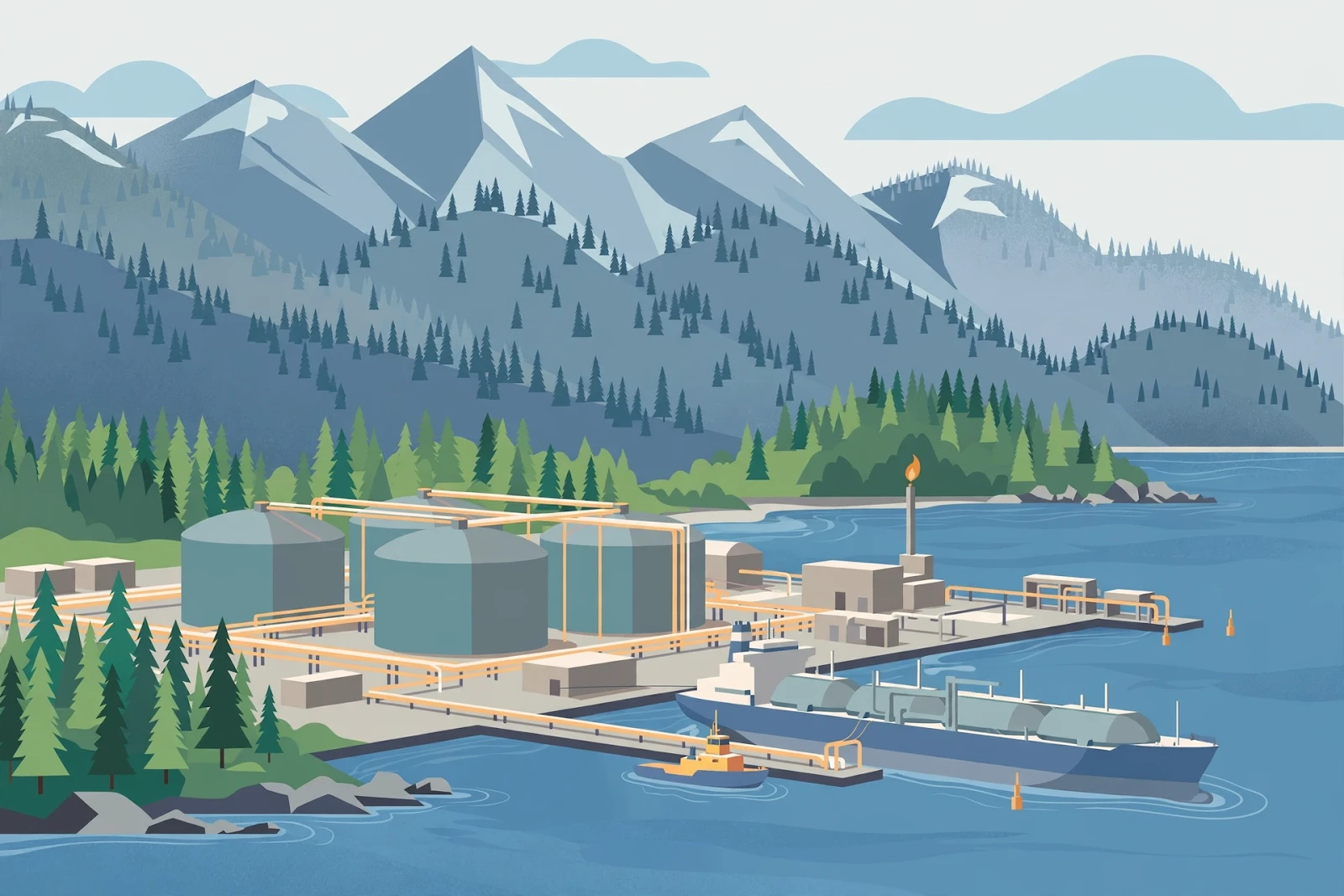
Illustration: A coastal liquefied natural gas terminal on Canada's Pacific coast with mountains and tankers.
Why It Matters
The scale of the Conservative victory matters. A 64-seat majority gives Doerkson a free hand to rewrite the province's energy and climate framework, and the pledges he made — scrapping emissions limits, replacing the carbon tax framework, courting back the energy majors — would amount to the sharpest policy reversal in British Columbia in a generation.
For Canada as a whole, the result complicates the federal climate agenda. British Columbia has often been presented as a province where climate policy and resource development could coexist; a government elected on a promise to dismantle emissions limits will test that assumption, and could embolden similar movements in other provinces.
For energy markets, the promise to double and then triple gas production, and to lure back ExxonMobil, Chevron and Woodside, signals a province open for LNG business again. If delivered, it could reshape Pacific gas flows to Asia and strengthen Canada's hand as an energy exporter at a time of global supply uncertainty.
For voters, the election was a verdict on nine years of New Democrat rule. The party's defeat, after nearly a decade in power, reflects how quickly cost-of-living pressures and trade anxiety can erode even an established government's standing.
What Happens Next
Doerkson will now form a government and take office as premier, with the legislature's new balance — 64 Conservatives to 27 New Democrats — giving him room to move quickly on his headline pledges. The Vancouver business summit planned for next year will be an early test of whether energy firms respond to his outreach.
Attention will turn to the details: how the carbon tax framework is replaced, what replaces the emissions limits, and how the government consults Indigenous communities and coastal residents on any revival of pipeline and tanker traffic on the northern coast.
The New Democrats, reduced to 27 seats, face a period of rebuilding after nine years in power, while the province watches whether the Conservatives' ambitious production targets — doubling gas output by 2032 — survive contact with markets, regulation and the courts.

Illustration: A ballot box with a paper ballot being cast and a rising bar chart, an election victory concept.
Sponsored: explore today's featured sponsored offers
FAQ
Who won the British Columbia election?
The opposition Conservative Party, led by Lorne Doerkson, won 64 of the 93 seats in the provincial legislature on October 25, 2026. The New Democrats won 27 seats.
Why is this win historic?
It is the first Conservative provincial election win in British Columbia since 1928 — nearly 100 years — and it ends nine years of New Democrat rule.
What did Doerkson promise on energy?
He pledged to double natural gas production by 2032 and more than triple it by 2035, end emissions limits, replace the province's carbon tax framework, and reach out to energy firms that left the LNG sector since 2018, including ExxonMobil, Chevron and Woodside.
What issues drove the campaign?
According to Reuters, polls showed voters focused on cost-of-living issues, healthcare and the ongoing trade war with US President Donald Trump.
What happens next in British Columbia?
Doerkson will become premier and form a government, with a Vancouver business summit planned for next year as an early test of his investment agenda.
Sources
- Reuters, "Conservative party wins first election in nearly a century in British Columbia," October 25, 2026.
Comments
Post a Comment