
BUNIA, 29 October 2026 — The first people have been vaccinated in a phase 2/3 trial of vaccines against the Bundibugyo strain of Ebola in Bunia, in the eastern Democratic Republic of the Congo, as the outbreak that began in May 2026 passes about 10,000 cases, health workers come under attack, and neighbouring countries step up screening, contact tracing and preparations for their own trials.
This article is general information about a public-health development, not medical advice. Anyone with symptoms or a possible exposure should follow the guidance of their local health authority.

Illustration: Health workers in protective equipment vaccinating people at a clinic in eastern Democratic Republic of the Congo.
What Happened
The trial, known as TUMAINI — Swahili for "hope" — began enrolling participants on 23 October 2026 in Bunia, according to a report in the BMJ summarised on 29 October. It uses an adaptive platform designed to evaluate several vaccine candidates at the same time, during an active outbreak, rather than testing one candidate in isolation and starting again for the next.
Participants are first receiving Ervebo, a vaccine licensed against the Zaire strain of Ebola. Its protection against Bundibugyo is not yet known, and that uncertainty is precisely what the trial is designed to test. Two experimental vaccines made specifically for Bundibugyo are expected to join the trial after regulatory approvals and World Health Organization recommendations: ChAdOx1 BDBV, developed by the University of Oxford, and mRNA-1469, an mRNA-based candidate developed by Moderna. Both have already entered early safety and immune-response studies, including an Oxford vaccine study that began in Uganda on 6 October in healthy adults.
The trial uses a ring-vaccination approach, in which the contacts of confirmed cases — and the contacts of those contacts — are offered vaccination, allowing researchers to study safety, immune response and protection while the outbreak is still spreading. It also includes groups that have historically been underrepresented in clinical research, including pregnant women and children aged 12 and older; children as young as 1 year are eligible for the Ervebo component, according to the BMJ summary.
At the same time, the scale of the outbreak has crossed a grim milestone. Data from the Congolese health ministry, summarised by Particle News on 29 October, put the total at more than 10,000 cases, with nearly 5,000 deaths. A separate summary of the BMJ report put the figures slightly lower, at nearly 10,000 confirmed cases and approximately 4,800 deaths, a difference that reflects the fast-moving nature of outbreak counting and the different cut-off points used by different summaries. What is consistent across the reporting is the direction: cases and deaths are still rising, and the outbreak remains the largest Bundibugyo outbreak on record in the region.
Background
Bundibugyo is one of the viruses that cause Ebola disease, but unlike the Zaire strain, it has no licensed vaccine and no specific licensed treatment. That gap is why the TUMAINI trial matters beyond the DRC: if a candidate proves safe and effective, it would be the first vaccine shown to protect against this strain in an outbreak setting. Until then, care remains supportive — early detection and treatment of symptoms improve a patient's chances, according to WHO guidance cited in reporting on the Kenya response — and prevention rests on surveillance, contact tracing, safe burial practices and infection control in health facilities.
The DRC outbreak began in May 2026 and has been concentrated in the east of the country, where conflict, displacement and mistrust of authorities have long complicated health responses. About 80% of new infections are being found outside known contact networks, according to the Particle News summary of ministry data. That figure is a warning sign for epidemiologists: it suggests many chains of transmission are going undetected, which makes ring vaccination harder, because the "rings" around known cases capture only part of the spread.
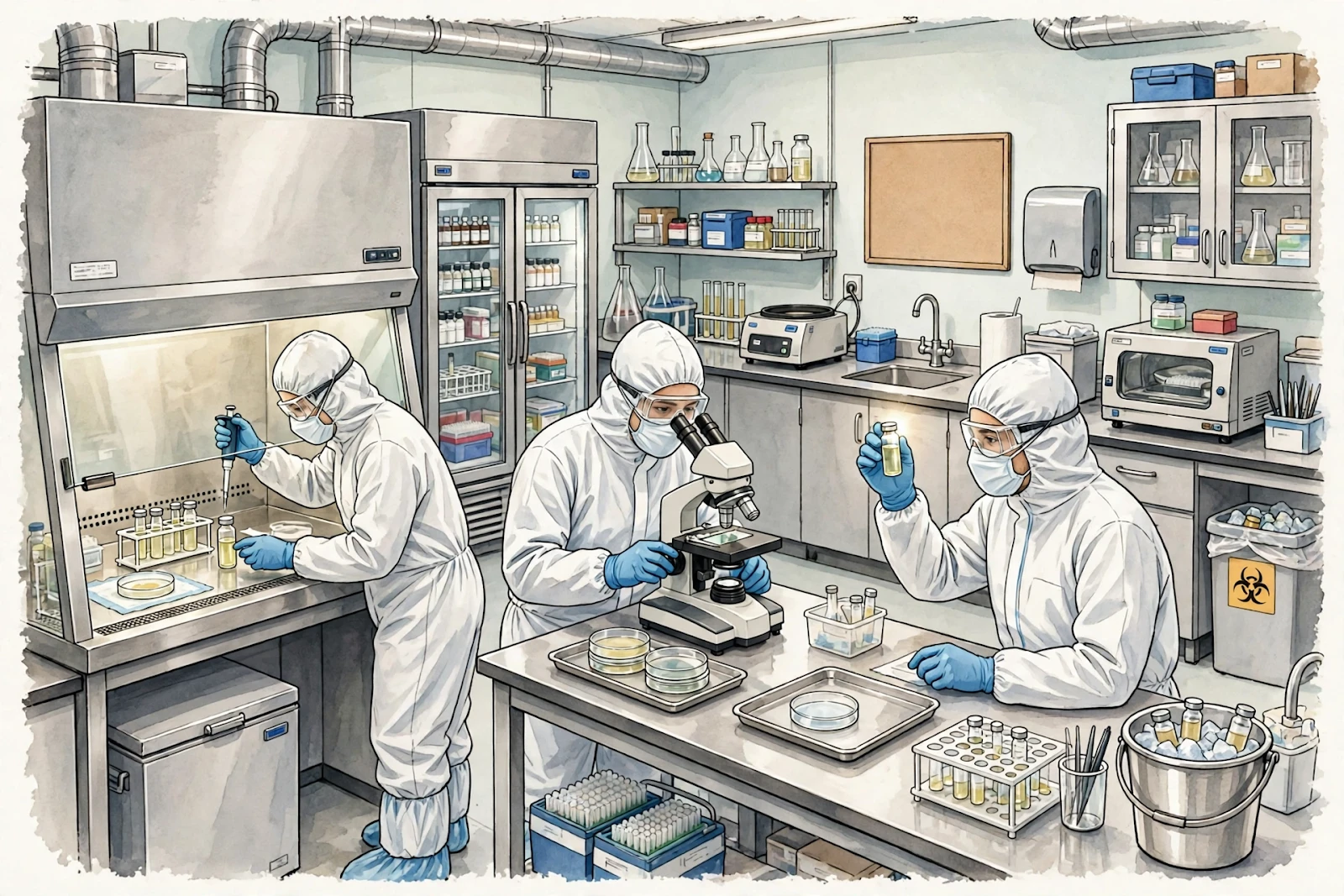
Illustration: Vaccine researchers in a laboratory examining vials and samples for an Ebola vaccine trial.
Violence has directly disrupted the response. On 24 October, a nurse was killed and another health worker was seriously injured while responding to an Ebola alert in Tshopo province, according to the BMJ summary. The United Nations condemned the attack and called for an investigation. Reporting on 29 October described teams being forced to shelter and access to affected areas being limited after attacks, a pattern that has repeatedly slowed Ebola responses in eastern DRC: when health workers cannot move safely, cases are found later, contacts are traced more slowly, and communities lose trust in the very teams trying to help them.
Our earlier reporting followed this outbreak from its early stages, when a trial was still weeks away and the case count stood above 9,000. The new development is not just a larger number: vaccination has now actually begun, in Bunia, under trial conditions, and the conversation has shifted from preparing a trial to learning, in real time, whether any of these vaccines can protect people against Bundibugyo.
Why It Matters
First, the trial is a test of speed as much as of science. Bundibugyo-specific candidates have existed in laboratories for years, but moving them into an outbreak trial requires regulatory decisions, manufacturing, cold-chain logistics and community consent — all in a conflict-affected setting. The adaptive design is meant to shorten that path: if one candidate looks unpromising, the platform can pivot to the next without rebuilding the trial from scratch.
Second, the regional picture shows why a DRC-only response is not enough. Kenya has reported nine confirmed cases, with two deaths and seven patients stable under care, according to the Kenyan Tribune on 29 October. Sequencing of three of the nine Kenyan samples showed a genetic link to the Bundibugyo lineage circulating in the DRC, with sequencing of the remaining six samples under way. Uganda has reported 20 cases and Nigeria one case — its first in more than a decade, which we reported earlier in October — according to the same 29 October reporting. Each cross-border case tests a different health system's ability to detect, isolate and trace before a single imported case becomes a local outbreak.
Third, Kenya's experience illustrates both progress and fragility. The country's first 20 contacts completed a 21-day monitoring period and stayed well, and were released from quarantine, according to WHO reporting carried on 29 October. WHO continues to support Kenya on coordination, surveillance, contact tracing, laboratory testing, case management, infection prevention, screening at points of entry and community engagement. But Kenya has also asked, through WHO and the Africa Centres for Disease Control and Prevention, for 10,000 doses of Ervebo to protect roughly 5,000 frontline workers — a request that underlines how exposed health workers remain while no Bundibugyo-specific vaccine is licensed.
Fourth, the regulatory debate now under way could shape future outbreaks. A joint position paper from the African Medicines Agency and the European Medicines Agency's Emergency Task Force recommends omitting certain repeated animal safety studies when a vaccine platform already has extensive pre-clinical toxicity data, so that promising Bundibugyo candidates could move to human testing within six months if they prove effective. The paper stresses that early human studies should involve small, closely monitored groups of adults, with safety as the primary endpoint, and recommends monitoring for reactions in the first week, other adverse effects during the first month, and serious events for six months after vaccination. The proposal opens the possibility of Kenya hosting a trial, according to the Kenyan Tribune — but it also raises the stakes of getting safety monitoring right, because accelerated testing only works if the public trusts the process.
What Happens Next
In Bunia, mobile vaccination teams may extend the TUMAINI trial to other affected areas, according to the BMJ summary. The immediate questions are practical: can teams reach contacts safely, can the cold chain hold, and will communities accept vaccination when the protection on offer — Ervebo against a different strain — is explicitly unproven against Bundibugyo? The trial's results will take months, and researchers have been clear that no efficacy conclusion should be drawn from the first vaccinations alone.

Illustration: Community health workers screening people and tracing contacts in a Congolese town.
The next milestones to watch are regulatory: whether the Oxford and Moderna Bundibugyo candidates receive the approvals and WHO recommendations needed to enter TUMAINI, and whether the African and European regulators' proposal to streamline animal testing is adopted for specific candidates. A second set of milestones is epidemiological: whether the share of cases found outside known contact networks falls, which would suggest surveillance is catching up with transmission, and whether Kenya, Uganda and Nigeria can keep their case counts contained without new chains of spread.
For the wider world, the lesson of this outbreak is already visible. A virus with no licensed vaccine can still cross borders, strain health systems and kill health workers, and the tools to fight it — trials, vaccines, surveillance and community trust — have to be built before, not during, the next outbreak. The Bunia trial is a step toward that preparedness, but as the case count passes 10,000, it is also a reminder of how much catching up remains to be done.
Sponsored: explore today's featured sponsored offers
Frequently Asked Questions
What is the TUMAINI trial?
TUMAINI, meaning "hope" in Swahili, is a phase 2/3 adaptive trial in Bunia, DRC, that began enrolling participants on 23 October 2026. It evaluates several Ebola vaccine candidates at the same time during an active outbreak, using a ring-vaccination approach around confirmed cases.
Is there already a licensed vaccine for Bundibugyo Ebola?
No. No vaccine has received licensure specifically for the Bundibugyo virus. Participants in TUMAINI are first receiving Ervebo, which is licensed against the Zaire strain, but its effectiveness against Bundibugyo remains uncertain.
How large is the outbreak now?
Reports on 29 October put the DRC total at about 10,000 cases, with deaths approaching 5,000. Different summaries give slightly different figures — more than 10,000 cases and nearly 5,000 deaths in one summary, nearly 10,000 confirmed cases and approximately 4,800 deaths in another — reflecting different reporting cut-offs in a fast-moving outbreak.
Which other countries have reported cases?
Kenya has reported nine cases and two deaths, Uganda 20 cases, and Nigeria one case, according to reporting on 29 October. Kenya's first 20 contacts completed 21 days of monitoring without illness and were released from quarantine.
When will we know if the vaccines work?
Not soon. Results will take months, and the trial is designed to study safety and immune response first, with protection against Bundibugyo to be established over time. The Oxford and Moderna Bundibugyo-specific candidates still need regulatory approvals and WHO recommendations before they can enter the trial.
Sources
- BMJ, "Ebola: First people vaccinated in phase 2/3 Bundibugyo jab trial as health worker killed," summarised by EMJ Reviews, 29 October 2026.
- Particle News, "Congo Bundibugyo Ebola Surpasses 10,000 Cases as Violence Disrupts Response," updated 29 October 2026 (Congolese health ministry data).
- Kenyan Tribune, "Kenya Considered for Bundibugyo Ebola Vaccine Trial as Experts Call for Faster Testing," 29 October 2026.
- World Health Organization, via African Media Agency, "Twenty contacts of Kenya's first Ebola case released from quarantine," 29 October 2026.
Comments
Post a Comment