
VANCOUVER, Canada — Fifteen young Canadians, aged 17 to 25, are asking a Federal Court in Vancouver to rule that Ottawa's climate targets and plans violate their constitutional rights, in a landmark trial that opened on Monday, October 26, 2026. This week, the case turned from emissions arithmetic to something more personal: what living through wildfires, smoke-filled summers and a warming future is doing to young people's minds.
The case, known as La Rose v. His Majesty the King, is the first of its kind to reach a full trial in Canada's Federal Court. The plaintiffs argue that successive federal governments have failed to protect their rights to life, liberty and security of the person, guaranteed by Section 7 of the Canadian Charter of Rights and Freedoms, by setting climate targets and plans they say are inadequate. The federal government disputes the claim. No outcome has been determined, and the trial is expected to continue into late November, with closing arguments scheduled for February, according to Canadian Press reporting.
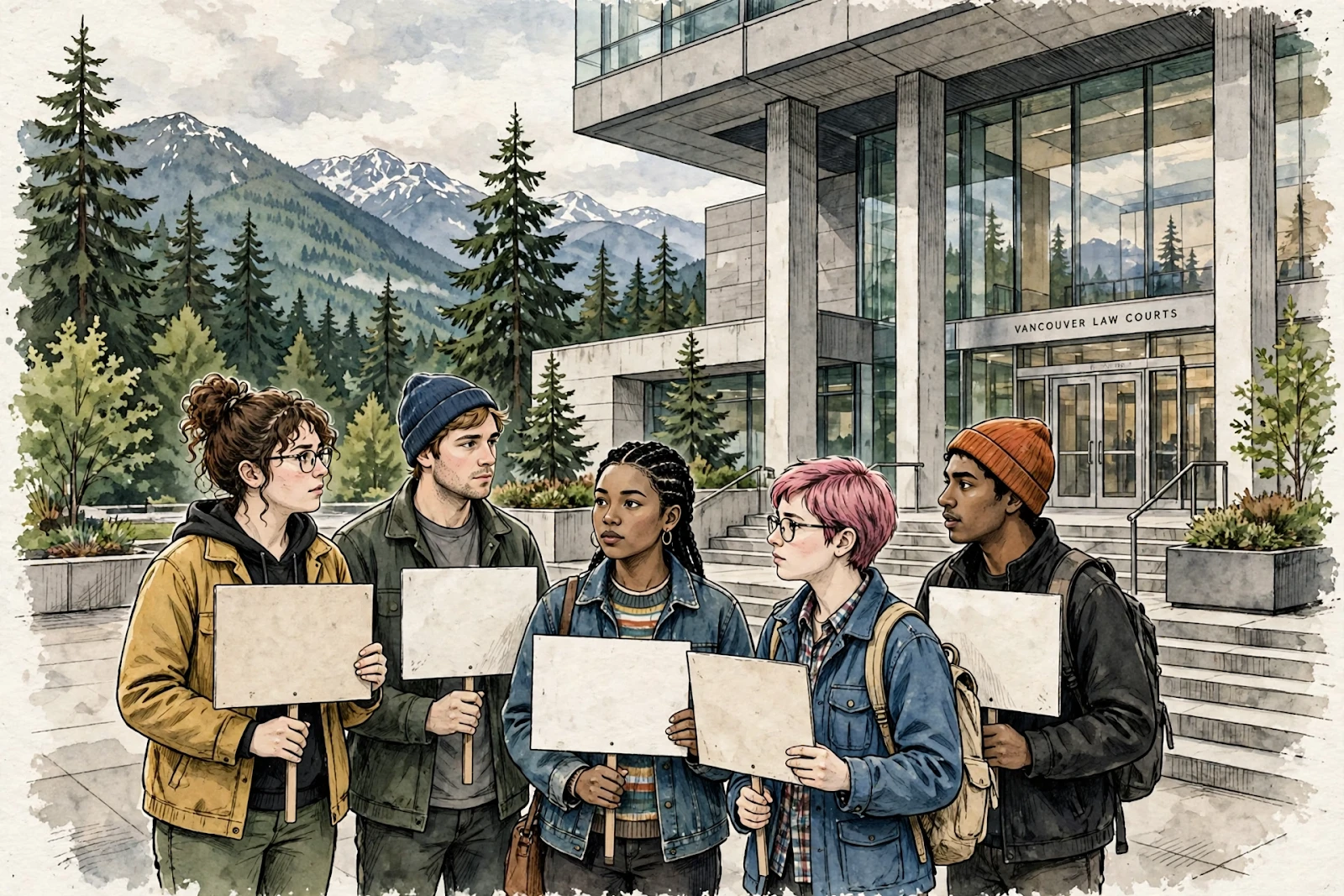
Illustration: Young people gather outside a courthouse in Vancouver during a climate trial.
What Happened
In the trial's first week, the young plaintiffs' lawyers set out to prove a point that is central to their case: that the consequences of climate change are not hypothetical future risks, but harms Canadians are already suffering. Testimony reported by Agence France-Presse (AFP) on October 31 focused on mental health, with a child and adolescent psychiatrist, Elizabeth Pinsky, telling the court that young Canadians — including those affected by devastating wildfires — have experienced depression, anxiety and post-traumatic stress disorder.
Pinsky described a condition she called "eco-anxiety," which she defined as "a category of psychological harm that has to do with anger, a sense of betrayal." She also testified, as reported by AFP, that concerns about the climate were fuelling a general trepidation about the future among young Canadians, and that 40 percent of youth are unsure whether they want children because of global warming. A 2022 Canadian health ministry report, cited in the same coverage, noted that climate change "disproportionately and inequitably affects the mental health" of certain groups, including youth.
The plaintiffs themselves then gave the court personal accounts. Montreal resident Albert Lalonde testified that although he loves being outside on his bike, he stayed indoors more often this summer because of what he described as "chokingly toxic air" caused by wildfires. He recalled feelings of "betrayal" after concluding that he was no longer safe outside, and told the court: "I just no longer expect anything from governments." He mentioned policy moves by Prime Minister Mark Carney, including the removal of a carbon tax on consumers.
Leandrea Reeves testified about a broader sense of loss, saying she feels "disadvantaged" because climate-linked extreme weather events are limiting her experiences. Lauren Wright, 22, from Saskatchewan, told the court about the "profound sense of calm" the outdoors provides — and how enjoying the outdoors and working as a farmer have been restricted by heat-related illnesses. Wright lived through the 2015 wildfires that displaced thousands. Another plaintiff, Saj Starcevich, testified in tears about doubts over becoming a parent, something she had previously dreamed of, saying: "It is a scary world. I struggle to think about what the future holds."
Government lawyers counter that climate change is a global problem, and that even if a court order bound Ottawa to certain emissions targets, it still would not protect Canadians from the harms of climate change. That argument — that the problem is too large and too shared for a single court order to fix — is likely to be a central theme of the government's case.
Background
The case has taken seven years to reach trial. It was first filed on October 25, 2019, by 15 children and youth who were then aged between 10 and 19 and lived across Canada. The claim was initially dismissed, but in 2023 the Federal Court of Appeal ruled that the plaintiffs' amended Section 7 claim could proceed to trial, while upholding the dismissal of separate claims brought under Section 15 of the Charter, which deals with equality rights.
As narrowed after that appeal ruling, the case now challenges two pieces of federal policy, according to an analysis by Columbia Law School's Sabin Center for Climate Change Law. The first is the Canadian Net-Zero Emissions Accountability Act, the statute that legally commits Canada to achieving net-zero greenhouse gas emissions by 2050 and requires the government to set interim targets and publish emissions reduction plans. The second is the government's 2030 Emissions Reduction Plan, which sets a target of cutting national emissions to 40 percent below 2005 levels by 2030 — a target described in wider reporting as a 40 to 45 percent reduction range.
The plaintiffs are seeking declaratory relief — a court finding that the current targets and plans violate their Charter rights — along with an order requiring the government to prepare and implement a climate recovery plan, as well as costs and other relief, according to the Sabin Center's description of the claim. In practical terms, they want the court to compel the government to cut greenhouse gas emissions and honour its previously set targets. Prime Minister Mark Carney's government has already indicated that the 2030 benchmarks may be missed, according to reporting on the trial's opening.

Illustration: A Canadian city skyline under hazy wildfire smoke, the kind of summer air described in trial testimony.
Why It Matters
First, the case tests how far Canadian courts are willing to go in reviewing climate policy. Federal courts in Canada have never before resolved, after a full hearing of evidence, whether federal climate protections raise the constitutional issues at stake here. A ruling for the plaintiffs would not, by itself, cut a single tonne of emissions — but it could force the government back to the drawing board on its targets and plans, with a court order behind the demand. A ruling for the government would set a different kind of precedent: that climate targets, however disappointing to critics, are a matter for Parliament and elections, not for judges.
Second, the mental-health testimony matters because it reframes the legal question. Climate cases often turn on tonnes, degrees and deadlines. Here, the plaintiffs are asking the court to see the harm in human terms: summers spent indoors, farming work curtailed by heat, and young people questioning whether to have children. If the court accepts that these experiences count as interference with life and security of the person, it would widen the way Canadian law understands climate harm. If it does not, the plaintiffs' case becomes much harder to sustain, however sympathetic their stories may be.
Third, the science testimony already heard points to a difficult backdrop. Climate science professor Kirsten Zickfeld of Simon Fraser University told the trial that models suggest Canada has "exceeded its fair share" of its carbon budget — the maximum amount of carbon dioxide that can be released while keeping warming around 1.5 degrees Celsius and well below two degrees, the targets of the 2015 Paris Agreement. On calculations based on equity, capability and responsibility, she said, "Canada's carbon budget is essentially zero or negative," meaning it has already surpassed its fair share. Under cross-examination, however, she said that while science helped determine the targets, it "doesn't provide the path" to meeting them — a distinction the government's lawyers are likely to press, since choosing that path is a policy decision.
Fourth, the trial lands in a political moment. Canadians concerned about the environment have criticised Prime Minister Mark Carney over what they say are policies favouring the economy over climate protections, including the removal of the consumer carbon tax. The trial gives those criticisms a courtroom, and a constitutional vocabulary, that protests and petitions do not. Whatever the court decides, the testimony alone has put the government's climate record under a sustained public spotlight in the weeks before the COP31 climate talks in Antalya, Türkiye, in November.

Illustration: A courtroom scene with scales of justice, as the Federal Court weighs Canada's climate obligations.
What Happens Next
The trial is expected to continue into late November, with more plaintiffs expected to testify about what the Sabin Center describes as "specific harms connected directly to the government's conduct." Government witnesses and legal argument will follow, and closing arguments are scheduled for February, according to Canadian Press reporting. A judgment would then follow at a date set by the court, and either side could appeal — meaning the legal story is unlikely to end with the first ruling, whichever way it goes.
Watch for three things in the coming weeks. The first is whether the court treats the mental-health evidence as legally relevant harm or as background context: that ruling, in effect, will shape the rest of the trial. The second is how the government defends its targets and plans on their merits — whether it argues they are adequate, or simply that they are not a matter for the courts. The third is the reaction in Ottawa: a government that has already signalled the 2030 benchmarks may be missed will have to decide whether to adjust its plans before the court forces the question.
For now, the verified picture is this: 15 young Canadians are in a Vancouver courtroom, telling a judge that their government has not done enough to protect them from climate change, and backing that claim with stories of smoke, heat and anxiety. The government says the problem is global and beyond the reach of a court order. The court must now decide whether the Constitution has anything to say about that disagreement — and, if so, what.
Sponsored: explore today's featured sponsored offers
FAQ
What is the La Rose climate trial?
It is a Federal Court case, La Rose v. His Majesty the King, in which 15 young Canadians argue that the federal government's climate targets and plans violate their Section 7 Charter rights to life, liberty and security of the person. The trial opened in Vancouver on October 26, 2026.
What are the plaintiffs asking the court to do?
They are seeking a declaration that the current targets and plans violate their rights, plus an order requiring the government to prepare and implement a climate recovery plan. In short, they want the court to compel stronger, legally enforceable emissions cuts.
What is "eco-anxiety" in this case?
Psychiatrist Elizabeth Pinsky, testifying for the plaintiffs, defined eco-anxiety as "a category of psychological harm that has to do with anger, a sense of betrayal." She told the court that young Canadians affected by wildfires have experienced depression, anxiety and post-traumatic stress disorder.
What does the government argue?
Government lawyers argue that climate change is a global problem, and that even a court order binding Ottawa to certain emissions targets would not protect Canadians from its harms. The government also disputes the claim that its targets and plans are arbitrary or grossly disproportionate.
When will the trial end?
The trial is expected to continue into late November 2026, with closing arguments scheduled for February, according to Canadian Press reporting. A judgment would follow later, and either side could appeal.
Sources
- Agence France-Presse, via Phys.org, October 31, 2026 — mental-health testimony, eco-anxiety evidence and plaintiff accounts at the Vancouver trial.
- Columbia Law School, Sabin Center for Climate Change Law, October 20, 2026 — procedural history, narrowed Section 7 claim, Net-Zero Act and 2030 plan details.
- The Canadian Press, October 27, 2026 — Professor Kirsten Zickfeld's carbon-budget testimony and the trial timetable (late November, closing arguments in February).
- Agence France-Presse / Associated Press trial-opening reporting, October 26, 2026 — 15 plaintiffs, Vancouver opening, 2030 targets and the government's position.
Comments
Post a Comment