
WASHINGTON — Airlines are urging the United States Centers for Disease Control and Prevention (CDC) to reconsider — and delay — a new Ebola-related travel declaration that is scheduled to take effect for flights to the United States at 11:59 p.m. Eastern Standard Time on 3 November 2026, arguing that carriers cannot rework check-in systems, train staff and collect the new forms consistently in the time available.
Note: This article provides general information only and is not medical advice.
Under the CDC order, as reported on 30 October 2026, every person boarding an international flight to the United States must sign a paper or digital statement confirming that they have not been present in the Democratic Republic of the Congo (DRC) during the 21 days before their flight. The requirement applies to everyone flying into or connecting through the United States, including American citizens, green card holders and airline crew members, according to the CDC, as reported by the New York Post. Travellers who have been in the DRC within that window will not be able to board a US-bound flight until the 21 days have elapsed, unless they have a government exemption, the same reporting said.
Airlines must collect the forms and keep them for at least 42 days after the flight arrives in the United States, according to the CDC requirement as reported. The 21-day period reflects the maximum time it can take for Ebola symptoms to appear after exposure, the CDC said.

Illustration: Travellers at an airport check-in desk signing a travel declaration form, with suitcases nearby, in stylised editorial illustration form.
The airline industry says it supports the public-health goal behind the rule but objects to its breadth and its timetable. Airlines for America (A4A), which represents major US carriers including American, Delta, Southwest, United and JetBlue, asked the CDC in an 26 October letter to reconsider the requirement and give airlines more time to prepare, according to reporting by Fox News Digital cited by the New York Post. The group said changes to check-in systems, digital signatures, station procedures and training "cannot readily be completed in the allotted time".
A4A also asked for what it called a "more proportionate and measured US response" focused more closely on affected areas and on travellers who have recently been there, rather than a blanket declaration for every international passenger bound for the United States. The International Air Transport Association (IATA), which represents more than 370 airlines around the world, has also asked the CDC to reconsider, Reuters reported.
What Happened
The dispute sharpened in the final days of October as the 3 November start date approached. An amended CDC order dated 28 October confirmed that the attestation requirement also covers relevant operating crew and crew travelling in position on passenger- and cargo-carrying aircraft, according to an update published on 29 October 2026. As of that update, no postponement or withdrawal had been announced, and the scheduled start remained 11:59 p.m. Eastern Standard Time on 3 November 2026.
Industry groups pressed their case publicly on 30 October. Simple Flying reported that US carriers were hoping the CDC would delay the rollout so they could prepare the necessary logistics and administration, while Travel Extra reported that IATA and A4A had urged the CDC to reconsider, citing an implementation timeline of less than two weeks. The groups are also seeking targeted relief before the deadline, including exemptions for flight crew members, US military personnel and jumpseat travellers, Travel Extra reported.
IATA also questioned why the mandate applies strictly to aviation, pointing out that maritime and surface transport are excluded, according to the same reporting. The scale of the exercise is part of the airlines' argument: the mandate affects more than 10 million monthly air travellers to the United States, Travel Extra reported, while Reuters reported that of the 130 million people US Customs and Border Protection screened in 2025, just 25,000 had direct links to the DRC.
For passengers, the practical question is straightforward, even if the systems behind it are not. From the scheduled start time, a traveller boarding a flight to the United States from anywhere in the world will be asked to attest to their recent travel history. Travellers who are required to attest but do not complete the declaration may be denied boarding, according to reporting on the CDC order. Travellers should check the latest official instructions and any applicable exemption before travelling, the same reporting advised.
Background
The attestation is the latest step in a series of US travel measures linked to the Ebola outbreak in the DRC. The CDC introduced restrictions in May 2026 preventing foreign airline passengers who had visited the DRC within the previous 21 days from entering the United States, and those restrictions were extended to US citizens in July 2026, according to Aviation Bizz reporting on 30 October 2026. The new declaration extends the paperwork to every US-bound international passenger, regardless of where their flight originates.
The outbreak behind the measures is caused by the Bundibugyo species of Ebola virus, a rare strain for which there is currently no licensed vaccine or approved specific treatment, according to the World Health Organization (WHO). The outbreak was declared in the DRC in May 2026, and by late October confirmed cases had surpassed 10,000, with deaths approaching 5,000, according to data compiled by the WHO and the DRC Ministry of Public Health as reported by Al Jazeera and other outlets. Figures vary slightly by cut-off date as field teams update data in real time.
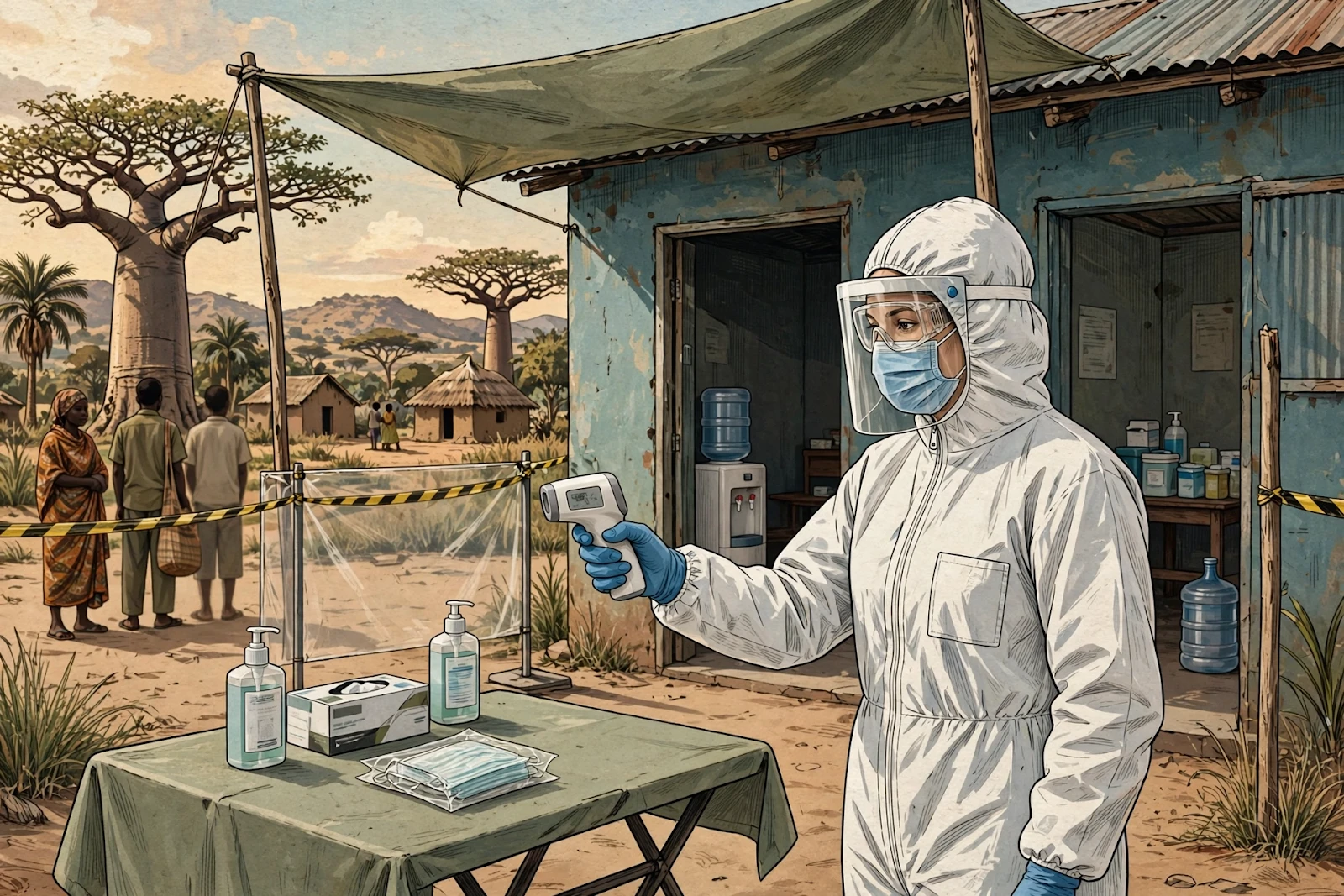
Illustration: A health worker in protective equipment at a clinic screening checkpoint, in stylised editorial illustration form.
The response has struggled to keep pace with transmission. Africa CDC Director-General Dr Jean Kaseya told more than 40 African health ministers at an extraordinary meeting on 28 October that "we are not winning so far", citing 10,172 confirmed cases and 4,932 deaths in data through 26 October, according to reporting by The National and JolibaLive. The Africa CDC has said at least 95 percent of cases must come from the known contacts of infected people for the outbreak to be considered under control; reporting in late October put the share of new infections outside monitored contact chains at around 80 percent.
At the same time, a vaccine trial is under way. The WHO and its partners are supporting the TUMAINI trial, launched in Bunia in the DRC's Ituri province on 23 October 2026, evaluating vaccine candidates including Ervebo, which is licensed against a different Ebola virus species. Researchers are testing candidates against Bundibugyo virus as part of efforts to strengthen the response, but no licensed Bundibugyo-specific vaccine exists yet — which is why early detection, contact tracing, timely access to care and cross-border coordination remain, in the WHO's words as reported, the core tools for limiting transmission.
Cases beyond the DRC have so far been limited. France and Nigeria have each recorded one imported case, and Kenya has reported nine cases, according to late-October reporting. Nigeria's single confirmed case involved a traveller with recent travel history to Uganda who tested positive on 20 October, and Nigeria's disease control agency was monitoring 54 identified contacts linked to that case.
Why It Matters
The clash over the attestation matters for three reasons. First, it tests how far a public-health agency can go, and how fast, when an outbreak abroad is still growing. The CDC's aim, as it stated, is to reduce the risk of Ebola entering the United States through air travel. The airlines' counter-argument is not about that aim — both A4A and IATA say they support the public-health goals — but about whether a universal, paper-or-digital declaration for every US-bound passenger is the proportionate way to achieve it, given how few US-bound travellers have recent DRC travel.
Second, the dispute is a preview of the operational friction that can follow any border health measure. A rule that looks simple on paper — one signed statement per passenger — requires changes to booking and check-in software, digital signature capture, airport station procedures, crew handling and staff training, across hundreds of airlines and airports, in less than two weeks. If those systems are not ready on 3 November, the risk is not only delay at check-in but inconsistent application: some passengers asked for a form, others not, and confusion about exemptions for crew and military travellers.
Third, the outcome will be watched well beyond the United States. Other countries facing imported-case risks look to US practice, and airlines operate the same check-in platforms worldwide. A delay, a narrowing of the rule, or a smooth rollout on 3 November will each send a different signal about how quickly border health declarations can realistically be stood up in a fast-moving outbreak.
What Happens Next
The immediate question is whether the CDC changes course before the deadline. As of 30 October, no postponement had been announced, and the start time remained 11:59 p.m. Eastern Standard Time on 3 November 2026. Watch for any CDC statement in the days before the deadline — a delay, a phased rollout, or exemptions for crew, military personnel and jumpseat travellers would each be a concession to the airlines' core asks without abandoning the declaration itself.

Illustration: Passengers seated inside an airplane cabin while a flight attendant holds a declaration form, in stylised editorial illustration form.
If the rule takes effect as scheduled, the first test will be operational: whether airlines can collect and retain declarations for every US-bound passenger, including those merely connecting through the United States, without major check-in delays. The second test will be epidemiological: whether the declaration, combined with the existing entry restrictions, helps identify travellers who need follow-up after recent DRC travel. The third test will be political: whether the airlines' argument for a more targeted approach gains traction with US authorities, or whether the CDC holds the universal rule in place through the outbreak's peak.
Beyond the airport, the outbreak itself remains the underlying story. Health authorities will be watching whether the share of cases arising outside known contact chains falls toward the Africa CDC's 95-percent target, whether the TUMAINI trial produces usable results, and whether imported cases in neighbouring countries stay isolated. Any of those developments could change the risk assessment behind the US rule — and with it, the argument over how long a universal declaration should stay in place.
For now, travellers planning US-bound flights in early November should expect to be asked about DRC travel in the previous 21 days, and should allow extra time at check-in while airlines adapt their systems to the new requirement.
Sponsored: explore today's featured sponsored offers
FAQ
What is the CDC's new Ebola travel declaration?
From 11:59 p.m. Eastern Standard Time on 3 November 2026, every person boarding an international flight to the United States must sign a paper or digital statement confirming they have not been in the Democratic Republic of the Congo during the 21 days before their flight, according to the CDC order as reported.
Does the rule apply to US citizens and airline crew?
Yes, as reported. The requirement applies to everyone flying into or connecting through the United States, including American citizens, green card holders and airline crew members, and an amended order dated 28 October confirmed it covers relevant operating and positioning crew.
Why are airlines asking for a delay?
Airlines for America and IATA say the timetable — less than two weeks from publication to enforcement — is too short to change check-in systems, add digital signatures, revise station procedures and train staff consistently. A4A also argues the universal rule is too broad, given that only a small share of US-bound travellers have recent DRC travel.
What happens if a traveller has been in the DRC in the last 21 days?
According to reporting on the CDC order, such travellers will not be able to board a US-bound flight until the 21 days have elapsed, unless they have a government exemption. Travellers who are required to attest but do not complete the declaration may be denied boarding.
Why 21 days?
The 21-day period reflects the maximum time it can take for Ebola symptoms to appear after exposure, according to the CDC. It is also the look-back window used in the earlier US entry restrictions introduced in May 2026.
Sources
- New York Post, "Deadly disease sparks new CDC rule for US-bound flyers as major airlines seek delay", 30 October 2026 (CDC requirement, A4A 26 October letter, IATA request, 42-day retention).
- Simple Flying, "Why US Airlines Aren't Happy About New 21 Day Ebola Rules For Passengers", 30 October 2026 (3 November 11:59 p.m. EST start, Reuters 130 million / 25,000 figure).
- Travel Extra, "US Airline groups urge CDC to reconsider Ebola screening rules", 30 October 2026 (crew, military and jumpseat exemption requests; aviation-only scope; 10 million monthly travellers).
- Bold Voices, "Airlines Ask CDC to Reconsider Ebola Travel Declaration Rule", updated 30 October 2026 (28 October amended order covering crew; no postponement announced).
- Al Jazeera, "Ebola cases in DR Congo surpass 10,000 in fastest-growing outbreak", 27 October 2026, and The National, "'We are not winning': Africa CDC warns as Ebola deaths near 5,000", 30 October 2026 (outbreak scale, Kaseya remarks, TUMAINI trial).
Comments
Post a Comment