
Clean Energy Passes Coal: Renewables Become the World's Largest Power Source as Investment Hits $2.2 Trillion
PARIS — Renewable energy has overtaken coal as the world's largest source of electricity for the first time, the International Energy Agency (IEA) says, in a milestone that caps a year in which clean energy investment reached about $2.2 trillion — almost double the amount flowing into fossil fuels.

Illustration: Solar panels and wind turbines on green hills at sunrise, symbolising the rise of renewable power.
What Happened
According to the IEA's 2026 analyses, electricity generated from renewable sources — wind, solar, hydro and bioenergy combined — moved ahead of coal-fired generation during 2026, making renewables the world's largest source of power generation. The agency's Electricity Mid-Year Analysis 2026 describes the shift as a first: never before have renewables together generated more electricity than coal plants.
The milestone arrived alongside a second headline figure. In its World Energy Investment 2026 report, the IEA puts total global energy investment at about $3.4 trillion in 2026, up around 5% from 2025, despite what the agency calls the destabilising effect of the Middle East conflict. Of that total, roughly $2.2 trillion is flowing into clean energy technologies and infrastructure — renewable power, nuclear energy, electricity grids, battery storage, energy efficiency, low-emissions fuels and electrification — while around $1.2 trillion goes to fossil fuels.
In other words, for every dollar invested in fossil fuels, close to two dollars are now being invested in cleaner energy systems, the IEA's figures show. Clean energy investment grew by 7% year on year in advanced economies and in China, and by 4% in other emerging markets, according to the agency's regional dashboards.
Background
Coal has been the backbone of the world's electricity system for more than a century, and its share of global generation had rarely been seriously challenged. The IEA's outlook describes a gradual changing of the guard rather than a sudden collapse: coal's share of global electricity generation is set to fall below 33% for the first time in a century, while renewables are expected to account for around 36% of global power supplies in 2026 and rise to about 37% by 2027.
Several forces converged to produce the crossover. Solar power remains the most important growth technology: the IEA expects solar output to increase by around 610 terawatt-hours in 2026 alone. Wind, hydro and bioenergy add further volume, while nuclear power is also experiencing a revival, with generation expected to reach new highs by 2027 as French production recovers, reactors restart in Japan, and new units come online in China, India and South Korea.

Illustration: A coal power plant at sunset with wind turbines rising in the foreground, symbolising the energy transition.
Demand is rising at the same time. Global electricity consumption is expected to grow by 3.6% in 2026 — significantly faster than the long-term average — and to reach around 30,700 terawatt-hours by 2027, driven by the electrification of industry, transport and heating, growing air-conditioning use, and the expansion of energy-hungry data centres. Low-emissions sources, including renewables and nuclear, are set to meet most of that additional demand.
The regional picture is uneven. In the European Union, the IEA forecasts that coal's share of power generation will fall below 10% in 2026 for the first time in more than 100 years, while low-carbon electricity overall will rise to around 76% by 2027. In other regions, coal generation is holding up better: declines in the EU and the United States are partly offset by increases in India and Southeast Asia, and natural gas generation is still expected to grow by about 1% a year.
Why It Matters
The crossover matters because electricity is the fastest-electrifying part of the energy system, and the power sector is the largest single source of carbon dioxide emissions. When the world's biggest source of electricity changes, the economics of everything built on top of it — factories, transport, heating and digital infrastructure — begin to change too.
The investment figures matter just as much as the generation figures. Power plants, grids and factories built today will operate for decades, so where capital goes now shapes emissions for years to come. The IEA's data suggest that, even amid geopolitical turmoil and volatile oil and gas markets, investors are increasingly betting on domestic, diversified and resilient energy systems rather than on imported fuels — a trend the agency links directly to energy-security concerns.
It is important to keep the milestone in proportion. Passing coal in electricity generation does not mean the energy transition is complete. Fossil fuels still supply the majority of the energy used worldwide, especially in transport, industrial heat, chemicals, aviation, shipping and buildings, where electrification is harder. Coal generation itself is expected to stagnate rather than collapse globally, and carbon dioxide emissions from electricity generation are projected to stabilise rather than fall sharply in the coming years.
What Happens Next
The IEA's trajectory points to renewables extending their lead. By 2027, renewables are expected to supply around 37% of global electricity, with solar alone covering about half of the anticipated increase in global electricity demand. Nuclear generation is also set to keep climbing toward new records.
What to watch is whether the investment gap keeps widening. Clean energy investment is growing in advanced economies, China and emerging markets alike, but at different speeds, and the IEA notes that grids, storage and permitting — not just building solar panels and turbines — will decide how fast new capacity can actually be used. The next test comes at the COP30 climate talks in Belém, Brazil, where governments will face pressure to turn the market shift into faster emissions cuts.
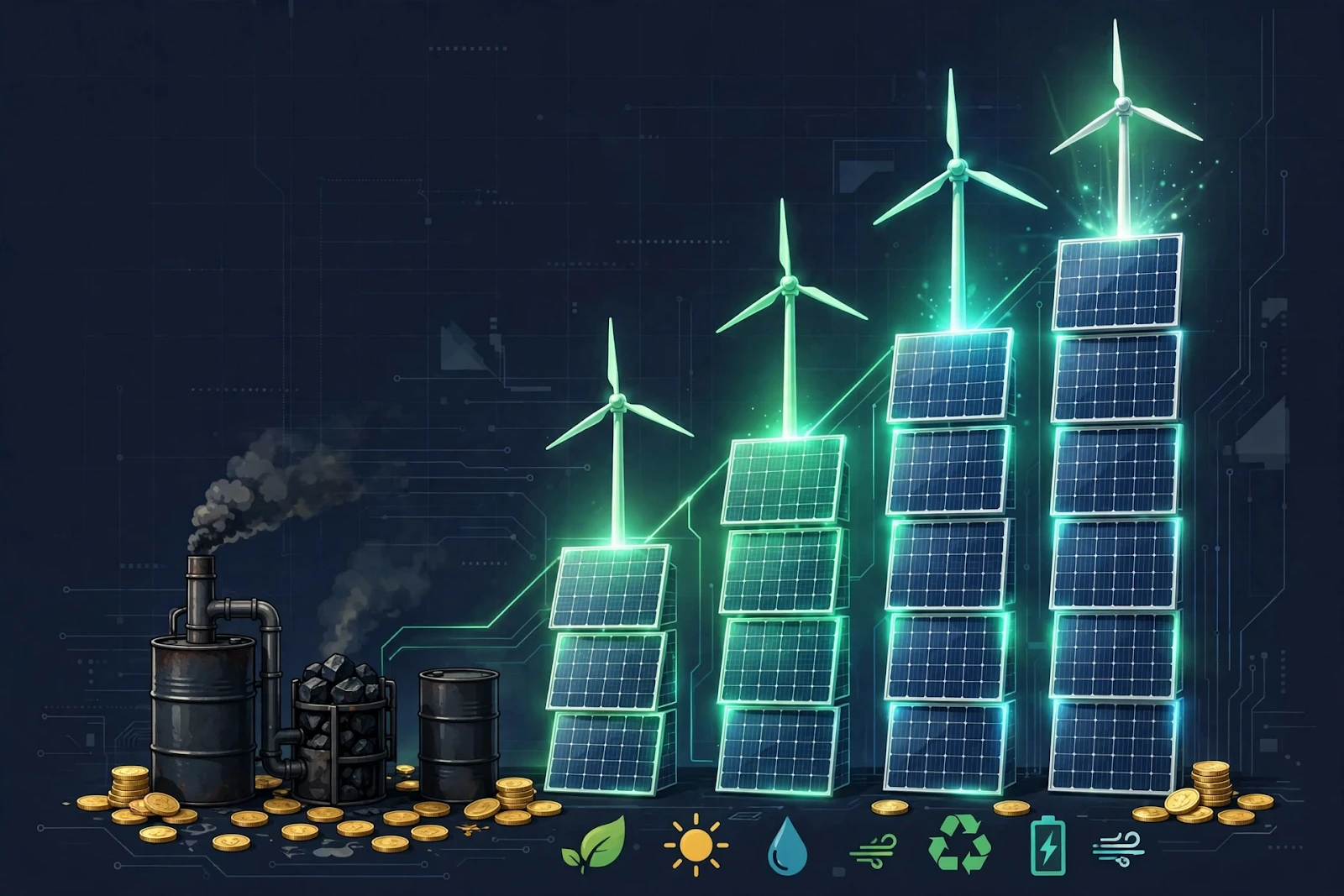
Illustration: Clean energy investment rising above fossil fuel investment, reflecting the IEA's 2026 figures.
For now, the symbolic changing of the guard is real: the fuel that powered the industrial revolution has been overtaken, in the world's power stations, by the technologies expected to power the next one.
Sponsored: explore today's featured sponsored offers
FAQ
What does it mean that renewables have overtaken coal?
It means that, combined, wind, solar, hydro and bioenergy now generate more electricity worldwide than coal-fired power plants — a first, according to the IEA. It refers to electricity generation, not to all energy use, where fossil fuels still dominate.
How much is being invested in clean energy?
The IEA puts clean energy investment at about $2.2 trillion in 2026, out of total global energy investment of about $3.4 trillion. Fossil fuel investment is around $1.2 trillion, so clean energy is running at almost double the fossil fuel level.
Why is electricity demand growing so fast?
The IEA points to the electrification of industry, transport and heating, more air conditioning, and the growth of data centres. Global electricity demand is expected to rise 3.6% in 2026 and reach around 30,700 terawatt-hours by 2027.
Is coal disappearing?
No. Coal's share of global electricity is falling below 33% for the first time in a century, but coal generation is expected to stagnate rather than collapse, with declines in the EU and the US partly offset by growth in India and Southeast Asia.
What happens next for the energy transition?
The IEA expects renewables to reach about 37% of global electricity by 2027, with solar driving much of the growth. Grids, storage and permitting will be key tests, and governments face pressure at COP30 to accelerate emissions cuts.
Sources
- International Energy Agency, World Energy Investment 2026 — regional dashboards (October 2026): total energy investment about $3.4 trillion, clean energy about $2.2 trillion.
- International Energy Agency, Electricity Mid-Year Analysis 2026: renewables overtake coal as the largest electricity source in 2026; demand growth 3.6%; 30,700 TWh by 2027.
- IEA reporting on the October 2026 analyses, via industry coverage (October 2026): solar output up about 610 TWh in 2026; EU coal share below 10% in 2026; EU low-carbon share about 76% by 2027.
Comments
Post a Comment