
CAMBRIDGE — For decades, comets have starred in one of science's most romantic origin stories: giant balls of ice and dust sweeping in from the outer solar system, carrying the chemical ingredients for life and dropping them gently onto a young Earth. A new study led by the University of Cambridge suggests that story is, at best, a one-off fluke — and most likely never happened at all. Computer simulations modelling the early solar system 100,000 times found that comets arrived too fast, at too steep an angle, and with too much destructive force for their fragile cargo to survive the trip, according to research published in the journal Scientific Reports and reported on 28–31 October 2026.
The finding does not answer how life actually began on Earth. It does, however, sharply narrow one of the leading explanations — and it shifts attention back to chemistry that happened on Earth itself, rather than chemistry delivered from space. "It's kind of a romantic idea, but our results suggest it's highly unlikely," lead author Dr. Richard Anslow, of Cambridge's Institute of Astronomy, said in the University of Cambridge report carried by Phys.org.
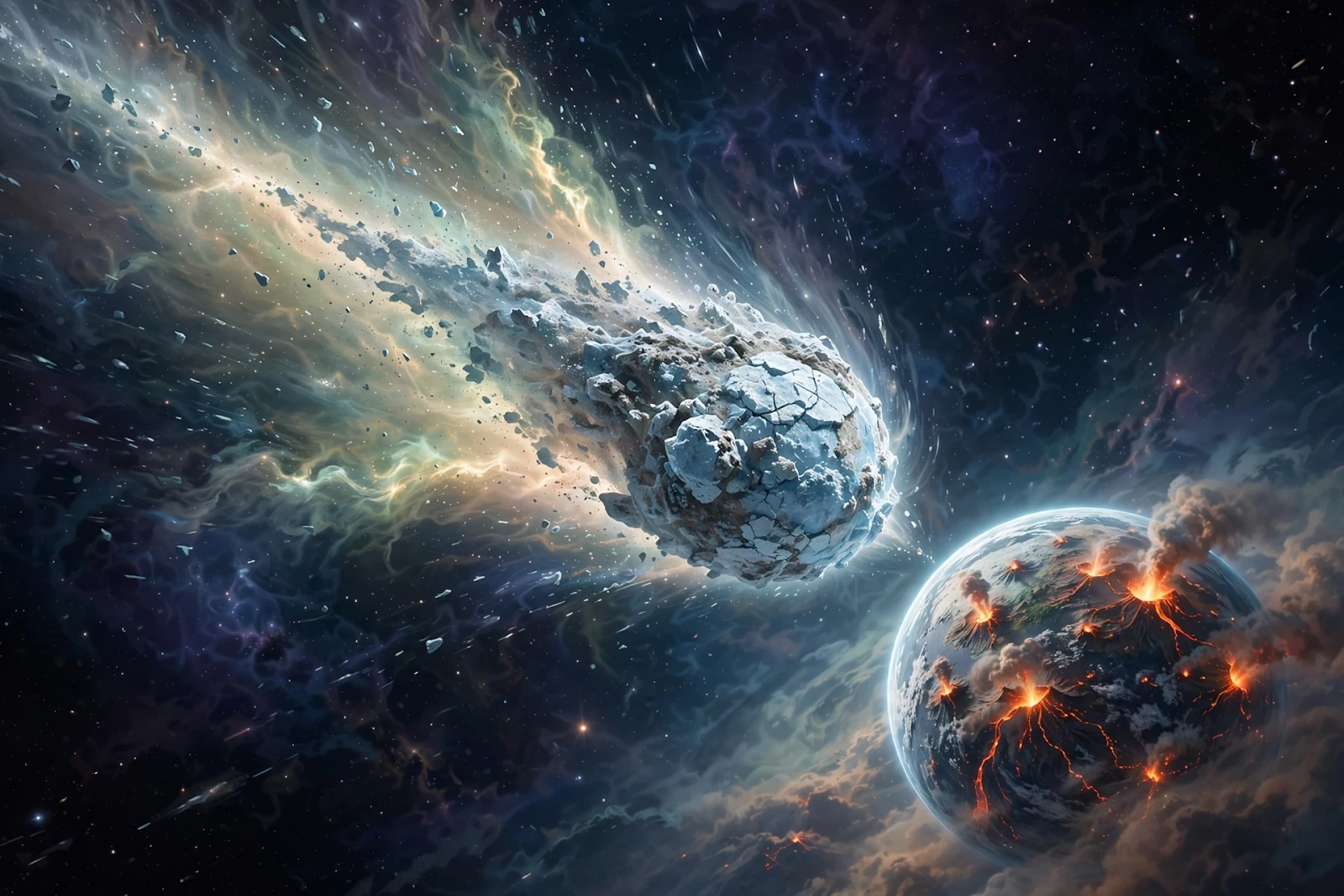
Illustration: A comet streaking toward a young, volcanic early Earth — an artist's impression, not a photograph of an actual impact.
What Happened
The Cambridge-led team set out to test a long-standing idea in origin-of-life science: that comets delivered "feedstock" molecules — the simple carbon- and nitrogen-bearing chemicals from which more complex prebiotic chemistry could build — to the early Earth. Historically, scientists thought comets were important because they carried those molecules in abundance, Anslow explained. "These giant space snowballs were almost like a 'get out of jail free card' that brought all the molecules a planet would need to seed life," he said.
To test the idea rigorously, the researchers combined models of comet populations and orbits with simulations of atmospheric entry and impact, running the early planetary bombardment 100,000 times. They focused on hydrogen cyanide, or HCN — a molecule made of hydrogen, carbon and nitrogen that is regularly detected on solar system comets, including Halley's comet and Hale-Bopp, and that is widely regarded as an important precursor in prebiotic chemistry. HCN can, in laboratory conditions, lead toward amino acids, the building blocks of proteins, and toward the components of RNA.
The results were stark. In 54% of the simulations, no comet hit Earth at all. In the remaining 46%, at least one impact occurred, and a tiny minority produced as many as three collisions. But across all 100,000 runs, the average number of impacts that successfully delivered a useful concentration of HCN was zero. "Given what we know about surface environments on the early Earth, on average, our simulations found that there were no successful impacts," Anslow told CNN. The study's authors describe cometary delivery as, at best, a "one-off fluke" rather than the steady rain of prebiotic molecules that had been theorised.
The team also found a second problem: timing. The number of comets striking Earth declined rapidly during the planet's first 500 million years, so there were, at most, a handful of opportunities in Earth's early history for HCN delivery by comet. Even if a delivery had succeeded, the HCN would not have stayed concentrated for long — and prebiotic chemistry would have needed to progress very quickly from the moment of impact, which the researchers say is highly unlikely.
Background
The idea that life's ingredients came from space has a long pedigree. The broader proposal, known as panspermia, was scientifically postulated in 1908, and the cometary version gained strength as astronomers confirmed that comets carry carbon- and nitrogen-bearing molecules. A theory dating back to at least 1961 held that comets were crucial in kick-starting life on Earth, CNN reported. Early in Earth's history — more than 4 billion years ago — the planet may have experienced a period of heavy bombardment from more than 100,000 comets larger than 100 metres (328 feet), according to the new study.
Why did the new simulations reach a different conclusion from the older intuition? The answer lies in impact physics. Small comets typically disintegrate during atmospheric entry in a destructive airburst, spreading their molecules over a huge area and making it difficult to achieve the local concentrations that prebiotic chemistry requires. Larger comets survive the atmosphere, but then slam into the ground at speeds that expose their cargo to extreme shock pressures and temperatures, destroying most of the feedstock molecules. Only a small number of low-velocity impacts could plausibly preserve any HCN at all.
The choice of HCN as the test molecule was deliberate — and deliberately generous to the comet theory. HCN's strong carbon-nitrogen triple bond makes it relatively resistant to impact destruction, and it occurs in comets at concentrations relevant to laboratory experiments. As Anslow put it, if things look bad for hydrogen cyanide, they are likely to look worse for other, more complicated and more fragile molecules. The researchers also acknowledged that they used optimistic assumptions about the early solar system to give comets their best shot — and the models still produced an average of zero successful deliveries.

Illustration: Molecules scattering and breaking apart as a comet strikes a planet's surface — an artist's impression of impact destruction, not a real event photograph.
Why It Matters
The study matters because it forces a rethink of where origin-of-life researchers should look. If comets could not reliably deliver HCN intact, then the most viable remaining source, the study's authors argue, is Earth's own atmospheric chemistry: lightning and ultraviolet radiation driving HCN synthesis from nitrogen, carbon dioxide and water vapour already present on the early planet. That shifts the search for life's origins from the sky back to the ground — to volcanic pools, shallow waters and atmospheric reactions on the young Earth itself.
The finding also has implications for the "RNA World" hypothesis, one of the leading frameworks for how life began. That hypothesis depends on HCN as a foundational precursor: adenine, one of life's four DNA bases, is structurally a pentamer of HCN, and HCN sits at the foundation of the cyanosulfidic synthesis network that generates RNA, protein and cell-membrane components under ultraviolet light. If the HCN supply had to come from Earth itself rather than from comets, then models of the early atmosphere — its composition, its lightning, its ultraviolet exposure — become even more important to getting the story right.
There is one intriguing exception in the results: Mars. The researchers found that the red planet could be a slightly more promising candidate for cometary delivery of prebiotic molecules than Earth, because its thinner atmosphere and lower gravity change the impact dynamics. Even there, however, successful delivery remains highly unlikely. The Mars finding is a relative statement — less impossible, not probable — and the authors do not claim that comets seeded life on Mars either.
Importantly, the study does not close the book entirely. "We can't rule out for certain that it happened that way," Anslow said. "But it seems to be a really rare occurrence — at best, a one-off fluke." A single fluke impact, at just the right speed and angle, with all the other feedstock molecules present in the same place and prebiotic chemistry succeeding on its first attempt, cannot be excluded. But science rarely builds a theory on a one-in-a-million event when a more ordinary explanation — chemistry on Earth itself — remains available.

Illustration: Astronomers studying computer simulations of comet orbits — an artist's impression, not a photograph of the study team.
What Happens Next
The next step for origin-of-life research is to test the Earth-based alternative with the same rigour the Cambridge team applied to comets. That means better models of the early Earth's atmosphere and surface: how much HCN could lightning and ultraviolet light actually produce, where it could accumulate, and whether those concentrations could sustain the reaction networks that lead toward RNA and proteins. Laboratory experiments that recreate early-Earth conditions will be central to that work, as will geological evidence about what the young planet's surface and atmosphere really looked like.
Astronomers, meanwhile, will keep refining the comet side of the ledger. The study's simulations rest on models of comet populations and orbits in the early solar system, and future observations — including studies of comets and interstellar visitors passing through our solar system today — can sharpen those models. If the comet population turns out to have been very different from what the team assumed, the numbers could shift. But the physical barrier at the heart of the study — that hypervelocity impacts destroy fragile molecules — is unlikely to disappear.
For the public, the study is a reminder of how science revises its own stories. The comet-delivery idea survived for decades because it was elegant, plausible and partly supported by real observations: comets do carry the right molecules. What the new work shows is that carrying the molecules and delivering them intact are two very different things — and that, in the violent early solar system, the delivery step may have been the one that failed.
Sponsored: explore today's featured sponsored offers
FAQ
What did the Cambridge study find?
Simulations run 100,000 times found that comets almost certainly could not deliver a useful concentration of hydrogen cyanide, a key prebiotic molecule, to the early Earth. On average there were zero successful deliveries, making cometary seeding of life, at best, a one-off fluke.
Why couldn't comets deliver life's building blocks?
Small comets disintegrate in the atmosphere, scattering their molecules too thinly, while larger comets hit the ground so fast that shock pressures and temperatures destroy most of their chemical cargo. Only rare low-velocity impacts could preserve any molecules at all.
What is hydrogen cyanide, and why does it matter?
Hydrogen cyanide (HCN) is a simple molecule of hydrogen, carbon and nitrogen found on comets including Halley's and Hale-Bopp. It is an important precursor in prebiotic chemistry that can lead toward amino acids and RNA components, which is why the team used it as its test case.
Does this mean comets played no role in the origin of life?
Not necessarily. The study cannot rule out a single fluke impact, and it does not address other ways space materials might have contributed. But it argues that comets were not a reliable, steady source of life's ingredients, shifting attention to chemistry produced on Earth itself.
What about Mars?
The researchers found Mars slightly more promising than Earth for cometary delivery, because of differences in atmosphere and gravity — but successful delivery there is still described as highly unlikely, not probable.
Sources
- University of Cambridge via Phys.org, "Comets probably didn't seed life on Earth after all, new study suggests," 28 October 2026.
- CNN, "Scientists say decades-old theory on the origin of life might be wrong," 31 October 2026.
- Richard Anslow and colleagues, "Cometary impacts an unlikely pathway towards the origins of life on Earth," Scientific Reports (2026), DOI: 10.1038/s41598-026-74214-y.
- ZME Science, "Comets Carried the Ingredients for Life. The Problem Is They Were Likely Destroyed on Impact," 28 October 2026.
Comments
Post a Comment