
Diwali celebrations are lighting up cities around the world this weekend, from Times Square in New York to Trafalgar Square in London, in the first festival season since Deepavali was inscribed on UNESCO's list of humanity's intangible cultural heritage.

Illustration: Rows of glowing clay oil lamps and marigold flowers arranged for Diwali at dusk.
What Happened
The global Diwali season is under way. In New York, the Diwali at Times Square festival took place on Saturday 24 October 2026, shutting down the heart of Manhattan for a free celebration that organisers describe as the largest Diwali festival outside India, now in its eleventh year. In London, Diwali on the Square returns to Trafalgar Square on Sunday 25 October, from 1pm to 7pm, with 200 dancers, live performances, family activities and food stalls. In Wellington, New Zealand, the city's Diwali Festival of Lights takes place on Sunday 25 October at TSB Arena and Shed 6, running from 2pm to 8.30pm with music, dance, crafts and fireworks.
This year's season carries a new distinction. On 10 December 2025, Deepavali was inscribed on UNESCO's Representative List of the Intangible Cultural Heritage of Humanity at a committee session held in New Delhi, according to cultural reporting on the inscription. It became the sixteenth element from India on UNESCO's intangible heritage lists, joining, among others, the Durga Puja of Kolkata, inscribed in 2021.
The main Diwali day itself, Lakshmi Puja, falls on 8 November 2026, according to the lunar festival calendar. That means the public celebrations now unfolding in London, New York and Wellington are the opening weeks of a season that builds towards the festival's central night, when families light rows of small clay lamps known as diyas.
Background
Diwali, also known as Deepavali and the Festival of Lights, is one of the most important celebrations in Hindu tradition, and is also observed by Sikh, Jain and other communities around the world. It celebrates the triumph of light over darkness, good over evil and knowledge over ignorance, and the lighting of diyas symbolises hope, renewal and the welcoming of light into people's lives.
The festival is observed in countless regional ways. In India, the season runs through weeks of preparation: homes are cleaned and decorated, sweets are shared, new clothes are bought, and fireworks light the night sky. Abroad, diaspora communities have built large public festivals that mix classical traditions with contemporary music and dance, turning Diwali into a shared civic celebration as well as a family one.
UNESCO's intangible heritage list recognises living practices rather than monuments: traditions that exist because people keep performing them, and keep changing them as they go. Deepavali's inscription therefore recognised not a single ceremony but a whole festive culture, practised in millions of homes and now in public squares on every continent.
The London celebration illustrates that evolution. Organised in partnership with the volunteer-led Diwali in London committee, Diwali on the Square opens with a dance sequence featuring 200 dancers in vibrant costumes around Trafalgar Square's fountains. This year's opening performance takes inspiration from the theme "What a Wonderful World", paying tribute to the planet and its natural beauty, with eight dance groups performing routines celebrating the five elements, rain, trees, roses, birds, butterflies, blue skies and white clouds.

Illustration: Dancers in colourful traditional costumes performing at an outdoor Diwali festival at dusk.
Why It Matters
The UNESCO recognition matters for several reasons. First, it gives international visibility to a festival that is already one of the world's most widely celebrated, and it frames Diwali as shared human heritage rather than only a national or religious occasion. Second, it draws attention to the crafts and livelihoods behind the festival: the potters who make diyas, the weavers and artisans who produce festive clothing, and the sweet-makers and performers whose work peaks during the season.
Third, the listing arrives at a moment when diaspora festivals are growing larger and more public. Events such as Diwali at Times Square, which New York City has officially partnered with since 2024, and Diwali on the Square, which brings together people of all backgrounds in one of London's most famous public spaces, show how a festival rooted in the home has become part of the public life of global cities.
For younger generations growing up far from India, these public celebrations are also a bridge. In Wellington, the festival programme moves from classical Indian traditions to contemporary Bollywood and Bhangra, with a Starlights Kids Zone for young performers, henna painting, and stalls selling clothing, jewellery and crafts. The mix of old and new is exactly what UNESCO's living-heritage idea is meant to capture: a tradition that survives by being practised, adapted and passed on.
The season also has an economic dimension for host cities. Free, family-friendly festivals draw visitors, support local traders and food vendors, and give community groups a visible stage. Organisers in London, New York and Wellington all emphasise that their events are free and open to everyone, regardless of background.
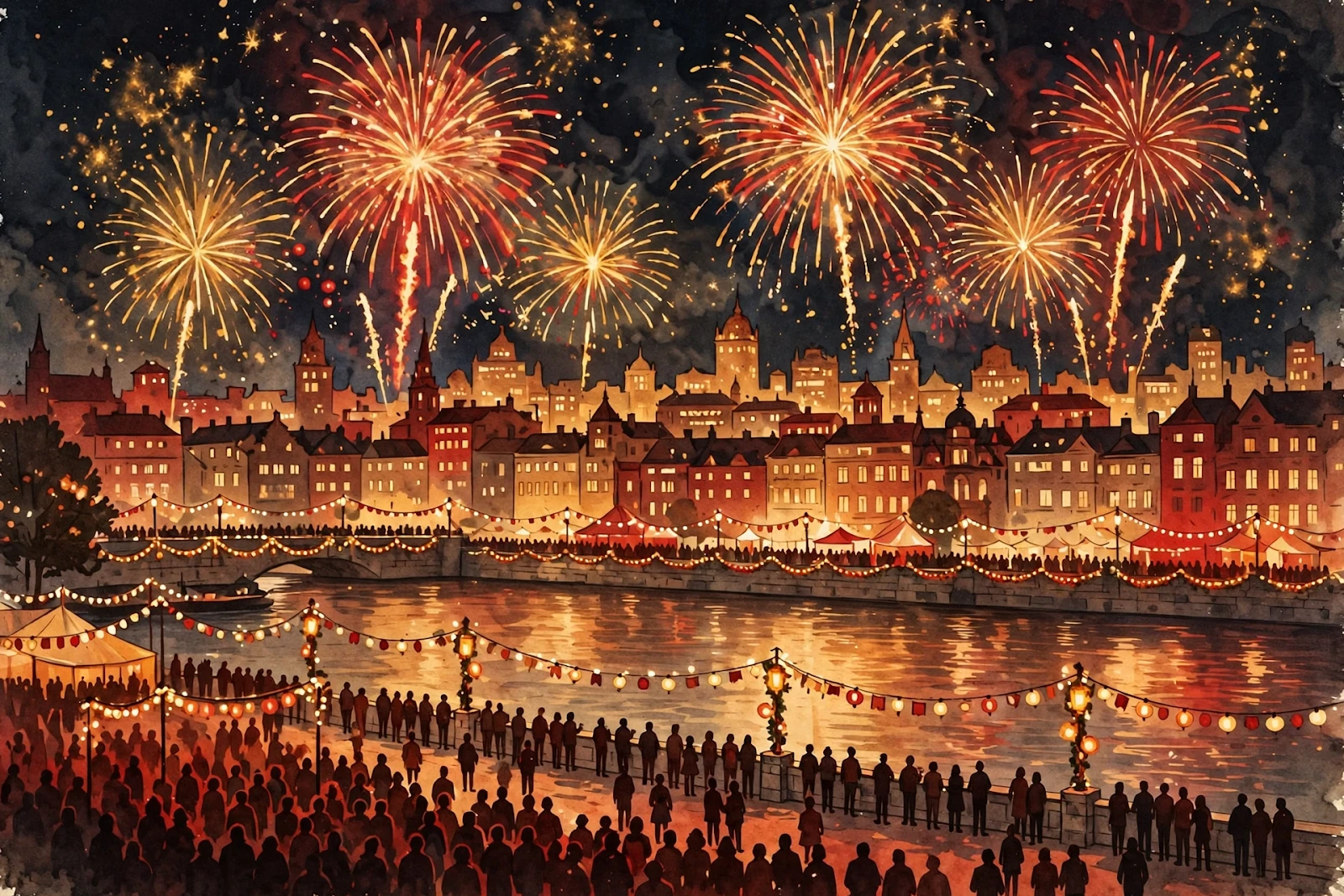
Illustration: Fireworks bursting over a city skyline at night during a festival of lights.
What Happens Next
The celebrations continue in the coming weeks. After the London and Wellington festivals on 25 October, the season builds towards Lakshmi Puja on 8 November, the central night of Diwali, when lamps are lit in homes, temples and public spaces around the world.
In Brussels, the Diwali Festival at the Atomium esplanade, originally planned for October, has been rescheduled to 7 and 8 November 2026 after weather warnings affected the planned weekend, according to the organisers. The tenth edition will feature classical and Bollywood stages, workshops, a Maha Aarti ceremony and fireworks, under the theme "Culture United".
For many families, the most important moments will remain private ones: the lighting of the first diya, the sharing of sweets with neighbours, and the gathering of relatives across generations. This year, for the first time, those private moments take place under a new public honour: Diwali is no longer only a beloved festival, but a festival formally recognised as part of the intangible heritage of humanity.
Sponsored: explore today's featured sponsored offers
FAQ
What is Diwali?
Diwali, also known as Deepavali, is the Festival of Lights, one of the most important celebrations in Hindu tradition, also observed by Sikh, Jain and other communities. It celebrates the triumph of light over darkness, good over evil and knowledge over ignorance.
When was Deepavali added to UNESCO's heritage list?
Deepavali was inscribed on UNESCO's Representative List of the Intangible Cultural Heritage of Humanity on 10 December 2025, at a committee session held in New Delhi.
When is the main Diwali day in 2026?
Lakshmi Puja, the central night of Diwali, falls on 8 November 2026, according to the lunar festival calendar.
Where are the big public Diwali celebrations this weekend?
Diwali at Times Square in New York took place on 24 October 2026, while Diwali on the Square in London's Trafalgar Square and Wellington's Diwali Festival of Lights both take place on 25 October 2026.
What do the diyas lit at Diwali symbolise?
The small clay oil lamps known as diyas symbolise hope, renewal and the welcoming of light into people's lives.
Sources
- UNESCO Representative List of the Intangible Cultural Heritage of Humanity, Deepavali inscription, 10 December 2025
- Diwali on the Square 2026, Trafalgar Square, London, 25 October 2026
- Diwali at Times Square festival, New York, 24 October 2026
- Wellington Diwali Festival of Lights, 25 October 2026
- Brussels Diwali Festival, Atomium esplanade, rescheduled to 7–8 November 2026
Comments
Post a Comment