
THE HAGUE — The Dutch government announced on Wednesday, 28 October 2026, that it will give Ukraine €1.2 billion (about $1.3 billion) in non-military support over the next three years, unveiling the pledge just hours before Ukrainian President Volodymyr Zelenskiy arrived in The Hague for meetings with Dutch leaders.
According to Reuters, which reported the announcement from Amsterdam on 28 October, the package will provide €380 million for reconstruction work in Ukraine next year, followed by around €410 million in each of 2028 and 2029. Part of the money will go into funds that support Dutch companies willing to invest in rebuilding Ukraine, while other parts are intended for urgent repairs to Ukraine's battered energy infrastructure and for the supply of machines to Ukrainian industry. Zelenskiy was expected in the Netherlands on Wednesday afternoon for meetings with Dutch Prime Minister Rob Jetten and other cabinet members, followed by a visit to Dutch King Willem-Alexander, according to Jetten's office.
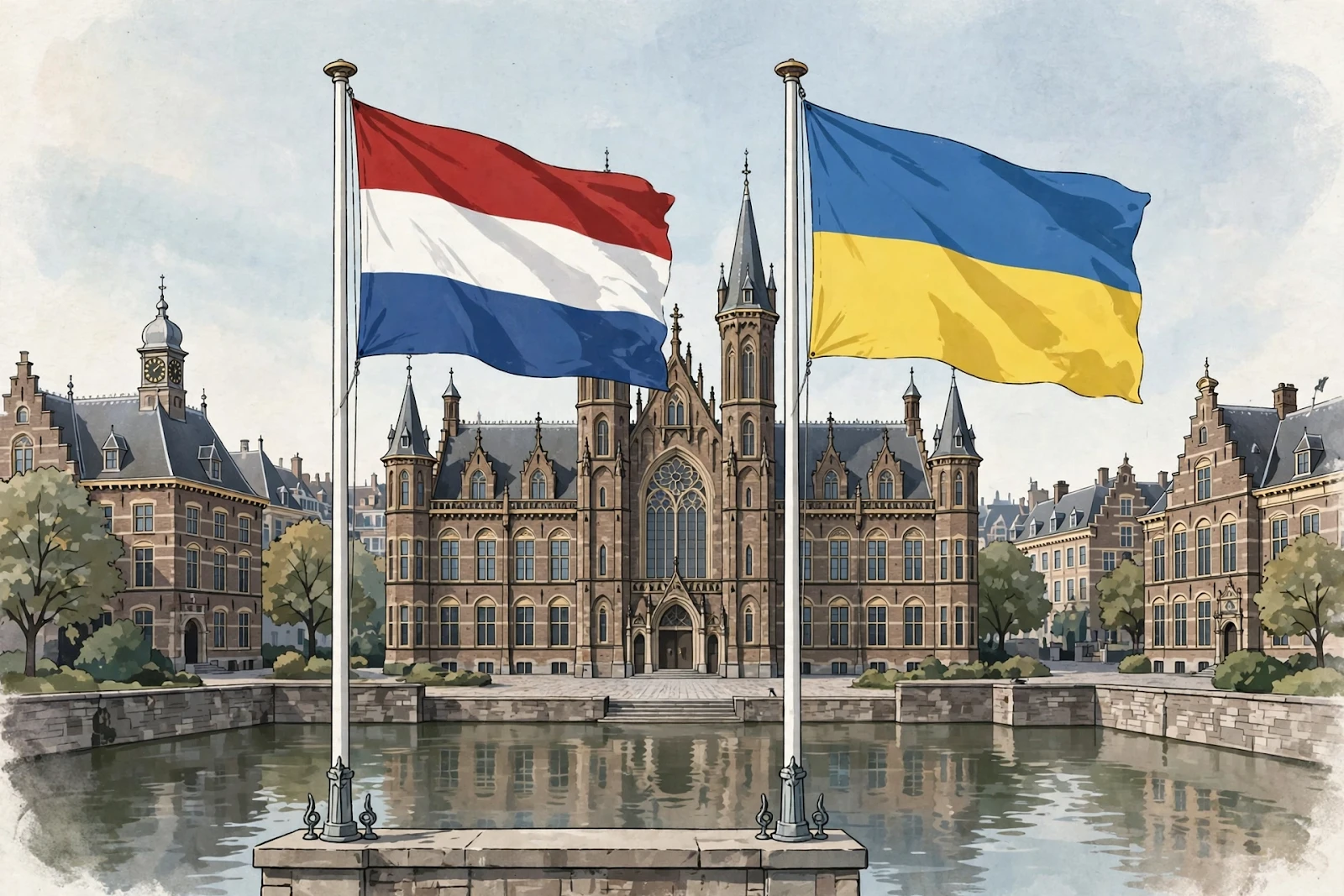
Illustration: The flags of the Netherlands and Ukraine flying side by side in The Hague — an artist's impression, not a photograph of the visit.
What Happened
The announcement was deliberately timed to Zelenskiy's visit. The Dutch government said on Wednesday morning that the €1.2 billion would be non-military support, a distinction that matters because it separates this package from the weapons, ammunition and military equipment the Netherlands has supplied since Russia's full-scale invasion began in February 2022. This money is for rebuilding, not rearming: for homes, power lines, factories and the machinery that keeps an economy running while a war continues.
The breakdown published by the government gives the pledge a concrete shape. Around €380 million is earmarked for next year, with roughly €410 million in each of the two following years. That profile — steady rather than front-loaded — suggests the Dutch government is planning for a long reconstruction effort rather than a single emergency injection. It also gives Dutch companies and Ukrainian partners time to plan projects, apply for funding and build the supply chains that large reconstruction work requires.
Two uses of the money stand out in the government's description. The first is support for Dutch companies willing to invest in Ukraine's rebuilding, channelled through dedicated funds. Reconstruction on Ukraine's scale cannot be delivered by governments alone; it needs private firms willing to build, supply and operate in a country still at war, and governments can lower that risk by sharing costs or guaranteeing investments. The second is urgent repair of energy infrastructure and the supply of machines to Ukrainian industry — both directly tied to keeping Ukrainians warm, lit and employed through another winter of war.
Zelenskiy's itinerary underlined the political message behind the money. Meetings with Prime Minister Jetten and his cabinet put the pledge in the context of government-to-government cooperation, while an audience with King Willem-Alexander gave the visit a formal, state-level weight. Visits like this serve a dual purpose for Kyiv: they secure concrete commitments, and they demonstrate, in public, that European support has not faded even as the war grinds into its fifth year.
Background
The scale of Ukraine's reconstruction challenge is difficult to overstate. A joint assessment by the Ukrainian government, the World Bank, the European Commission and the United Nations, published in February 2026 and known as RDNA5, put the total cost of recovery and reconstruction over the next decade at nearly $588 billion — almost three times Ukraine's projected nominal GDP for 2025. The same assessment found that direct damage to physical assets had already exceeded $195 billion by the end of 2025, and that the country's economy was 21 per cent smaller in real terms than it had been in 2021, before the full-scale invasion.
Within that total, the energy sector alone accounts for roughly $91 billion in reconstruction needs, according to the World Bank assessment, with close to $25 billion in direct damage already recorded. Housing needs are estimated at about $90 billion, with 14 per cent of the country's housing stock damaged or destroyed, affecting more than three million households. Transport needs exceed $96 billion over the decade. These figures explain why a pledge like the Dutch one, while large in absolute terms, is best understood as one contribution among many: no single country can finance Ukraine's rebuilding alone, and the effort will depend on dozens of donors, lenders and private investors acting over many years.

Illustration: Construction workers rebuilding damaged apartment buildings — an artist's impression, not a photograph of reconstruction work in Ukraine.
The Netherlands has been one of Ukraine's most consistent supporters since 2022. According to a statement by the Dutch ambassador to Ukraine published on the Netherlands' official diplomatic site, the country has pledged over €20 billion in military and non-military assistance since 2022. Military support accounts for the larger share: reporting in June 2025 put total Dutch military assistance at around €10 billion, including a €175 million package announced that month for drone-detection radars and medical evacuation vehicles, building on a €500 million deal to produce drones with Ukrainian industry. The new €1.2 billion pledge sits squarely in the non-military column, and it extends a pattern in which Dutch support has moved gradually from emergency military aid towards longer-term economic and reconstruction commitments.
Energy has become one of the most urgent fronts in that reconstruction effort. Russian strikes on Ukraine's power grid, heating plants and gas facilities have been a recurring feature of the war, and each winter brings fresh warnings about blackouts and heating failures. Reporting in October 2026 described near-daily strikes on the energy sector, with hundreds of thousands of families losing power after overnight attacks. Against that background, the Dutch pledge's emphasis on urgent energy repairs is not incidental: it addresses the part of reconstruction that cannot wait for a ceasefire, because people need electricity and heat now, in the middle of the war.
The visit also takes place against a busy diplomatic backdrop. In the same week, European leaders have been engaged in parallel efforts to keep Ukraine's cause on the international agenda, from German Chancellor Friedrich Merz's tour of Asia to fresh rounds of diplomacy around the war. Zelenskiy's trip to The Hague fits that pattern: a working visit designed to convert political sympathy into signed, budgeted commitments, and to remind European publics that reconstruction is already under way, not a distant post-war project.
Why It Matters
The pledge matters first for Ukraine itself. Reconstruction funding announced during wartime has a different value from money promised for after a peace deal: it pays for repairs that keep cities functioning, factories producing and people employed while fighting continues. Energy repairs are the clearest example. A repaired substation or a delivered transformer does not wait for diplomacy; it restores power to homes, hospitals and schools within weeks. The same logic applies to machines for industry: keeping Ukrainian factories running preserves jobs, tax revenue and export capacity, all of which Ukraine will need whenever the war ends.
It matters second for the Netherlands and for Europe's wider reconstruction debate. European governments face competing pressures at home — inflation, energy costs, defence spending — and every new pledge for Ukraine is also a domestic political statement that support will continue. By structuring the money over three years and channelling part of it through funds for Dutch companies, The Hague is making a case that reconstruction support is not only charity but also economic policy: it creates work for Dutch firms, builds commercial relationships in Ukraine and positions Dutch industry for the much larger rebuilding market that will follow any ceasefire.
It matters third as a signal to other donors. Reconstruction pledges tend to come in waves, with each announcement encouraging others to match or exceed it. A €1.2 billion, three-year commitment from a country of the Netherlands' size sets a benchmark, particularly for non-military support, which has historically attracted less attention than weapons deliveries. If other European governments follow with similar multi-year reconstruction packages, the cumulative effect could be substantial — and it could help close the funding gap that Ukraine's own recovery ministry has warned about, with billions still unsecured for priority projects in 2026 alone.
Finally, the timing matters. Announcing the pledge on the day of Zelenskiy's visit, rather than quietly through a budget document, maximises its diplomatic impact. It gives Kyiv a headline to take home, gives The Hague a visible demonstration of solidarity, and gives other capitals a reminder that the reconstruction agenda is moving even while the fighting continues. In a war where attention is a resource, that visibility is part of the point.
What Happens Next
The immediate next step is implementation. The Dutch government will need to spell out how the funds for Dutch companies will operate — which projects qualify, how applications are assessed and how risk is shared — and how the energy repair and industrial machinery components will be delivered. Ukrainian ministries, Dutch agencies and private firms will all be involved, and the pace at which money turns into repaired substations and delivered machines will be the real test of the pledge.

Illustration: Engineers repairing high-voltage power lines at dusk — an artist's impression, not a photograph of energy repair work.
Zelenskiy's visit will also be watched for what else it produces. Bilateral visits of this kind often yield additional agreements — on trade, on justice and accountability for war crimes, on military cooperation — even when the headline pledge is civilian. The Netherlands has been active in efforts to prosecute war crimes and establish accountability mechanisms, and any progress on that front would complement the reconstruction money.
More broadly, the pledge will be measured against Ukraine's enormous needs. The World Bank's $588 billion decade-long estimate means that even generous bilateral packages cover only a fraction of the total, and the debate over how to finance the rest — including the use of frozen Russian assets, international loans and private investment — will continue. The Dutch announcement does not settle that debate, but it adds momentum to it, and it shows that at least one European government is willing to commit multi-year reconstruction money while the war is still being fought.
For Ukrainians, the most important question is simpler: whether the money arrives quickly enough to make a difference this winter. Energy repairs, in particular, are racing against the cold. If the first tranche of Dutch funding translates into equipment on the ground before the worst of winter, the pledge will have done its most urgent job. If it stalls in bureaucracy, it will join a long list of well-intentioned announcements that arrived too late. The coming months will tell which it is.
Sponsored: explore today's featured sponsored offers
FAQ
How much has the Netherlands pledged to Ukraine, and over what period?
According to Reuters on 28 October 2026, the Dutch government pledged €1.2 billion (about $1.3 billion) in non-military support over the next three years: €380 million next year and around €410 million in each of 2028 and 2029.
What will the money be used for?
Part of the money will support Dutch companies willing to invest in rebuilding Ukraine, through dedicated funds. Other parts are intended for urgent repairs to Ukraine's energy infrastructure and for supplying machines to Ukrainian industry, according to the Dutch government as reported by Reuters.
Why did Zelenskiy visit The Hague?
Ukrainian President Volodymyr Zelenskiy visited the Netherlands on Wednesday, 28 October 2026, for meetings with Dutch Prime Minister Rob Jetten and other cabinet members, followed by a visit to King Willem-Alexander, according to Jetten's office as reported by Reuters.
How big is Ukraine's overall reconstruction need?
A joint assessment by Ukraine, the World Bank, the European Commission and the United Nations, published in February 2026, estimated total reconstruction and recovery costs at nearly $588 billion over the next decade, with energy needs of about $91 billion and housing needs of about $90 billion.
Is this pledge military aid?
No. The €1.2 billion is explicitly non-military support, separate from the military assistance the Netherlands has provided since 2022, which reporting in 2025 put at around €10 billion. The new package is for reconstruction, energy repairs and industrial support.
Sources
- Reuters, "Dutch pledge Ukraine reconstruction support as Zelenskiy visits," 28 October 2026 (reporting by Bart Meijer).
- World Bank, European Commission, United Nations and Government of Ukraine, Rapid Damage and Needs Assessment RDNA5, February 2026, as reported by Reuters on 23 February 2026.
- Netherlands and You (Dutch Ministry of Foreign Affairs), Ambassador's statement on Dutch support for Ukraine, 2026.
- FDI Insider, "Netherlands' Drone Deal Elevates Ukraine Support," June 2025, reporting the €175 million package and approximately €10 billion in military assistance since 2022.
Comments
Post a Comment