
LONDON — England has just recorded its wettest week in two years, yet most of the country remains in drought, with reservoirs still far below normal and forecasters warning that months of above-average rain will be needed before the drought can be declared over.
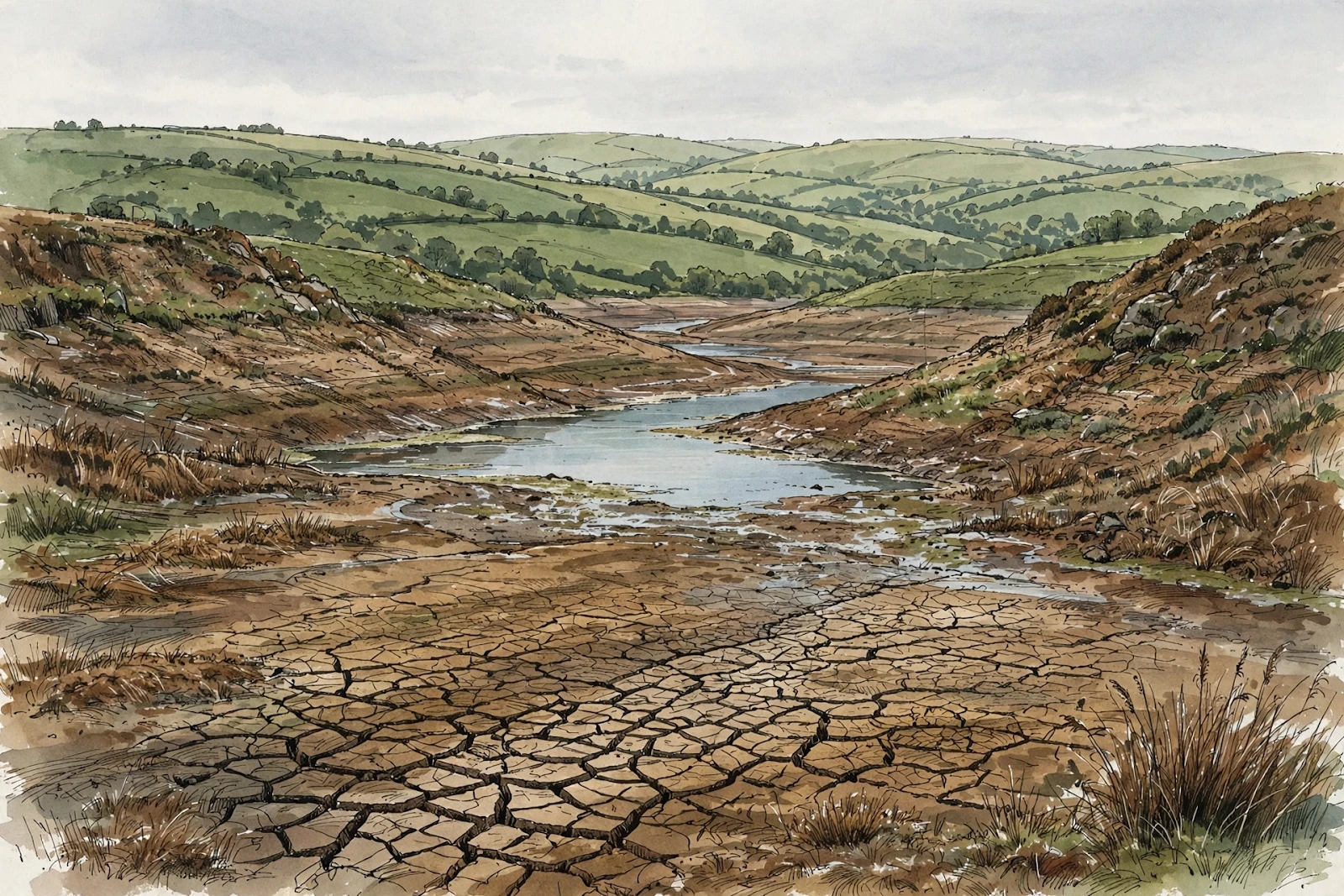
Illustration: A low reservoir in England with exposed banks, as water levels remain far below normal despite a stormy week.
What Happened
Two named storms, Austen and Boelo, swept across England in the week of 23 to 29 October 2026, making it the wettest reporting week across the country since October 2024, according to the Environment Agency. The rain improved river flows and reservoir storage, but the agency was clear that significant water resource pressures remain.
Rainfall for October to date reached 111 percent of the long-term average for England, the agency reported, ranging from 99 percent of the average in central England to 120 percent in the north-west. More than two-thirds of reservoirs or reservoir groups gained storage in the week ending 27 October. Even so, total storage for England stood at just 57.9 percent as of 27 October, 19 percent below average for the time of year.
Ten reservoirs or reservoir groups were still classed as exceptionally low, the agency said, and seventeen reservoirs were less than half full. Only three reservoirs were classed as normal for the time of year, with all others below normal or lower. The BBC reported that Ardingly reservoir in West Sussex was 19 percent full, having risen by only 2 percent after the wet week, while Wimbleball reservoir in Somerset was below 20 percent of its normal capacity.
Severe drought remains in parts of Cornwall, Devon, Dorset, Somerset, East Sussex and West Sussex, according to the Environment Agency, reflecting continued pressure in areas reliant on Ardingly, Wimbleball and several smaller reservoirs in Devon and west Cornwall. There was better news in the north-west: Cumbria and Lancashire, and Greater Manchester, Merseyside and Cheshire, moved from drought to recovery status on 28 October 2026.

Illustration: Cracked dry earth under storm clouds in southern England, where one wet week has not erased months of rainfall deficit.
Background
England's drought is the result of months of dry weather, not a single dry week. The BBC reported that England saw only 10 percent of its average July rainfall, and the Environment Agency noted that soil remains drier than expected for the time of year even after October's rain. Groundwater levels fell at most sites in the latest reporting week, the agency said, because dry soils must become saturated before rainfall can recharge underground resources.
That long build-up explains why a record-breaking week has not ended the drought. Mid-month, around 80 percent of England was in drought, covering around 50 million people, according to reporting of Environment Agency figures. Yorkshire, for example, was moved into drought on 9 October 2026 after one of its driest April-to-September periods on record.
The Environment Agency has said England will need at least 120 percent of average rainfall — at least 20 percent more than average — over the next six months for the entire country to be out of drought by next spring. Anything less risks the drought continuing into next year, with Devon, Cornwall and East Anglia reported to be most at risk. The BBC reported no significant rain in the forecast for at least the next week, with high pressure expected to dominate the opening of November.
Why It Matters
A drought that survives the wettest week in two years matters because it shows how deep the water deficit has become. Reservoirs, rivers and groundwater do not recover on rainfall totals alone: water must soak through dry soils, refill underground aquifers and rebuild storage that was drained over a long, hot summer. Until that happens, water supplies remain under pressure even when the weather turns wet for a few days.
The uneven picture matters too. While the north-west has improved enough to move into recovery, the south remains in severe drought, and the areas most at risk — Devon, Cornwall and East Anglia — face restrictions and environmental stress stretching into 2027 if the winter and spring stay dry. Hosepipe bans remain in force in parts of the country, according to BBC reporting, a visible sign for households that the drought is not over.
Environment Agency chief executive Philip Duffy has said, as reported by the BBC, that drought is only over when rivers, groundwater and reservoirs return to normal levels — a test England does not yet pass.

Illustration: Water conservation in an English garden during drought restrictions, with a watering can and an unused hosepipe.
What Happens Next
The immediate outlook offers little relief. Forecasters expect high pressure to dominate into early November, with little sign of significant or widespread rainfall over the next week and potentially longer.
Over the longer term, the benchmark is clear: England needs sustained, above-average rainfall — at least 120 percent of the average over six months — to be out of drought by spring. The National Drought Group, which brings together government, regulators, the Met Office, water companies and farmers, will keep monitoring river flows, groundwater and reservoir stocks through the winter.
For households, the message is unchanged: water-saving measures and restrictions in the worst-hit areas are likely to stay in place. One stormy week has not ended England's drought — recovery will be measured in months, not days.
Sponsored: explore today's featured sponsored offers
FAQ
Is England still in drought after the wettest week in two years?
Yes. Despite storms Austen and Boelo making the week of 23 to 29 October 2026 the wettest reporting week since October 2024, the Environment Agency says significant water resource pressures remain, with severe drought continuing in parts of the south and total reservoir storage 19 percent below average.
Which reservoirs are lowest?
Ardingly reservoir in West Sussex was reported by the BBC to be 19 percent full, up only 2 percent after the wet week, while Wimbleball reservoir in Somerset was below 20 percent of its normal capacity. Ten reservoirs or reservoir groups were classed as exceptionally low in the Environment Agency's weekly report.
How much rain does England need to end the drought?
The Environment Agency says England needs at least 120 percent of average rainfall — at least 20 percent more than average — over the next six months to be out of drought by next spring.
Has any part of England improved?
Yes. Cumbria and Lancashire, and Greater Manchester, Merseyside and Cheshire, moved from drought to recovery status on 28 October 2026 after the recent rainfall improved conditions there.
Will the drought continue into 2027?
It could, if rainfall falls short. The agency has warned that anything less than the required above-average rainfall over six months risks the drought continuing into next year, with Devon, Cornwall and East Anglia most at risk, and forecasters expect a largely dry start to November.
Sources
- Environment Agency, "Dry weather and drought in England: 23 to 29 October 2026," GOV.UK, October 2026
- BBC News, "Wettest week for two years but still not enough rain to get out of drought," reported 30 October 2026
- The Guardian, "You can see the water going down: residents on edge as one of England's worst-hit reservoirs dries up," 30 October 2026
- Netweather, "Dry days return as the drought continues after October's stormy weekend," 31 October 2026
Comments
Post a Comment