
ESA's Euclid Telescope Found a Comet It Wasn't Looking For: Meet C/2026 S1
October 20, 2026 — The European Space Agency announced on October 19, 2026, that its Euclid space telescope has discovered its first previously unknown comet. Designated C/2026 S1 (Euclid), the object turned up as a faint streak in images taken between September 16 and 24, 2026 — found not by astronomers peering at the sky, but by custom software written by a University of Helsinki researcher. It is a genuine surprise: Euclid was built to map distant galaxies and dark energy, not to chase comets, according to ESA.
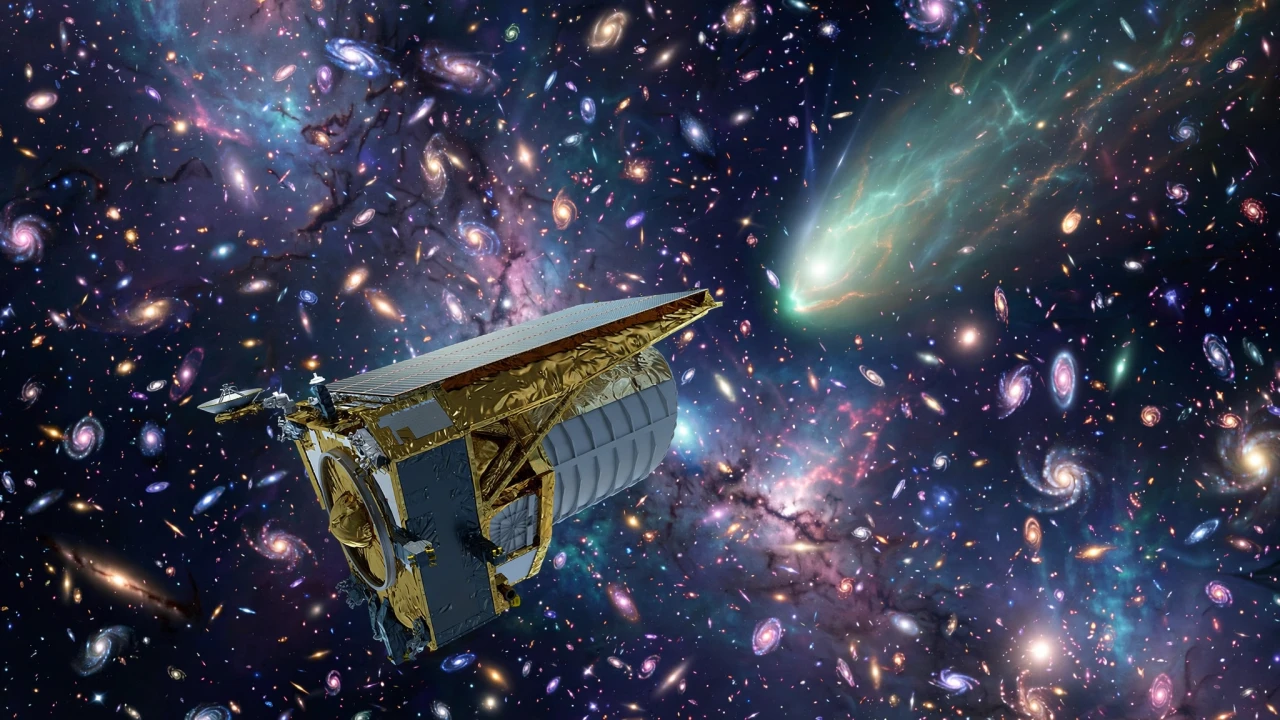
Illustration: ESA's Euclid space telescope as a comet streaks past it among distant galaxies — a discovery the galaxy-mapping mission was never designed to make.
What Happened
The discovery began with a smudge. Mikko Pöntinen, a doctoral researcher at the University of Helsinki working with the Euclid Consortium's Solar System Objects Science Working Group, wrote software to scan Euclid's images for small, fast-moving Solar System objects — a side project on a mission whose day job is photographing billions of distant galaxies. In images from Euclid's Deep Field North survey, taken in the constellation Draco, his program flagged a "streak" smeared across several frames: a nearby body moving during Euclid's long exposures.
By predicting where the object should appear in other frames, Pöntinen tracked it down in five separate image sets across 16 total exposures. A wide-field VIS image captured on September 20, 2026 — a single 560.52-second exposure — shows the object as an elongated streak surrounded by a fuzzy cloud of dust and gas. That cloud, called a coma, is the signature of an active comet shedding material, as opposed to a bare asteroid. "I was excited to see my software flag a 'streak' smeared across several images — the result of a fast-moving object," Pöntinen said, according to phys.org. "By predicting its position I could identify it in other images, in total finding it in five image sets," he added, according to Nanowerk News.
Checks against catalogues of known comets and asteroids found no match, so Pöntinen reported the observations to the International Astronomical Union's Minor Planet Center — the global clearing house for such sightings. Ground-based astronomers contributed follow-up observations, and on October 8, 2026, the center confirmed the object as a new comet. ESA publicly announced the discovery on October 19.
C/2026 S1 (Euclid) sits roughly 1.3 billion kilometers — about 810 million miles — from Earth, placing it approximately between the orbits of Jupiter and Saturn. But it is far outside the planets' plane: seen from the Sun, it hangs almost directly above the Solar System, arcing over the planetary plane on an orbit that will take thousands of years to complete. It is a long-period comet, a pristine visitor from the Solar System's outer reaches.
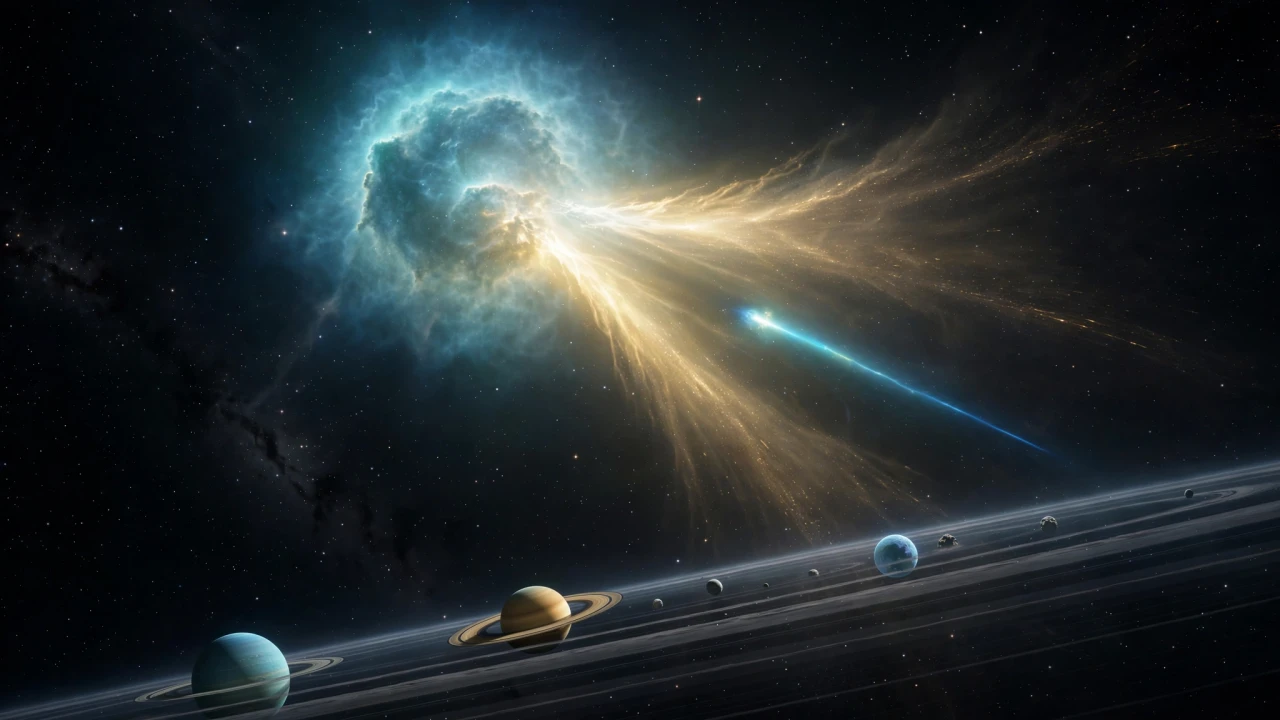
Illustration: Comet C/2026 S1 glowing with a dusty coma as it travels on its thousands-year orbit above the plane of the planets.
Background
Euclid launched with one of the most demanding assignments in astronomy: to map about two billion galaxies, looking up to 10 billion years back in time, to trace how dark energy has stretched the universe and how dark matter has shaped cosmic structure. It is deliberately built for deep, steady imaging of the distant universe. To protect its delicate measurements from dust, Euclid normally avoids the band of sky along the Solar System's plane — exactly where comets and asteroids are most likely to lurk. It also usually photographs each patch of sky only once, giving fast-moving objects little chance to leave a trail.
C/2026 S1 slipped through all those filters because its orbit arches steeply up and over the Solar System instead of following the planetary plane. The comet simply wandered through Euclid's Deep Field North field of view during the September imaging campaign. "Very few comets are expected to be discovered by Euclid so it was a happy coincidence that the combination of the comet's orbit and Euclid's scanning over those days captured the object in multiple images," said Dr. Bruno Altieri, Euclid archive scientist, according to the Discovery Wire.
Long-period comets like this one are scientific time capsules. Thought to originate in the Solar System's outer fringes, they carry largely pristine material left over from the formation of the planets, largely unchanged for billions of years. Studying them offers clues to the conditions of the early Solar System — which is why spotting one this far from the Sun, while it is still relatively inactive, is particularly valuable.
Why It Matters
The find demonstrates an underappreciated superpower of modern astronomy: big-data serendipity. Euclid's images were taken for cosmology, yet they contained a brand-new comet — found because one researcher wrote software to ask a question the mission never intended to answer. As survey telescopes produce ever-larger datasets, dedicated "moving object" pipelines are becoming a standard way to extract bonus science from observations taken for other purposes.
It also shows that Euclid can detect new comets while they are still relatively far from the Sun. That capability matters for mission planning: ESA's future Comet Interceptor mission, which will use three spacecraft to study a pristine comet, is planned for launch in late 2028 or early 2029 and will need a suitable target. Euclid's early-warning ability could help supply one, ESA noted in its announcement.
More broadly, the discovery is a reminder that the Solar System is still full of surprises even in the age of comprehensive sky surveys. A spacecraft designed to study dark energy, photographing one patch of sky for cosmology, casually captured an object that takes thousands of years to circle the Sun — an object no human had ever seen before.
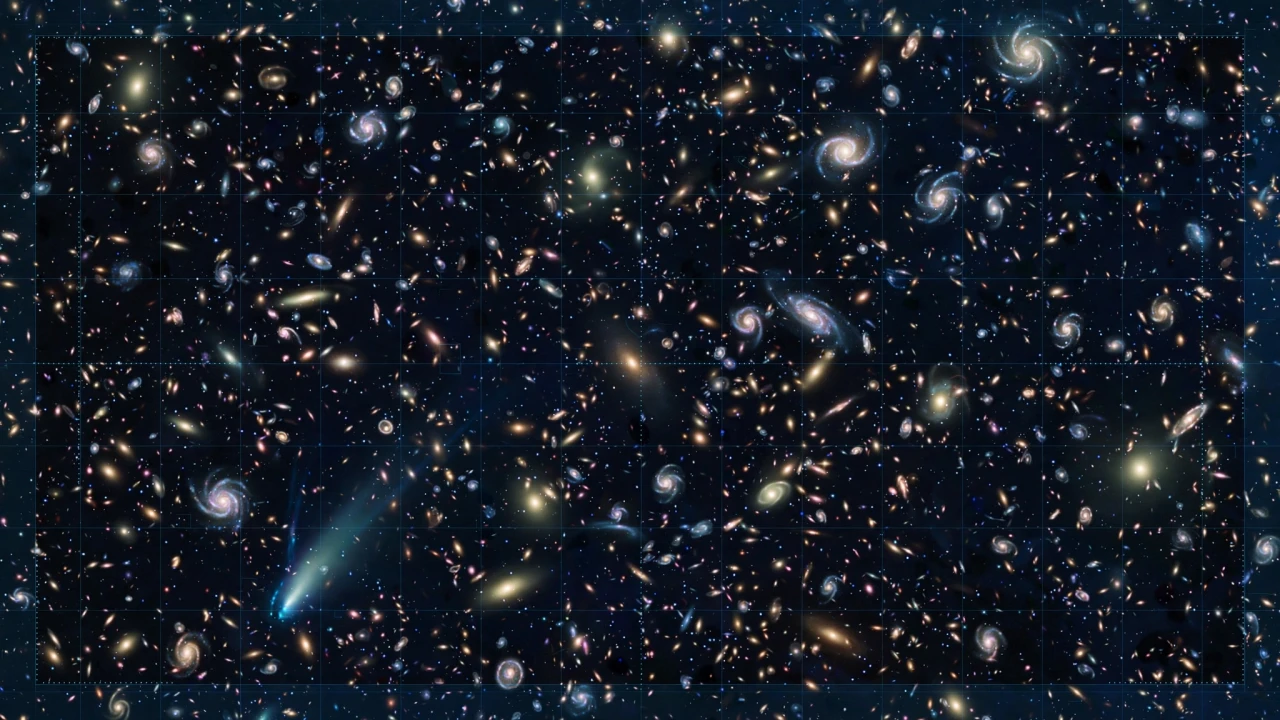
Illustration: A Euclid deep-field survey packed with distant galaxies, where automated software flagged the faint streak of the new comet among the stars.
What Happens Next
The comet's story is just beginning:
- Orbit refinement: Astronomers will continue observing C/2026 S1 to pin down its orbit and orbital period, which is currently estimated only roughly at thousands of years.
- Comet Interceptor candidacy: ESA says the quick turnaround between identification and validation proves Euclid could supply targets for the future Comet Interceptor mission — watch for C/2026 S1 or similar finds to enter the shortlist.
- More Euclid surprises: Pöntinen's software and the Solar System Objects Science Working Group will keep scanning Euclid's flood of images; archive scientist Bruno Altieri's comments suggest more serendipitous finds are possible, if rare.
- Ground-based follow-up: Telescopes on Earth will keep tracking the comet as it continues its slow journey, gradually refining our picture of its size, composition, and path.
- No public skywatching: At 1.3 billion kilometers away, C/2026 S1 is not a naked-eye target — this is a discovery for the telescopes, not the headlines' night sky.
Sponsored: explore today's featured sponsored offers
FAQ
What is C/2026 S1 (Euclid)?
It is a newly discovered long-period comet — the first previously unknown comet found in data from ESA's Euclid space telescope. It sits roughly 1.3 billion kilometers (about 810 million miles) from Earth, between the orbits of Jupiter and Saturn, and takes thousands of years to complete one orbit, according to ESA and phys.org.
How was it discovered?
Mikko Pöntinen, a doctoral researcher at the University of Helsinki working with the Euclid Consortium's Solar System Objects Science Working Group, wrote moving-object detection software that flagged a "streak" smeared across Euclid images taken September 16-24, 2026. A fuzzy cloud (coma) around the object identified it as an active comet. The IAU Minor Planet Center confirmed it as a new comet on October 8, 2026.
Why is it surprising that Euclid found a comet?
Euclid was built to map about two billion distant galaxies to study dark energy and dark matter — not to chase comets. It deliberately avoids the comet-rich band of sky along the Solar System's plane and usually photographs each sky patch only once. The comet was only captured because its steep, high-arched orbit carried it through Euclid's field of view during the Deep Field North survey.
Can I see the comet in the night sky?
No. At roughly 1.3 billion kilometers away, C/2026 S1 is far too distant and faint to be a naked-eye target. The discovery was made from spacecraft images and follow-up telescope observations, not casual skywatching.
Why does this discovery matter for future missions?
ESA says the quick turnaround between identifying and validating the comet proves Euclid can detect new comets while they are still relatively far from the Sun — potentially supplying targets for ESA's future Comet Interceptor mission, a three-spacecraft mission planned for launch in late 2028 or early 2029 to study a pristine comet.
Sources
- European Space Agency, "Euclid discovers its first new comet," esa.int, October 19, 2026
- Phys.org, "Euclid discovers its first new comet 810 million miles from Earth," October 19, 2026
- Nanowerk News, "Euclid discovers new comet," October 19, 2026
- International Astronomical Union Minor Planet Center, confirmation of C/2026 S1 (Euclid), October 8, 2026
Comments
Post a Comment