
PARIS, 27 October 2026 — The European Space Agency has ordered four additional Galileo Second Generation navigation satellites, expanding Europe's planned next-generation positioning fleet from 12 to 16 spacecraft and extending a programme that will underpin satellite navigation across the continent into the 2030s. The agency announced the contract extensions on Tuesday, 27 October 2026, acting on behalf of the European Commission.
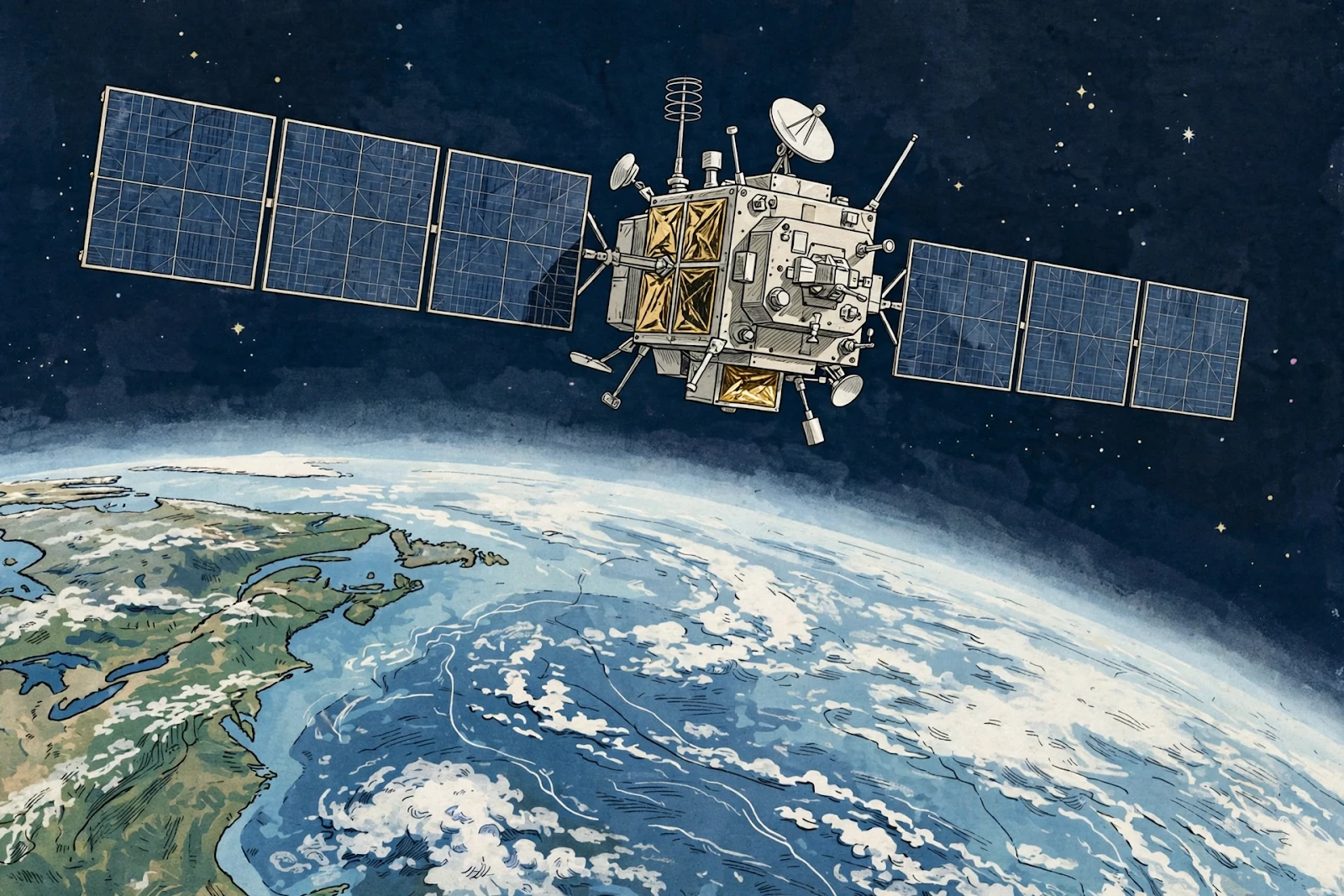
Illustration: A navigation satellite with extended solar panels orbiting above Earth.
What Happened
Under the extensions, Airbus Defence and Space and Thales Alenia Space will each build two additional Galileo Second Generation, or G2G, satellites. Thales Alenia Space Italy signed its contract extension on Friday, 23 October, while Airbus Defence and Space Germany finalised its agreement on Monday, 26 October, according to reports of the announcement. Neither ESA nor the contractors disclosed the financial value of the additions.
The four supplemental spacecraft will share the same technical baseline as the initial 12 G2G platforms. That includes full electric propulsion systems, enhanced digital navigation payloads, and inter-satellite links designed to improve the accuracy of the constellation's orbital data. The satellites are configured for launch aboard Europe's heavy-lift Ariane 6 rocket, using dual-launch dispensers to deploy pairs of satellites into medium Earth orbit.
The four newly contracted satellites are scheduled for delivery in 2031, following the deployment of the initial 12 G2G satellites, whose launches on Ariane 6 are slated to begin in 2028. The expanded fleet is intended to provide a seamless operational bridge as legacy first-generation Galileo satellites reach the end of their service lives, ensuring that the navigation service continues without a gap.
Procuring four identical spacecraft across two independent prime contractors is also a deliberate industrial choice. By maintaining dual assembly lines, the European Commission hedges against manufacturing bottlenecks and technical problems on any single line, while ensuring long-term continuity for civilian, commercial and secure governmental positioning signals across the European Union. Reports of the announcement describe this as reinforcing European strategic autonomy: the ability to build, launch and operate a critical navigation system without depending on a single supplier or a single foreign system.
Background
Galileo is Europe's civilian global navigation satellite system, the counterpart to the United States' GPS, Russia's GLONASS and China's BeiDou. Its signals are used, often invisibly, in smartphones, cars, aircraft, ships, farm machinery, financial timestamping and emergency services. A phone that shows a blue dot on a map in Europe is frequently combining signals from several of these constellations at once, and Galileo's contribution has grown steadily since the system began offering services.
The contract extensions build directly on industrial awards finalised in 2021, when ESA committed 1.47 billion euros across Airbus and Thales Alenia Space for the initial batch of 12 G2G spacecraft. That framework set up parallel manufacturing tracks, with Galileo Second Generation entering its full development phase, followed by Airbus commencing serial satellite production in Germany alongside Thales Alenia Space's integration lines in Italy. The newly exercised options extend those existing lines rather than starting a new competition, which is why the two contractors could sign their extensions within days of each other in late October.

Illustration: Engineers in clean-room suits assembling a satellite in a bright factory hall.
Second-generation satellites are not simply replacements for the first generation. Their enhanced digital navigation payloads are designed to be more flexible, allowing signals and services to be reconfigured more easily over the satellites' lifetimes. Inter-satellite links let spacecraft exchange data directly with each other, rather than relying solely on ground stations, which can improve the precision of the orbital information broadcast to users. Full electric propulsion, meanwhile, changes how satellites reach and maintain their orbits: electric thrusters are far more fuel-efficient than chemical rockets, though they produce much lower thrust, so orbit-raising takes longer but leaves more mass available for payloads and extends operational life.
The choice of Ariane 6 as the launch vehicle is equally significant. Europe's heavy-lift rocket is the continent's independent route to orbit, and pairing two G2G satellites on a single dual-launch dispenser is an efficient way to populate a medium Earth orbit constellation, which sits far above low Earth orbit broadband constellations but far below geostationary orbit. Each launch therefore adds a meaningful increment of capability, and the sequence of launches planned from 2028 onward will gradually replace ageing first-generation spacecraft while adding the new services that second-generation payloads enable.
Navigation constellations are long-lived infrastructure, and that timescale explains why decisions taken in 2026 concern deliveries in 2031. A satellite ordered today must be designed, built, tested, launched and commissioned before it can serve users, and the constellation as a whole must be planned so that enough healthy satellites are always in orbit. Ordering four more spacecraft now, while the first twelve are still in production, keeps the production lines warm, preserves skilled teams, and avoids a gap in which the fleet would slowly shrink as older satellites retire.
Why It Matters
Satellite navigation has become so routine that its strategic importance is easy to overlook. When a navigation signal is degraded or denied, the effects ripple far beyond a lost driver: aircraft navigation, shipping, precision agriculture, power-grid synchronisation and emergency response all depend on precise timing and positioning. Owning and operating an independent constellation gives Europe a measure of insurance against disruption to any single system, and the dual-contractor approach extends that insurance into manufacturing itself.
The expansion from 12 to 16 second-generation satellites also matters for service quality. More satellites in view means better geometry for a receiver calculating its position, which translates into more accurate and more reliable fixes, particularly in difficult environments such as cities with tall buildings or mountainous terrain. The inter-satellite links and digital payloads of the second generation are intended to push that accuracy further, and to make the system more resilient to interference and spoofing, a growing concern as navigation signals become a target for hostile actors.
There is an industrial story here too. Large space contracts sustain specialised workforces in Germany, Italy and across the European supply chain, from propulsion and electronics to testing and launch operations. By exercising options on existing contracts rather than reopening competition, ESA and the Commission are signalling continuity for those teams, while the undisclosed value of the additions leaves the precise scale of that support unquantified in public reporting. What is clear is the direction: Europe is investing to keep its navigation capability sovereign, modern and continuously available, rather than treating the first generation as a finished job.
The timing also fits a wider pattern in European space policy, in which autonomy has moved from aspiration to procurement. Galileo itself was born from a decision that Europe should not rely solely on a military-controlled foreign system for a civilian necessity. The second generation, and now its expansion to 16 satellites, extends that original decision into a new technological era, in which navigation, Earth observation and secure communications are increasingly treated as critical infrastructure on a par with energy and transport networks.
What Happens Next
The immediate next step is production. Airbus in Germany and Thales Alenia Space in Italy will build the four additional spacecraft alongside the initial twelve, with delivery of the new batch scheduled for 2031. Before then, the first G2 satellites are slated to begin launching on Ariane 6 in 2028, and those early launches will be the first real-world test of the second-generation design in orbit, including its electric propulsion, digital payloads and inter-satellite links.
Users are unlikely to notice a single launch, and that is the point. Constellation renewal is designed to be seamless: new satellites join the fleet, older ones are retired, and the signals in a phone or a tractor cab keep working. Over time, however, the cumulative effect should be visible in the form of more accurate positioning, more robust services, and new capabilities that second-generation payloads make possible. ESA and the Commission have not, in the reported announcement, detailed which new services will be introduced first, and that sequencing will become clearer as the first launches approach.
The broader question is how Galileo's expansion interacts with the crowded orbital environment of the 2030s. Medium Earth orbit is far less congested than low Earth orbit, but launch cadence, space debris management and spectrum coordination all remain live issues for every constellation operator. For now, the October announcement answers the most basic question: Europe intends its navigation fleet to grow, not shrink, and it has placed the orders to make that happen.

Illustration: A heavy-lift rocket lifting off carrying navigation satellites toward orbit.
Sponsored: explore today's featured sponsored offers
Frequently Asked Questions
What is Galileo?
Galileo is Europe's civilian global navigation satellite system, comparable to the United States' GPS. Its signals are used in smartphones, vehicles, aircraft, ships, agriculture, finance and emergency services across Europe and beyond.
What did ESA announce on 27 October 2026?
ESA announced contract extensions with Airbus Defence and Space and Thales Alenia Space for four additional Galileo Second Generation satellites, two from each company, expanding the planned next-generation fleet from 12 to 16 spacecraft.
When will the new satellites launch?
The four additional satellites are scheduled for delivery in 2031, after the initial 12 second-generation satellites, whose launches on Ariane 6 are slated to begin in 2028. All dates are planned targets, not completed launches.
What is new about second-generation Galileo satellites?
They feature full electric propulsion, enhanced digital navigation payloads that can be reconfigured more flexibly, and inter-satellite links that let spacecraft share data directly, improving orbital accuracy and service resilience.
Why build the satellites with two companies instead of one?
Using two independent prime contractors maintains dual assembly lines, hedges against manufacturing bottlenecks or technical problems on a single line, and supports European strategic autonomy in a critical navigation infrastructure.
Sources
- SatNews, "ESA Orders Four Additional Galileo Second Generation Satellites From Airbus and Thales," 27 October 2026.
- European Space Agency announcement, 27 October 2026, as reported by SatNews.
Comments
Post a Comment