
The European Space Agency's Hera spacecraft has successfully slammed on the brakes. On October 15, 2026, Hera fired its thrusters continuously for 93 minutes — its first major braking maneuver — to slow down for a November rendezvous with the Didymos–Dimorphos binary asteroid system, the scene of humanity's first deliberate asteroid-deflection experiment. ESA confirmed on October 16 that the burn, designated BRM-1, performed within its required parameters, setting up a second braking firing scheduled for October 22.
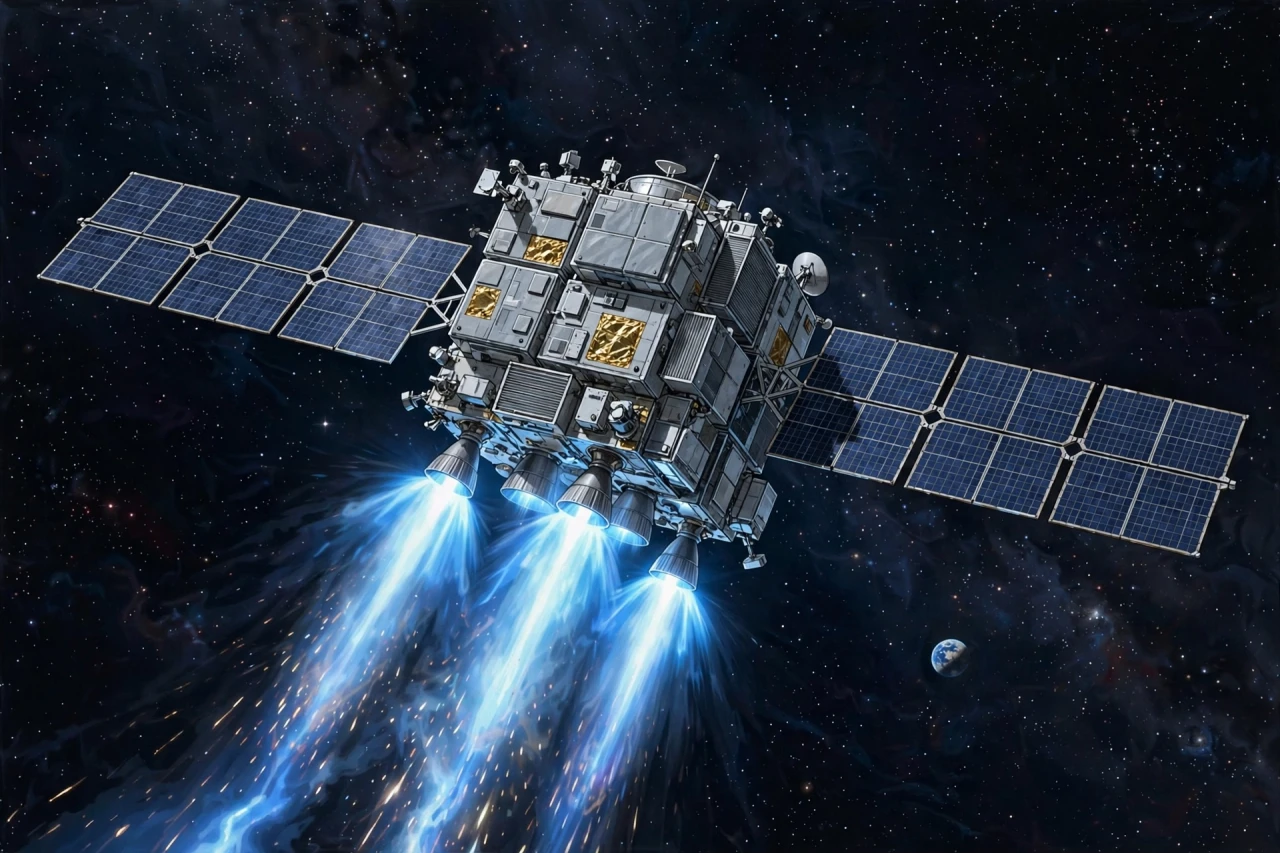
Illustration: ESA's Hera spacecraft firing its thrusters during the braking maneuver in deep space. This is an AI-generated illustration, not a real scene.
What Happened
Hera executed the first of its two core braking burns, BRM-1, on October 15, 2026. According to ESA's mission account, as reported by NeoTeo, the spacecraft rotated so that its ring of Orbit Control Thrusters faced toward the Didymos system, then fired three hydrazine-based thrusters continuously for 93 minutes. Reaction Control Thrusters fired intermittently during the burn to keep the spacecraft correctly oriented.
The goal was to reduce Hera's velocity relative to the Didymos asteroid system by a few hundred meters per second — a delicate adjustment needed so the spacecraft can match the asteroids' motion and arrive safely. ESA assessed the burn using telemetry, guidance and navigation measurements, ranging data and Doppler observations, and confirmed on October 16 that it had performed within required parameters.
The next maneuver, BRM-2, is scheduled for October 22, 2026 — a planned 31-minute burn that, according to ESA's schedule, will complete most of the remaining velocity adjustment and compensate for any shortfall in the first firing. Three smaller transition maneuvers are expected toward the end of October to fine-tune the trajectory for arrival.
Background
Hera is a planetary-defense mission — Europe's follow-up to one of the most dramatic experiments in spaceflight history. In September 2022, NASA's Double Asteroid Redirection Test (DART) spacecraft deliberately slammed into Dimorphos, a roughly 160-meter moonlet orbiting the larger asteroid Didymos, at about 6.1 kilometers per second (nearly 22,000 kilometers per hour). The impact shortened Dimorphos's orbital period around Didymos from 11 hours and 55 minutes to approximately 11 hours and 22–23 minutes, as measured by ground-based telescopes.
That proved the concept: a spacecraft can be used to deflect an asteroid. But DART was only the first half of the experiment. No spacecraft was present to observe the impact up close, so fundamental questions remain — how extensively did the collision alter Dimorphos's structure, how much momentum was actually transferred, and what does the crater look like? Ground observations gave the headline number; the forensic detail is still missing.
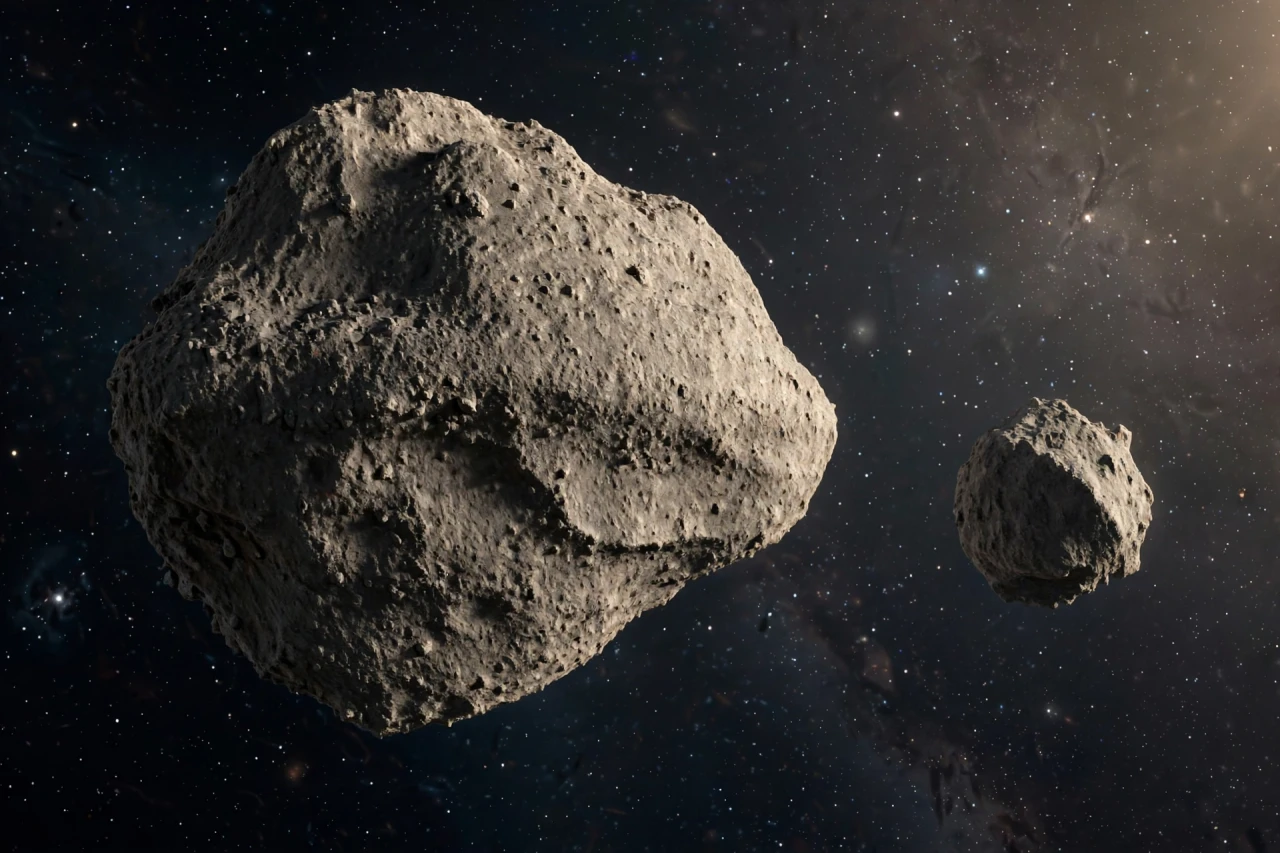
Illustration: the binary asteroid system Didymos and its moonlet Dimorphos, Hera's destination. This is an AI-generated illustration, not a real scene.
The braking sequence now underway is the most demanding in-flight activity Hera has attempted since liftoff. The two core burns plus the smaller transition maneuvers must together erase the spacecraft's excess speed with centimeter-level precision; any significant shortfall would leave Hera unable to match the asteroids' motion, while an overshoot would waste propellant needed for the months of close-up operations ahead. ESA's flight dynamics team planned the sequence so that BRM-2 can correct for deviations measured in BRM-1's telemetry, giving the mission two chances to nail the approach.
The spacecraft carries two specialized CubeSats, Milani and Juventas, which will be deployed on arrival to perform high-resolution mapping and radar soundings probing the asteroids' interior and surface structure. Together, the data will turn DART from a successful demonstration into a validated, repeatable technique.
Why It Matters
Planetary defense is one of the few areas of space science where the stakes are civilization-scale. Astronomers estimate that asteroids large enough to devastate a region strike Earth every few thousand years, and city-killers every few centuries. DART showed that kinetic deflection works in principle; Hera will show how well it works in practice — the efficiency of momentum transfer is the number that future deflection missions will be designed around.

Illustration: NASA's DART spacecraft striking Dimorphos in 2022 — the impact Hera will now investigate up close. This is an AI-generated illustration, not a real scene.
The mission also matters as a model of international space cooperation. DART was NASA's; Hera is ESA's; the two were designed from the start as a transatlantic pair — NASA's impactor and Europe's investigator. The coordination between the agencies on the braking sequence, arrival geometry and data sharing shows how planetary defense, by its nature, demands a global approach: an asteroid does not check passports before it enters the atmosphere.
And there is pure science in the mix. Didymos and Dimorphos are a binary pair — a large fraction of near-Earth asteroids turn out to be binaries, and understanding how such systems hold together, how rubble-pile asteroids respond to impacts, and what their interiors look like feeds directly into models of solar-system formation as well as defense planning.
What Happens Next
The immediate milestone is BRM-2 on October 22, 2026 — the shorter, 31-minute burn that completes most of the velocity matching. Three smaller transition maneuvers follow toward the end of October, bringing Hera's relative velocity with respect to the asteroids to nearly zero.
Then comes arrival in November. Hera will first characterize the Didymos system from a distance, then move in for close-up observations of Dimorphos, deploying the Milani and Juventas CubeSats for their mapping and radar missions. The detailed survey phase is expected to run for months, gradually building the three-dimensional picture of the impact site that DART could never provide.
If the rendezvous goes to plan, Hera's data will complete the first full loop of planetary defense: detect a threat (Dimorphos was never a threat, but it was a stand-in), hit it (DART), and measure exactly what happened (Hera). The next time astronomers find a real asteroid on a collision course, the playbook will be ready.
Sponsored: explore today's featured sponsored offers
FAQ
What is the Hera mission?
Hera is the European Space Agency's planetary-defense spacecraft, launched in October 2024, sent to investigate the Didymos–Dimorphos binary asteroid system — the target of NASA's 2022 DART asteroid-deflection test.
What was the BRM-1 braking maneuver?
On October 15, 2026, Hera fired three hydrazine thrusters continuously for 93 minutes to reduce its velocity relative to the Didymos system by a few hundred meters per second. ESA confirmed on October 16 that the burn, designated BRM-1, performed within its required parameters.
When will Hera arrive at the asteroids?
Hera is scheduled to arrive at the Didymos–Dimorphos system in November 2026, after a second braking burn (BRM-2) on October 22 and three smaller transition maneuvers later in the month.
What did the DART impact actually do?
In September 2022, NASA's DART spacecraft struck the 160-meter moonlet Dimorphos at about 6.1 km/s, shortening its orbital period around Didymos from 11 hours 55 minutes to roughly 11 hours 22–23 minutes. Hera's job is to measure the impact's structural effects in detail.
What are the Milani and Juventas CubeSats?
Two small companion spacecraft Hera will deploy on arrival. According to ESA's mission plan, they will perform high-resolution mapping and radar soundings to probe the asteroids' interior and surface structure — data essential for validating asteroid-deflection techniques.
Sources
- European Space Agency mission account (via NeoTeo) — "ESA confirms Hera completed its first braking maneuver" (October 16, 2026)
- NeoTeo — "Hera's planned 93-minute asteroid braking maneuver" (October 7, 2026)
- EarthSky — "Hera mission hits the brakes to arrive at asteroid" (October 2026)
- ESA — Hera mission plan and DART follow-up objectives
Comments
Post a Comment