
EU Calls Western Balkans Leaders to Brussels Summit on November 25 as Enlargement Push Gains Momentum
BRUSSELS, Oct 23 — European Union leaders will gather with their Western Balkans counterparts in Brussels on November 25 for a summit meant to reaffirm the region's path toward EU membership, the European Council announced on Friday. The meeting will be the latest step in a renewed enlargement push that Brussels calls a "crucial geopolitical investment" for the continent.
Illustration: European Union flags with gold stars flying in front of a modern government headquarters building in Brussels
What Happened
The European Council announced the summit in a press release published on October 23, 2026, at 10:00 CET. EU and Western Balkans leaders will meet in Brussels on November 25, with the President of the European Council representing the EU alongside the President of the European Commission.
The summit, the announcement said, "will highlight the strategic importance of the relations between the EU and the Western Balkans" — diplomatic language for a relationship Brussels now frames as central to European security. European Council President António Costa was quoted directly: "The Western Balkans's future is in the European Union. Their accession is our priority, our shared ambition and a crucial geopolitical investment in these turbulent times. The EU is and will remain the most reliable partner of the region."
According to the Council's release, the summit will serve several purposes: reaffirming the EU's commitment to the membership perspective of the six Western Balkan partners — Albania, Bosnia and Herzegovina, Kosovo, Montenegro, North Macedonia and Serbia — encouraging them to accelerate decisive reforms and deliver on the commitments needed to advance toward the EU, assessing progress in their gradual integration through the Growth Plan for the Western Balkans, and discussing how to advance that plan further.
Leaders will also, the release said, "examine common challenges and ways to strengthen security and resilience amid an increasingly complex geopolitical landscape" — a nod to the region's exposure to foreign influence campaigns, organized crime and the lingering effects of past conflicts.
Illustration: diplomats shaking hands around a round summit table with small European and Balkan national flags in a bright conference hall
Background
Regular EU–Western Balkans summits have been held since 2018, and the November meeting is the latest in a quickening sequence. The most recent leaders' summit took place in Tivat, Montenegro, in June 2026, and between June 1 and 4, President Costa travelled across the region, meeting the leaders of the Western Balkan partners to discuss enlargement, gradual integration, regional cooperation, security and stability, according to the Council's background notes.
The summit forms part of the implementation of the European Council's 2024–2029 strategic agenda, which elevated enlargement from a slow bureaucratic process to a stated geopolitical priority. The shift reflects a broader European reckoning: after Russia's full-scale invasion of Ukraine, Brussels concluded that leaving its southeastern neighbors in a gray zone of delayed accession was a strategic liability — an invitation to rival powers to fill the vacuum.
The Western Balkans have been waiting a long time. North Macedonia and Albania opened accession negotiations in 2022; Montenegro and Serbia have been negotiating for over a decade; Bosnia and Herzegovina was granted candidate status in 2022; Kosovo applied for membership in 2022. Progress has been uneven, slowed by bilateral disputes, governance concerns and reform fatigue on both sides.
The Growth Plan for the Western Balkans, which the summit will review, is the EU's attempt to break the logjam: a package tying financial support and gradual access to parts of the EU's single market to concrete reform milestones. The idea is to give citizens tangible benefits of integration — faster payments, fewer roaming charges, access to EU programs — before full membership arrives, sustaining public support for a process that has stretched across generations.
The summit also lands in a busy diplomatic season. Just this week, the OSCE Secretary General participated in the Berlin Process Leaders' Summit in Budva, Montenegro, where regional cooperation and shared challenges were discussed — a reminder that the Western Balkans sit at the intersection of multiple diplomatic tracks, European and otherwise.
Why It Matters
Enlargement is the EU's most powerful foreign policy tool, and the Western Balkans are its most immediate test. Every year of delay risks deepening public disillusionment in the region, where support for EU membership has wavered as the accession process has dragged on. A summit that produces credible momentum — not just communiqués — matters for the EU's standing in its own neighborhood.
Costa's language of "geopolitical investment" is deliberate. The region has been a theater of competing influence: Russia's historical and cultural ties, China's infrastructure financing, and the Gulf states' growing economic presence. Brussels' argument is that only the EU offers what the region's citizens consistently say they want — the rule of law, economic opportunity and the freedom to live, work and study across Europe.
The summit also matters for the EU itself. Enlargement changes the Union: new members bring new votes, new veto points and new budget demands. Member states that are enthusiastic in principle — particularly those on the EU's eastern flank — must still agree on the terms, and the November meeting will be watched in capitals from Paris to Warsaw for signals about how far and how fast Brussels is prepared to go.
Finally, there is the reform bargain at the heart of every enlargement summit. The EU wants accelerated reforms on the rule of law, corruption, media freedom and electoral standards; the Balkan partners want credible timelines and visible rewards. Whether the Brussels meeting narrows that gap — through the Growth Plan, through political commitments, or through both — will determine whether November 25 is remembered as a turning point or another photo opportunity.
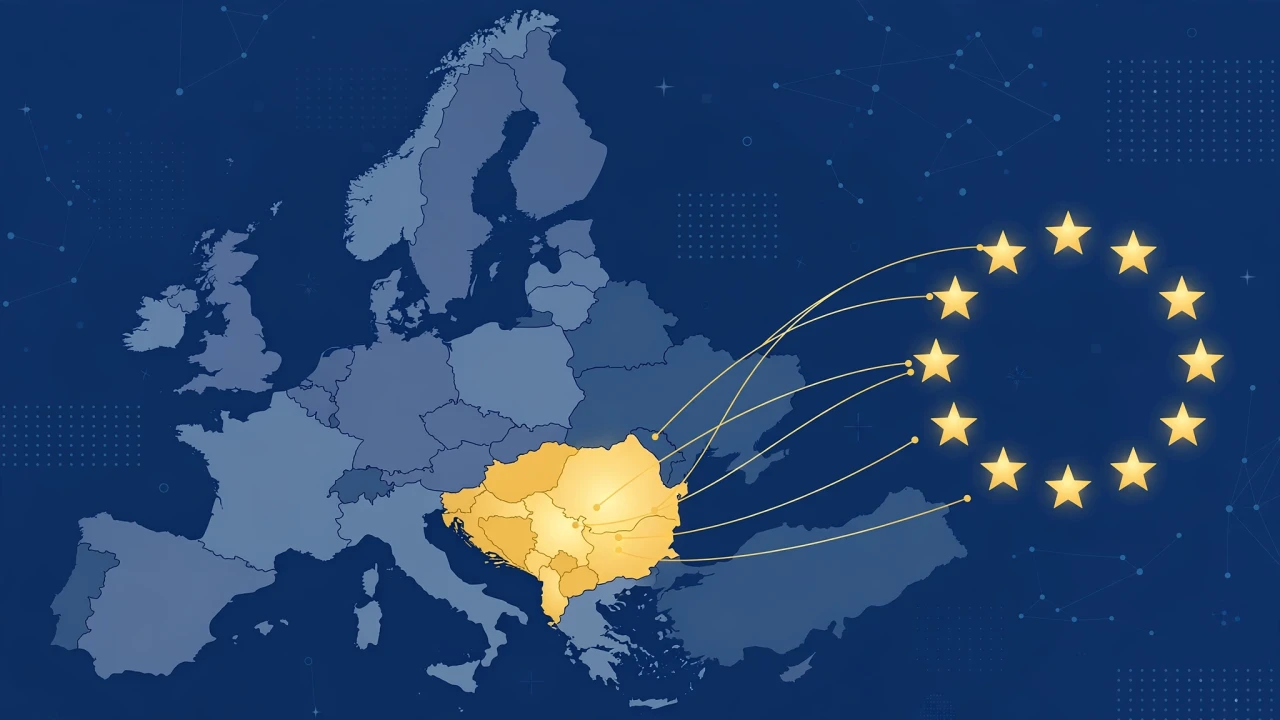
Illustration: a stylized map of Europe with the Western Balkans highlighted in gold and connected to a circle of EU stars
What Happens Next
The summit takes place in Brussels on November 25, a little over a month away. In the run-up, expect a flurry of preparatory diplomacy: foreign ministers' meetings, progress assessments from the European Commission, and bilateral visits as both sides position themselves for the leaders' table.
The key deliverables to watch are the Growth Plan review — will leaders agree on how to advance it, and with what money? — and any new political commitments on accession timelines. Watch also for language on security cooperation, which has grown in prominence as the region faces hybrid threats.
Beyond November, the enlargement calendar continues: the EU's credibility will be judged not by summits but by whether negotiations actually move. For the six Western Balkan partners, the Brussels meeting is another chance to convert decades of promises into momentum. For Brussels, it is a chance to show that the "geopolitical investment" Costa describes is more than rhetoric.
Sponsored: explore today's featured sponsored offers
FAQ
When is the EU–Western Balkans summit?
EU and Western Balkans leaders will meet in Brussels on November 25, 2026, as announced by the European Council on October 23, 2026. The EU will be represented by the President of the European Council together with the President of the European Commission.
Which countries are the Western Balkan partners?
The six Western Balkan partners are Albania, Bosnia and Herzegovina, Kosovo, Montenegro, North Macedonia and Serbia. All have either candidate status or membership applications with the European Union.
What will the summit discuss?
According to the European Council, leaders will reaffirm the EU's commitment to the region's membership perspective, encourage accelerated reforms, assess progress under the Growth Plan for the Western Balkans, and discuss common challenges including security and resilience.
What did António Costa say about the summit?
European Council President António Costa said: "The Western Balkans's future is in the European Union. Their accession is our priority, our shared ambition and a crucial geopolitical investment in these turbulent times. The EU is and will remain the most reliable partner of the region."
When was the last EU–Western Balkans summit?
Regular summits have been held since 2018. The most recent one before the November meeting took place in Tivat, Montenegro, in June 2026, and President Costa visited the region from June 1 to 4, 2026.
Sources
- European Council (Consilium), press release, "EU-Western Balkans summit to take place in Brussels on 25 November," October 23, 2026
- European Council background notes on EU–Western Balkans summits and the June 2026 Tivat summit (via Consilium, October 23, 2026)
- OSCE, press release, "OSCE Secretary General highlights importance of regional co-operation at Berlin Process Summit in Montenegro," October 23, 2026
Comments
Post a Comment