
Fed Chair Warsh Warns of 'Synchronous Tightening' as Global Central Banks Move Together to Fight Inflation
Federal Reserve Chair Kevin Warsh has warned that the world's major central banks are now tightening monetary policy "in sync," telling an audience on October 15, 2026, that there are "no free riders" in the global fight against stubbornly persistent inflation — even as a historic bond-market selloff is doing some of the central banks' work for them.
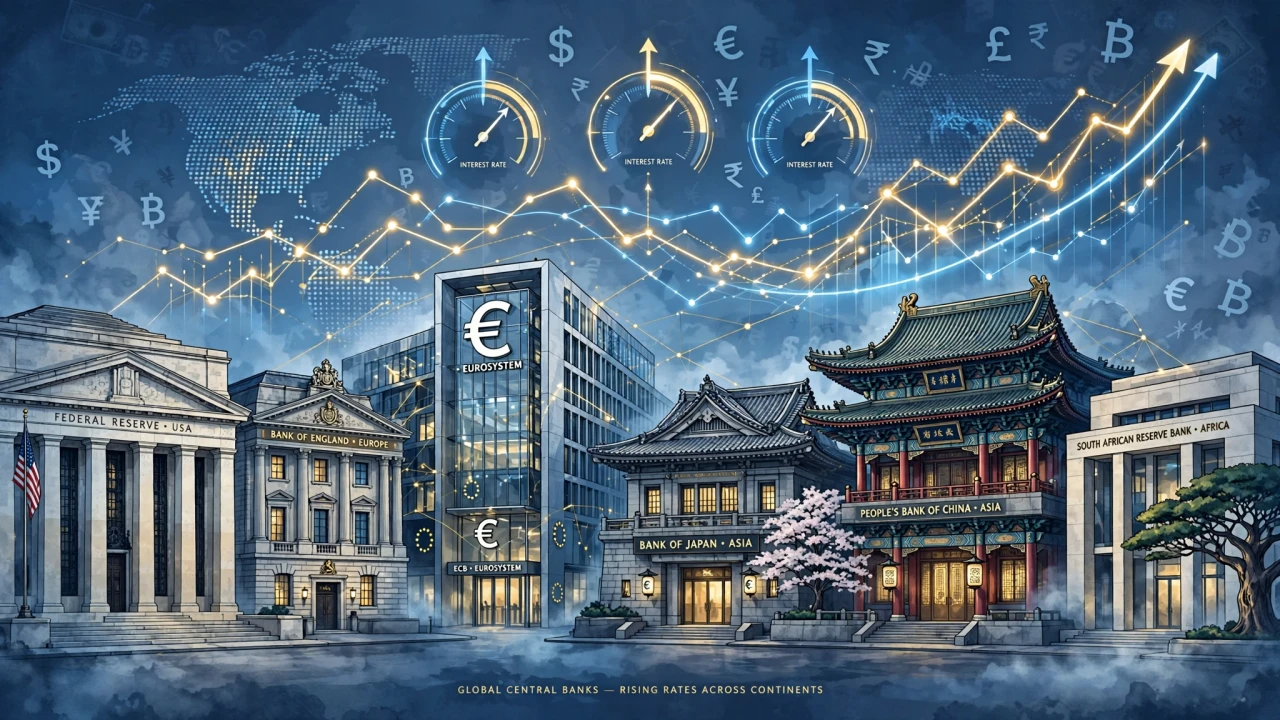
Illustration: grand central bank buildings from different continents under rising interest-rate charts.
What Happened
Speaking at a public event on October 15, 2026, Fed Chair Kevin Warsh declined to signal what the Federal Reserve will do at its October 27–28 meeting, but he was unusually blunt about the global picture: central banks around the world have undertaken "a synchronous tightening in monetary policy in most places around the world," and inflation remains a "common challenge" shared across economies, according to reporting on his remarks. Warsh said he had returned from meetings in Bangkok hearing the same message from fellow central bankers, and expressed some surprise at how well global economies have been "hanging in there" amid geopolitical shocks and energy-price pressures.
"I don't prejudge meetings. I don't believe in saying now what I might do at the meetings that we have in the balance of this year," Warsh said, a communication philosophy he has repeated since taking over as Fed chief in May — markets, he argued, should interpret data rather than rely on central bank signaling. According to the reporting, CME FedWatch showed a 72.3 percent chance of no change at the October meeting, with a majority expecting a 25-basis-point increase in December instead.
Warsh was more expansive on artificial intelligence, calling AI "probably the most consequential change to the U.S. and the global economy in my lifetime" while warning that "the road there may be very bumpy" and its near-term effect on jobs is uncertain. Crucially, he described an "investment surge" that began with AI but has broadened to other sectors, creating a near-term demand shock that is putting upward pressure on inflation — the growth promise of AI spending set against its near-term price pressures.
Background
The Warsh remarks landed in the middle of one of the most volatile bond markets in recent memory. Yields have surged to multiyear highs after weeks of selling, tightening financial conditions even without further action from policymakers, Bloomberg reported on October 12, 2026. Traders have responded by paring rate-hike expectations: the amount priced into swaps across eight major economies has fallen by almost 200 basis points since mid-September. Markets now price a combined 539 basis points of hikes across those eight economies, down from 717 basis points in September, the highest since 2022 — with the biggest pullback in Australia, followed by the euro area amid concerns over France's fiscal outlook.
The logic is straightforward: when the bond market itself pushes borrowing costs higher, central banks may not need to. "The more tightening markets price, the tighter financial conditions become," said Ken Orchard, head of international fixed income at T. Rowe Price. "And the tighter financial conditions become, the less tightening central banks may ultimately need — or be able — to deliver."
Several forces are driving the selloff: fiscal-spending concerns from the United States to Japan and France, and a wave of AI-related corporate borrowing — companies funding data centers and computing infrastructure — soaking up capital. The higher borrowing costs are spilling into mortgages and junk credit, delivering some of the economic restraint that central banks would otherwise seek through higher policy rates.
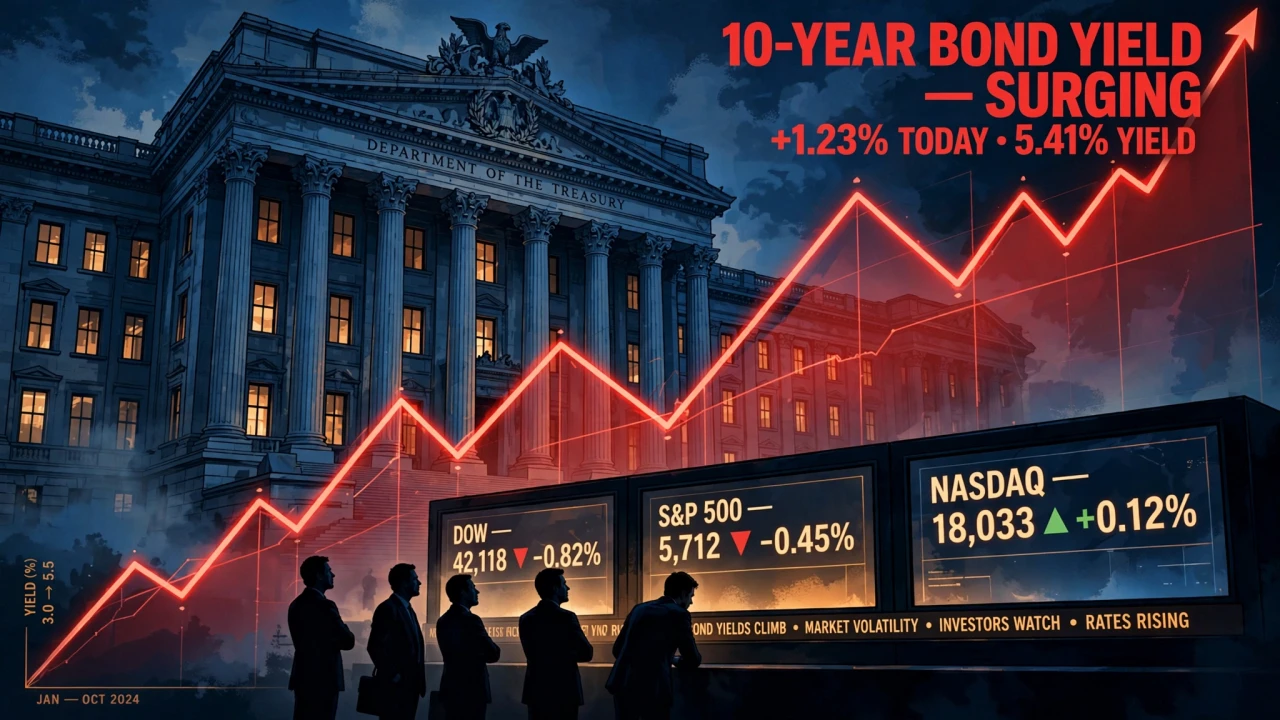
Illustration: a columned government building with a surging red bond-yield chart and investors watching tickers.
The synchronization Warsh described is real. The European Central Bank has kept its deposit facility rate at 2.25 percent with a meeting-by-meeting, data-dependent approach, and ECB President Christine Lagarde warned on October 17 that the global economy faces downside risks to growth and upside risks to inflation, citing Middle East energy disruptions, trade tensions, and protectionist policies, according to reporting on her statement. In Canada, markets are pricing a much higher chance that the Bank of Canada raises its overnight rate from 2.25 percent to 2.5 percent at its October 28 meeting, driven by fears that energy and trade disputes could lift inflation expectations.
The trade picture adds pressure. The United States imported a record level of goods in August, pushing the overall trade deficit to a reported $105.6 billion, according to reporting on the figures — striking because the US has spent much of the year using tariffs to discourage imports, yet demand, including AI-linked capital-goods imports, remains strong.
Why It Matters
A synchronous tightening is fundamentally different from one country raising rates alone. When every major central bank pulls in the same direction, the effects compound: borrowing costs rise everywhere at once, and there is nowhere for indebted governments, companies, or households to hide. For ordinary people, the consequences show up in mortgages, credit-card rates, auto loans, and small-business credit — in many economies, the bond selloff is already delivering this pain directly.
For emerging markets, synchronized tightening is historically one of the most dangerous configurations: capital flows back toward safe assets, currencies come under pressure, and dollar-denominated debt gets more expensive to service. Several emerging economies have proven resilient so far — Warsh's "hanging in there" — but the pressure is building.
The AI investment boom adds a twist with no historical parallel. The current demand shock comes partly from a productivity revolution — spending on AI infrastructure that could, over time, make economies less inflation-prone. The risk is that central banks over-tighten into what turns out to be a productive boom, or under-tighten while an investment bubble inflates.
Illustration: glowing money-flow arrows streaming across a world map between continents.
What Happens Next
All eyes are now on the late-October meetings. The Fed meets October 27–28, and the Bank of Canada meets on October 28, with markets widely expecting the Fed to hold in October while a December hike remains the majority bet. Analysts will also watch whether the bond selloff abates: if yields keep climbing, markets will continue tightening financial conditions on autopilot — potentially forcing central banks to hold fire even as inflation stays elevated.
Warsh's refusal to pre-commit means markets will hang on every data release between now and year-end. And the longer-term question is whether synchronization holds: if inflation diverges across regions, the "synchronous tightening" could fracture into divergent paths, with all the currency and capital-flow turbulence that implies.
Sponsored: explore today's featured sponsored offers
FAQ
Q: What did Fed Chair Warsh mean by "synchronous tightening"?
A: He meant that central banks in most major economies are raising interest rates — or holding them at restrictive levels — at the same time to fight inflation, so no country's policymakers can rely on others to do the work alone.
Q: Will the Fed raise rates at its October 27–28 meeting?
A: Warsh declined to signal any decision ahead of the meeting. According to reported CME FedWatch data, markets see about a 72 percent chance of no change in October, with most traders expecting a 25-basis-point hike in December.
Q: Why are bond yields rising, and how does that affect interest rates?
A: Yields are surging to multiyear highs on fiscal-spending concerns in the US, Japan, and France, plus heavy AI-related corporate borrowing. Higher bond yields raise mortgage and corporate borrowing costs directly, tightening financial conditions even if central banks hold policy rates steady.
Q: How does synchronized tightening affect ordinary borrowers?
A: Mortgages, credit cards, auto loans, and business credit get more expensive across many countries at once. When tightening is synchronized, there is no refuge: borrowing costs rise everywhere simultaneously.
Q: What is the connection between AI investment and inflation?
A: Warsh described an "investment surge" starting with AI that is creating near-term demand pressure, pushing prices up. Over the longer term, he said, AI could make economies more productive and wealthier — the near-term bump versus the long-term payoff is the central tension for policymakers.
Sources
- Reporting on Fed Chair Kevin Warsh's October 15, 2026 remarks (via political.org)
- Bloomberg / Moneyweb, "Bond selloff may mean fewer rate hikes from global central banks," October 12, 2026
- Reporting on ECB President Christine Lagarde's October 17, 2026 statement to the International Monetary and Financial Committee
- Reporting on US August 2026 trade figures (US trade deficit, imports, capital-goods imports)
- Market reporting on Bank of Canada rate expectations ahead of the October 28, 2026 meeting
Comments
Post a Comment