
WASHINGTON, 28 October 2026 — The United States Federal Reserve held interest rates steady on Wednesday, keeping its benchmark rate in the 3.75% to 4.00% range in a 10-2 decision, while Chair Kevin Warsh insisted that politics played no role in the choice, telling reporters after the meeting that he had heard no mention of politics, elections or the week ahead during two days of deliberations.

Illustration: The Federal Reserve building in Washington DC with columns and an American flag, seen from the street.
What Happened
The Federal Reserve held interest rates steady on Wednesday, 28 October 2026, at the end of a two-day meeting of its rate-setting Federal Open Market Committee, according to Reuters. In a 10-2 decision, the central bank said it would maintain its benchmark interest rate within the current 3.75% to 4.00% range, while acknowledging that inflation "remains elevated" and upgrading its assessment of the economy from "solid" to "strong."
The statement said investment was still viewed as robust and job gains were keeping pace with the workforce. It also hinted that further rate hikes may be coming depending on inflation, saying: "The accumulation of more information will help the Committee determine the policy stance appropriate to ensure a timely return of inflation to the Committee's 2% goal. The Committee will deliver price stability."
Two policymakers dissented in favour of a quarter-percentage-point rate hike: Fed Governor Lisa Cook, who is currently targeted by President Donald Trump for removal from the central bank, and Cleveland Fed President Beth Hammack, described by Reuters as a consistently hawkish voice who also dissented in July for the same reason. Their dissents show that the decision to hold was contested inside the committee, even though the majority chose to wait for more data.
Speaking to reporters after the meeting, Warsh pushed back against suggestions that politics had influenced the outcome. "We just came out of a heck of a family fight" at the latest meeting, he said, adding: "I think we came to the right policy decision for this moment, and I'm honored to be here and honored to be the chairman of this group." He continued: "Politics played no role in the decision. I just spent two days with my colleagues upstairs. I didn't hear an utterance about politics. I didn't hear a reference to politics, elections, what's happening in the next week."
Background
The decision came against a backdrop of political pressure on the central bank that has run throughout President Trump's second term. Trump has repeatedly criticised the Federal Reserve for failing to deliver big rate cuts, and after the Fed's decision in September to raise rates, he blamed Warsh's colleagues as "hostile" and "partisan," according to Reuters. Trump has not attacked Warsh himself in the same way he routinely attacked the previous Fed Chair, Jerome Powell, and on Wednesday Treasury Secretary Scott Bessent said both he and the president have "great confidence that Chair Warsh will steer the Fed between the right combination of growth and inflation."
The September meeting, held on 15-16 September, had also raised rates, and Wednesday's statement marked a notable change from that meeting, Reuters reported, with a hint of the sort of forward guidance Warsh has said he wants to avoid. The Fed's latest assessment upgraded the economy to "strong" from the "solid" expansion seen in September, while investment remained robust and job gains kept pace with the workforce — a picture of resilience that, paradoxically, makes both holding and hiking defensible, depending on how the inflation data develop.
Warsh told reporters the committee will have plenty of data in the coming weeks that will leave it "better positioned" in December to determine whether to raise rates, and that the coming period will be "information-rich" but will have "nothing to do" with politics. That framing sets up December as the next decisive meeting, with the data — not the political calendar — presented as the deciding factor.

Illustration: A financial analyst looking at a large chart showing interest rates and inflation trends on a screen in a modern office.
Why It Matters
The decision matters first for American households and businesses, because the Fed's benchmark rate shapes borrowing costs across the economy — from mortgages and car loans to business investment and credit-card rates. Holding the rate at 3.75% to 4.00% means no immediate relief for borrowers hoping for cuts, but also no additional squeeze from a hike, at a moment when voters say affordability concerns, including high borrowing costs, are top of mind heading into the midterm elections on 3 November.
It matters second because of the dissents. A 10-2 vote, with two policymakers pushing for a hike, signals that the committee is divided about how serious the inflation risk has become. Cook's and Hammack's dissents, and Hammack's repeat dissent from July, suggest that the case for tighter policy is not going away — and that December's meeting could go either way depending on the inflation and jobs data that arrive between now and then.
It matters third for the Fed's independence. Warsh's unusually direct denial — that he heard no utterance about politics in two days of meetings — was aimed at a specific allegation: that the Fed Board is partisan and acting against the president. By addressing it head-on, and by pointing to the December data as the real deciding factor, Warsh was defending the institution's credibility at a moment when that credibility is itself part of the political debate. Markets appeared to take the message calmly: Reuters reported that US stock indexes rose modestly after Warsh began speaking, with the Nasdaq composite and the S&P 500 both up 0.2%.
What Happens Next
The next decisive moment is December. Warsh said the committee will be "better positioned" then to determine whether to raise rates, after an "information-rich" period of new data on inflation, jobs and growth. If inflation stays elevated or rises further, the dissenters' case for a hike will strengthen, and the hint in Wednesday's statement that further hikes may be coming could become reality. If inflation cools, the hold could extend, and the conversation could shift back toward eventual cuts.
Before December, however, comes the midterm election on 3 November, which will determine whether Trump's Republican Party retains its majorities in the House and Senate. Warsh insisted the election played no part in Wednesday's decision, but the political context will not disappear: whatever the results, the Fed's next move will be scrutinised for signs of political influence, and Warsh's own words on Wednesday — "politics played no role" — will be quoted back at him if December's decision surprises markets.
Markets will also be watching the data releases between now and December, and the bond market's initial reaction gives a sense of the mood: after Warsh began speaking, Reuters reported, the 2-year Treasury yield most sensitive to Fed policy fell 1 basis point to 4.726%, the 10-year yield rose 1 basis point to 5.007%, and the 30-year yield rose 2 basis points to 5.325%, while the US dollar index was off 0.02%. Those are small moves, consistent with a decision that was broadly expected but leaves the future path open.
For households, the practical takeaway is patience. Borrowing costs are unchanged for now, inflation remains above the Fed's 2% goal, and the central bank has told the public, in effect, to wait for the data. December will show whether that patience was rewarded with cooler prices — or whether the two dissenters were right, and a hike was needed after all.
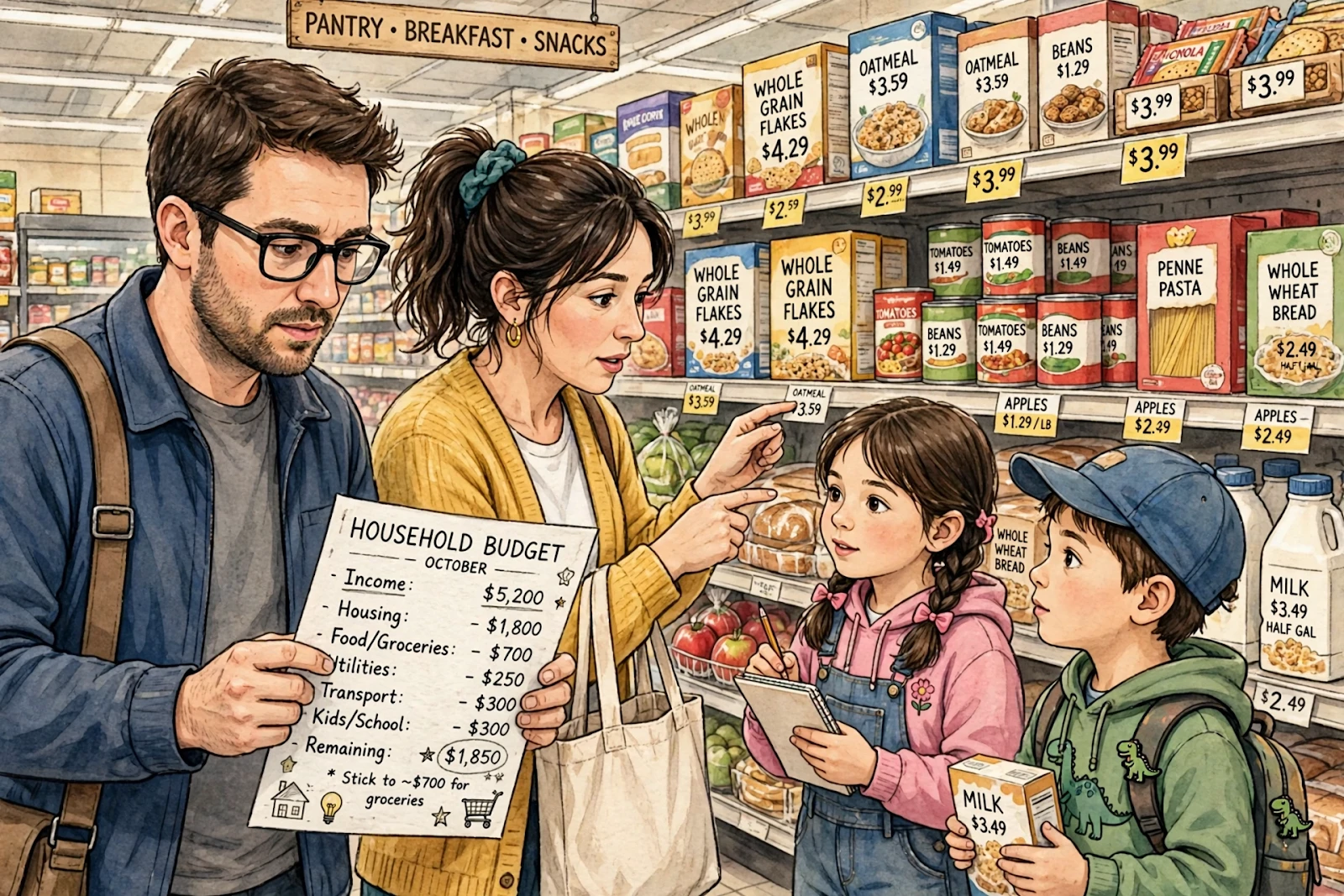
Illustration: A family checking grocery prices in a supermarket aisle while reviewing a household budget on paper.
Sponsored: explore today's featured sponsored offers
FAQ
What did the Federal Reserve decide on 28 October 2026?
The Fed held its benchmark interest rate steady in the 3.75% to 4.00% range, in a 10-2 decision by the Federal Open Market Committee, while acknowledging that inflation "remains elevated" and upgrading its assessment of the economy from "solid" to "strong."
Who dissented, and why?
Fed Governor Lisa Cook and Cleveland Fed President Beth Hammack dissented in favour of a quarter-percentage-point rate hike. Hammack had also dissented in July for the same reason, according to Reuters.
What did Chair Kevin Warsh say about politics?
Warsh said: "Politics played no role in the decision. I just spent two days with my colleagues upstairs. I didn't hear an utterance about politics. I didn't hear a reference to politics, elections, what's happening in the next week." He also said he was "honored" to lead the committee.
When will the Fed decide next?
Warsh said the committee will be "better positioned" in December to determine whether to raise rates, after an "information-rich" period of new data, and that the coming period will have "nothing to do" with politics.
How did markets react?
Reuters reported that US stock indexes rose modestly after Warsh began speaking, with the Nasdaq composite and the S&P 500 both up 0.2%. The 2-year Treasury yield fell 1 basis point to 4.726%, while the 10-year yield rose 1 basis point to 5.007%.
Sources
- Reuters, "Warsh says politics played no role in Fed's rate decision by group he is 'honored' to lead", 28 October 2026
- Reuters, "VIEW FOMC holds rates steady, markets rise modestly", 28 October 2026
- Reuters, "Canadian 2-year yield hits two-year high as BoC hikes interest rates", 28 October 2026 (Bank of Canada contrast)
Comments
Post a Comment