
WASHINGTON — The United States Federal Reserve is widely expected to hold its benchmark interest rate steady when its two-day policy meeting ends on Wednesday, 28 October 2026, even as inflation running at 3.7% keeps the prospect of another increase in December firmly on the table.
The decision, due at 2 p.m. Eastern Time on Wednesday, followed by Chair Kevin Warsh's press conference at 2:30 p.m., will be the Federal Open Market Committee's first meeting since it raised rates by a quarter of a percentage point on 16 September 2026. That move took the federal funds target range to 3.75% to 4.00%, and most economists and market traders now expect the committee to pause there — while signalling that the tightening cycle may not yet be over.

Illustration: The Federal Reserve building in Washington, where policymakers are meeting on 27–28 October 2026 to set US interest rates.
What Happened
The Federal Open Market Committee (FOMC) opened its two-day meeting in Washington on Tuesday, 27 October 2026, according to the Federal Reserve's official calendar. The meeting is one of eight regularly scheduled gatherings this year, and it is not one of the meetings paired with a Summary of Economic Projections, which means the committee will not publish fresh forecasts for growth, inflation and the future path of rates alongside its statement.
Market pricing points overwhelmingly to a hold. Fed funds futures imply about a 91% probability that the committee keeps rates unchanged, according to the CME Group's FedWatch tool, as reported by Reuters on 28 October. A Reuters poll conducted from 16 to 20 October found that 94 of 100 economists expected a hold in October — while all 100 anticipated an increase in December.
That combination — a pause now, a hike later — is what analysts call a "hawkish hold": rates stay where they are, but the language of the statement and the chair's press conference leaves the door open to further tightening. As Chris Weston, head of research at Pepperstone Group in Melbourne, told Reuters: "The Fed doesn't need to hike today to move markets. It simply needs to change the perceived probability of hiking in December."
At its September meeting, the committee voted 12–0 to raise the target range to 3.75% to 4.00%, describing economic activity as "expanding at a solid pace" and domestic spending as "resilient", while noting that "inflation remains elevated". InvestmentNews reported that the September increase was the Fed's first rate rise since July 2023.
Background
The backdrop to this week's decision is an inflation problem that has refused to fade. US consumer price inflation stood at 3.7% in the 12 months to September 2026, according to the Bureau of Labor Statistics, well above the Fed's 2% longer-run objective. The energy index rose 20.4% over the same period, reflecting higher oil prices linked in part to Middle East tensions and supply disruptions.
The September hike came just six weeks ago, and policymakers have repeatedly said they want time to judge its effect before moving again. Higher Treasury yields since then have already tightened financial conditions, raising borrowing costs for households and businesses even without a further rate move. The yield on the US 10-year Treasury bond was unchanged at about 5.00% in early trading on Wednesday, according to Reuters.
The Fed is not acting in isolation. Central banks around the world are facing the same trade-off between stubborn inflation and fragile growth. The Bank of Canada was also due to decide on rates on 28 October, with economists having reversed course during October to expect a possible increase, while the Reserve Bank of New Zealand was widely expected to raise rates at its own meeting this week. The dollar held at a two-week high ahead of the Fed's announcement, with the dollar index at 102.40, its highest since 14 October.
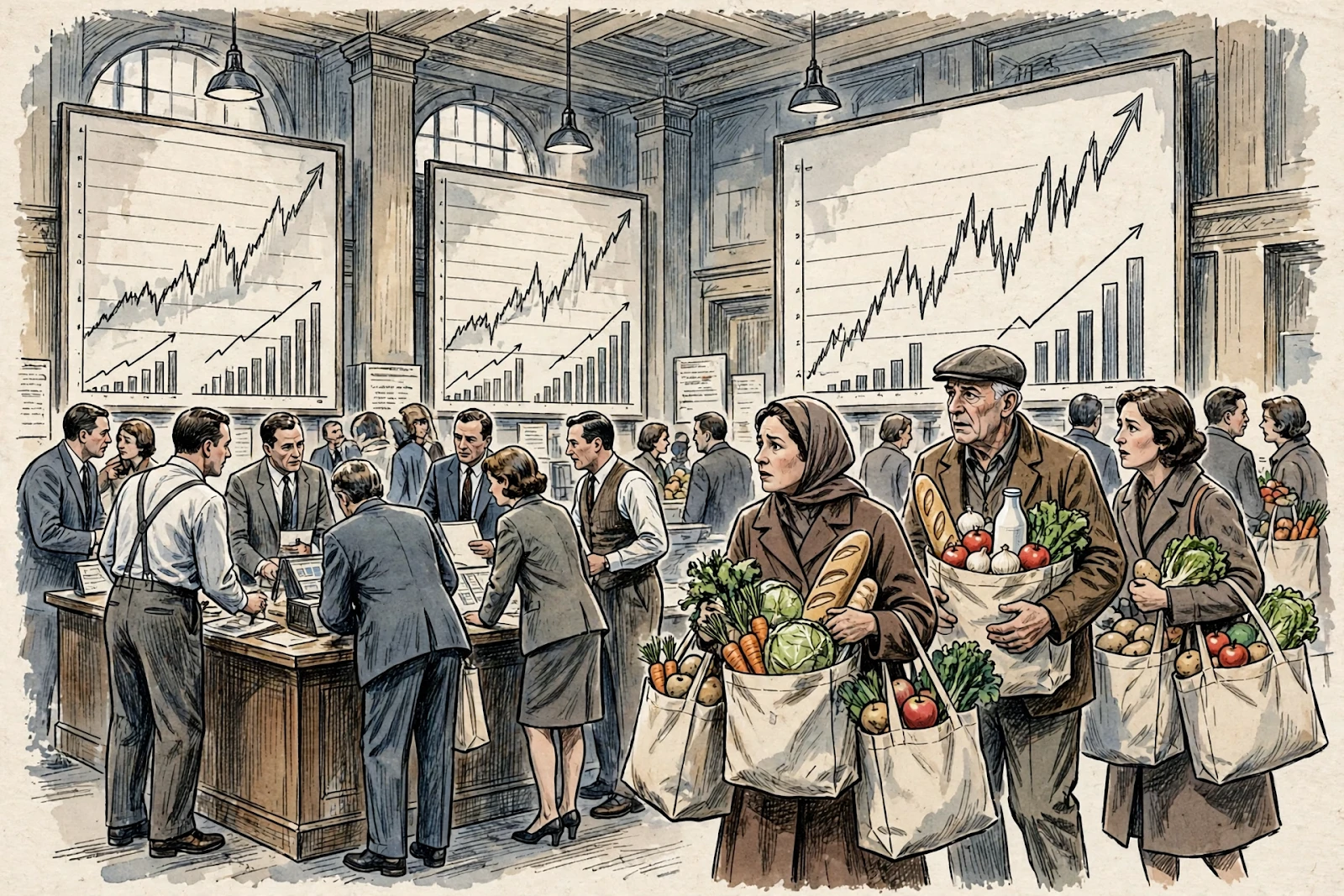
Illustration: Rising prices and market trading screens capture the inflation pressures facing households and policymakers alike.
Why It Matters
The Fed's decision matters far beyond Washington because the US dollar and US interest rates set the price of money for much of the world. When the Fed holds rates high, borrowing becomes more expensive globally: mortgages, business loans and government debt all cost more, and capital tends to flow towards dollar assets, putting pressure on other currencies.
For American households, the path of rates determines how quickly mortgage rates, car loans and credit-card borrowing ease — or tighten further. For emerging economies, a hawkish Fed can mean weaker currencies and higher debt-servicing costs, which is why finance ministers and central bankers from Bangkok to Brasilia watch the FOMC statement line by line.
The December question is the one that will move markets most. If Warsh signals that a December increase is likely, bond yields and the dollar could rise further even though rates are unchanged this week. If he sounds more cautious, markets may read the pause as the start of a longer wait — and price in a gentler path for 2027. Either way, the statement's wording on inflation, employment and the balance of risks will be parsed within seconds of its release.
There is also a credibility question. The Fed raised rates in September after a long pause, and then must show that it can judge when enough is enough. Moving too fast risks damaging employment growth, which has already shown signs of weakening; moving too slowly risks letting inflation become entrenched. The October pause, if confirmed, would be the committee choosing patience over haste — while keeping its options open.
What Happens Next
The immediate sequence is fixed: the FOMC statement at 2 p.m. Eastern Time on Wednesday, 28 October, and Chair Warsh's press conference half an hour later. Traders and analysts will focus on three things: whether the statement keeps the phrase that the committee will "carefully assess incoming data, the evolving outlook, and the balance of risks"; whether Warsh describes a December move as a live possibility; and whether any policymaker dissents from the decision.
Beyond Wednesday, attention turns to the next round of inflation and jobs data, and to the FOMC's final meeting of the year on 8–9 December 2026. That meeting is paired with a Summary of Economic Projections, so it will give the clearest picture yet of where policymakers think rates are heading in 2027.
Other central banks will also set the tone in the coming days. The Reserve Bank of Australia meets next week, after its governor, Michele Bullock, told lawmakers on Wednesday that policymakers will debate whether four rate hikes this year will prove sufficient to return inflation to target. The European Central Bank's December meeting is likewise in focus, with markets watching for any signal of a further increase there.

Illustration: Central bank buildings around the world, as policymakers from Washington to Wellington weigh the same inflation dilemma.
Sponsored: explore today's featured sponsored offers
FAQ
What is the Federal Reserve expected to do on 28 October 2026?
Economists and market traders overwhelmingly expect the FOMC to hold the federal funds target range at 3.75% to 4.00%, according to a Reuters poll and CME FedWatch pricing reported on 27–28 October 2026.
Why is inflation still a problem for the Fed?
US consumer price inflation was 3.7% in the year to September 2026, well above the Fed's 2% target, with energy prices up 20.4% over the same period, according to the Bureau of Labor Statistics.
What is a "hawkish hold"?
It is a decision to leave rates unchanged while signalling that further increases remain possible — so markets still face tighter policy ahead even though no hike happens at that meeting.
When is the next Fed meeting after October?
The FOMC's final scheduled meeting of 2026 is on 8–9 December, and it will include a Summary of Economic Projections.
How does the Fed's decision affect people outside the United States?
US rates influence global borrowing costs and the value of the dollar, so a hawkish Fed can raise debt costs and weaken currencies in other countries, especially emerging economies.
Sources
- Reuters, "Dollar holds gains ahead of Fed policy signal, RBNZ decision," 28 October 2026 (via KRRO/MIX-FM republication).
- The Boston Report, "Fed Rate Decision Oct. 28: What to Expect From Warsh," 27 October 2026.
- Wall Street Next, "Federal Reserve Prepares to Pause Interest Rates as Inflation Challenges Persist," 27 October 2026.
- Crypto Daily, "Fed Rate Decision October 2026: Why Another Rate Hike Is Still on the Table," October 2026 (Reuters poll 16–20 October 2026).
Comments
Post a Comment