
SUVA — Fiji's military has asked Parliament to strip away its own constitutional immunity, urging lawmakers to replace a protection forged in the era of coups with a Truth, Accountability and Reconciliation Commission before a decisive vote expected on Monday, 2 November 2026.
In a six-page submission to Parliament's Special Committee reviewing Constitution Amendment Bill No. 32 of 2026, Republic of Fiji Military Forces (RFMF) Commander Major-General Ro Jone Kalouniwai said the military no longer wants the legal shield that could protect it from accountability for past coups, according to reports by Mai TV Fiji and FijiGlobalNews on 30–31 October 2026.

Illustration: Fiji's Parliament in Suva during the constitutional debate. This is an AI-generated illustration, not a real photograph of the event.
What Happened
Major-General Kalouniwai told the Special Parliamentary Select Committee that the RFMF was prepared to relinquish the immunity provisions in the proposed Constitution and accept accountability under the ordinary law. The military asked Parliament to remove Chapter 14 of the proposed Constitution, including the immunity provisions under Section 206, and to replace it with a Truth, Accountability and Reconciliation Commission.
The commander stressed that the decision was voluntary. "No court has ordered it. No Government has demanded it. No law compels it," he said, according to FijiGlobalNews. The RFMF confirmed that it had signed a declaration on constitutional immunity on 16 October 2026, formally stating that it did not seek protection under Section 206.
Under the military's proposal, any protection offered through the proposed commission would depend on full disclosure, and would never extend to the gravest crimes. The RFMF also reaffirmed its acceptance of civilian authority under Section 151, pledged to cooperate with any lawful accountability process, and said it takes no position on any referendum or political party.
"The RFMF takes no position on the referendum, and none on any political party," Kalouniwai said, according to reports of the submission. The military exists, he added, to "serve the people and never to rule them," and it pledged to remain neutral throughout any referendum and future elections and to respect the will of the people.
The most urgent part of the submission was a warning about Section 207. Kalouniwai argued that if the Bill passes its third reading in its current form, Section 207 would entrench the immunity provisions and place them beyond the reach of the courts. "Once this Bill passes its third reading, Section 207 would make its immunity permanent and place it beyond the reach of the courts," he said, according to Mai TV Fiji. He also warned, according to FijiGlobalNews: "If we fail to choose rightly now, our grandchildren will inherit the same mark of impunity we inherited, and the cycle will turn again."
Background
Fiji's debate over immunity cannot be understood without its coup history. The RFMF acknowledged its involvement in the coups of 1987, 2000 and 2006, according to FijiGlobalNews. For decades, immunity provisions have been among the most contested features of Fiji's constitutional settlements, because they determine whether those involved in seizing power can later face legal consequences.
Kalouniwai referred to a Supreme Court advisory opinion issued in August 2025, which, according to reports, noted that military immunity can weaken the rule of law and may foster future coups. The submission also pointed to steps the military says it has already taken towards confronting its past, including acknowledging its wrongs in March 2024 and beginning its truth and reconciliation process.
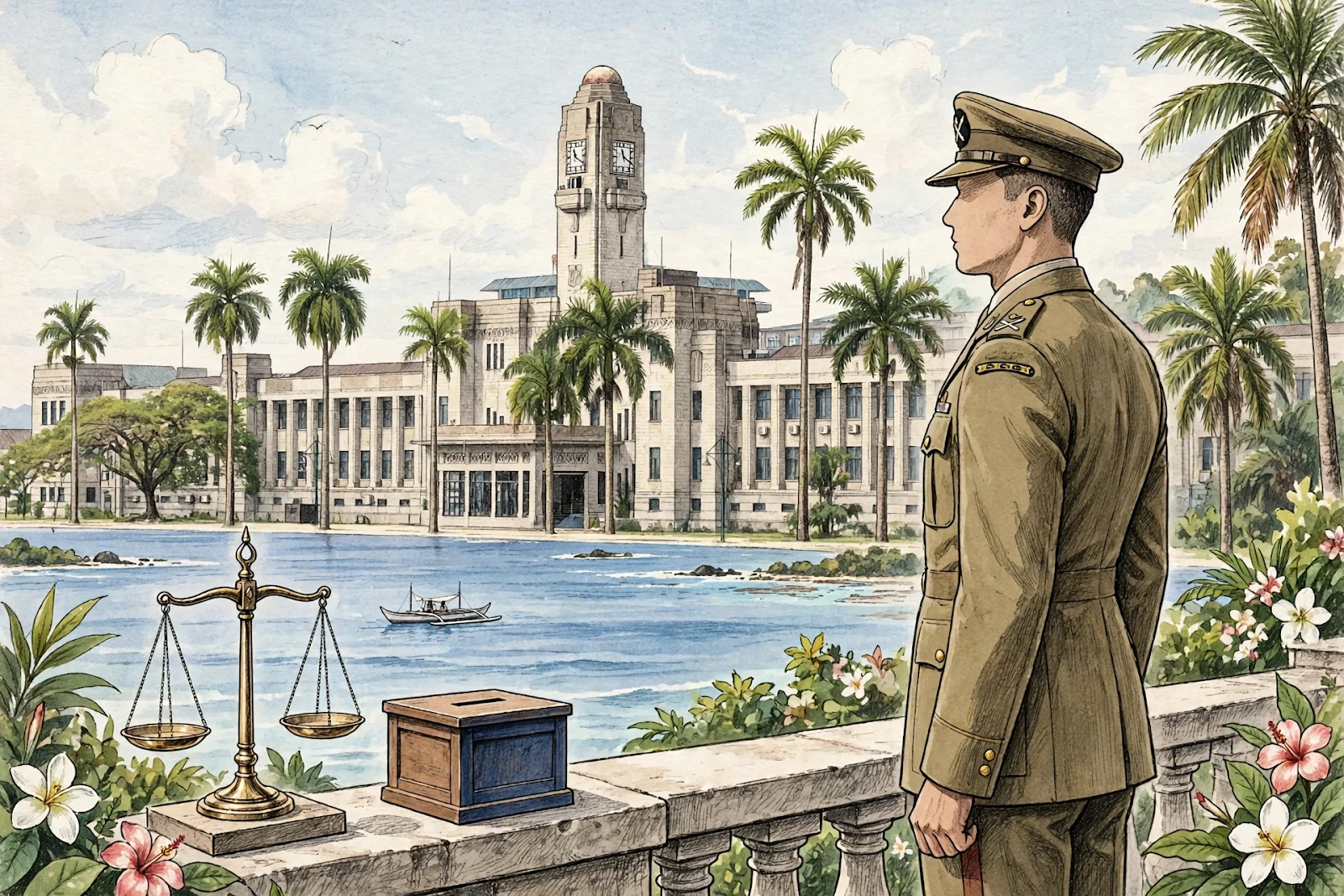
Illustration: Fiji's military neutrality under civilian authority, symbolised by a soldier standing beside Parliament. This is an AI-generated illustration, not a real photograph of the event.
The wider process has moved quickly. The National Federation Party (NFP) had supported the Bill's second reading on 2 October in good faith, expecting a more thorough committee stage, according to Mai TV Fiji. On 29 October, party leader Professor Biman Prasad wrote to Prime Minister Sitiveni Rabuka saying he would no longer participate in the committee's examination of Bill No. 32 and would not sign its final report.
On 30 October, the NFP Management Board, endorsed by its Working Committee, directed all of the party's MPs to vote against the Bill at its third reading. Prasad told reporters that every MP must sign a written undertaking before the vote, requiring attendance, a vote against the Bill, and a recorded vote. The party's stated reasons centre on a rushed timetable: it questioned the 19 days allocated to consultation and committee work between 12 and 31 October, the absence of translations of the draft into iTaukei and Hindi, and what it describes as limited opportunities for the public to ask questions. The NFP says the process should continue after the next general election rather than be hurried through now.
Other parties have also opposed the Bill's immunity clauses. The Social Democratic Liberal Party (SODELPA) has rejected the Bill and called for the complete repeal of the 2013 Constitution, objecting in particular to Clauses 206 and 207, according to FijiGlobalNews. Prime Minister Rabuka has said submissions gathered during consultations in Lau will be collated and presented to Parliament on Monday, with debate expected during the week and the third-reading vote to follow. According to FijiGlobalNews, Rabuka said passage would trigger a referendum, while defeat would end this amendment effort, and he urged MPs to be present for the vote.
Why It Matters
The RFMF submission is remarkable because militaries rarely volunteer to give up legal protection. Immunity clauses are usually defended by the institutions they protect, or imposed as part of a political bargain after a coup. Here, the institution that would benefit from immunity is asking Parliament to remove it — a reversal that would change how Fiji deals with its past and guards against a return to military rule.
First, the proposal reframes accountability. Blanket immunity closes questions; a truth commission, as proposed, would open them, but only on condition of full disclosure. That model balances two competing needs: victims and the wider public want truth and responsibility, while a society emerging from coups also needs a process that encourages people to come forward. The exclusion of the gravest crimes from any protection is the military's answer to the charge that a commission would simply become immunity by another name.

Illustration: A truth and reconciliation gathering in Fiji. This is an AI-generated illustration, not a real photograph of the event.
Second, the submission strengthens civilian control. By accepting civilian authority under Section 151 without conditions and pledging neutrality in referendums and elections, the RFMF is publicly accepting a subordinate role in democratic politics — a pledge that matters as much as the legal detail in a country where the military has repeatedly intervened.
Third, the timing gives Parliament a genuine choice rather than a formality. If Section 207 entrenches immunity beyond court challenge after the third reading, as Kalouniwai warns, then the committee stage is the last practical moment to amend it — turning a technical clause into the central question of the week.
Finally, the episode matters beyond Fiji: other Pacific democracies will watch whether this ends in reform, referendum, or defeat.
What Happens Next
Parliament is expected to take up the Bill from Monday, 2 November 2026: submissions collated and presented on Monday, debate during the week, then the third-reading vote. Passage would reportedly trigger a referendum; defeat would end this amendment effort.
Several questions remain open and should be watched rather than assumed. It is not yet clear whether the committee or Parliament will accept the RFMF's recommendation to remove Chapter 14 and substitute a Truth, Accountability and Reconciliation Commission, or whether the immunity clauses will survive in amended form. The NFP's directed opposition adds pressure, but the outcome will depend on how other parties and independent MPs vote, with no outcome presumed before the vote.
Equally important is what happens after the vote. A commission, if created, would need legislation, membership, powers and funding, none of which are settled by the military's submission alone. And if the Bill is defeated, Fiji's 2013 Constitution remains in place, leaving wider constitutional replacement to a future Parliament. For now, the most significant fact is the one the military itself has put on the record: it says it does not want immunity, and it wants Parliament to choose truth and accountability instead.
Sponsored: explore today's featured sponsored offers
FAQ
What is Fiji's military asking Parliament to do?
It is asking Parliament to remove Chapter 14, including the immunity provisions under Section 206, from the proposed Constitution, and to replace them with a Truth, Accountability and Reconciliation Commission.
What would the proposed Truth, Accountability and Reconciliation Commission do?
According to the RFMF submission, it would address past injustices, with any protection dependent on full disclosure and never available for the gravest crimes.
Why is Section 207 so important?
Kalouniwai warned that after a third-reading passage, Section 207 would make immunity permanent and beyond the courts' reach — hence his plea at committee stage.
Has the Constitution Amendment Bill already passed?
No. At the time of writing, the Bill's third reading is upcoming, expected from Monday, 2 November 2026. Passage would reportedly trigger a referendum; defeat would end this amendment effort.
Why is the National Federation Party opposing the Bill?
The NFP says the process was rushed, points to the lack of iTaukei and Hindi translations, and argues reform should continue after the next general election. On 30 October it directed its MPs to vote against the Bill at its third reading.
- Sources: Mai TV Fiji, "RFMF Offers to Surrender Constitutional Immunity, Calls for Removal of Chapter 14," https://maitvfiji.com/rfmf-offers-to-surrender-constitutional-immunity-calls-for-removal-of-chapter-14/
- Sources: FijiGlobalNews, "Fijian Military Seeks to End Constitutional Immunity, Promoting Accountability and Transparency," 31 October 2026, https://fijiglobalnews.com/fijian-military-seeks-to-end-constitutional-immunity-promoting-accountability-and-transparency/
- Sources: FijiGlobalNews, "NFP Directs MPs to Oppose Constitution Amendment Bill as RFMF Stresses Civilian Oversight," 30–31 October 2026, https://fijiglobalnews.com/nfp-directs-mps-to-oppose-constitution-amendment-bill-as-rfmf-stresses-civilian-oversight/
- Sources: FijiGlobalNews, "Fiji faces pivotal week as military immunity debate could trigger referendum," https://fijiglobalnews.com/fiji-faces-pivotal-week-as-military-immunity-debate-could-trigger-referendum/
- Sources: Evening Report / Asia Pacific Report, 1 November 2026 (same RFMF submission, as briefed).
Comments
Post a Comment