
TAIPEI — Foxconn, the world's largest contract electronics manufacturer, said on Friday, 30 October 2026, that a new collaboration with OpenAI is in the works, as its chairman rejected fears that the artificial intelligence boom has become a bubble and pointed to humanoid robots already at work inside its Texas factories.
Foxconn Chairman Young Liu told reporters at the company's annual technology showcase that he had met OpenAI Chief Executive Sam Altman earlier in the day and that an announcement would follow once details are confirmed, Reuters reported. Liu did not elaborate on the scope, timing or value of any deal, and no agreement was described as signed — a restraint worth noting on a day when investors were already nervous about how much the AI build-out is costing.
Any new arrangement would build on an agreement the two companies reached last year to work together on designing and engineering data-centre racks, components and other AI hardware, according to Reuters. Foxconn, formally known as Hon Hai Precision Industry, is Nvidia's biggest maker of AI servers, and it is increasingly relying on AI infrastructure for growth.
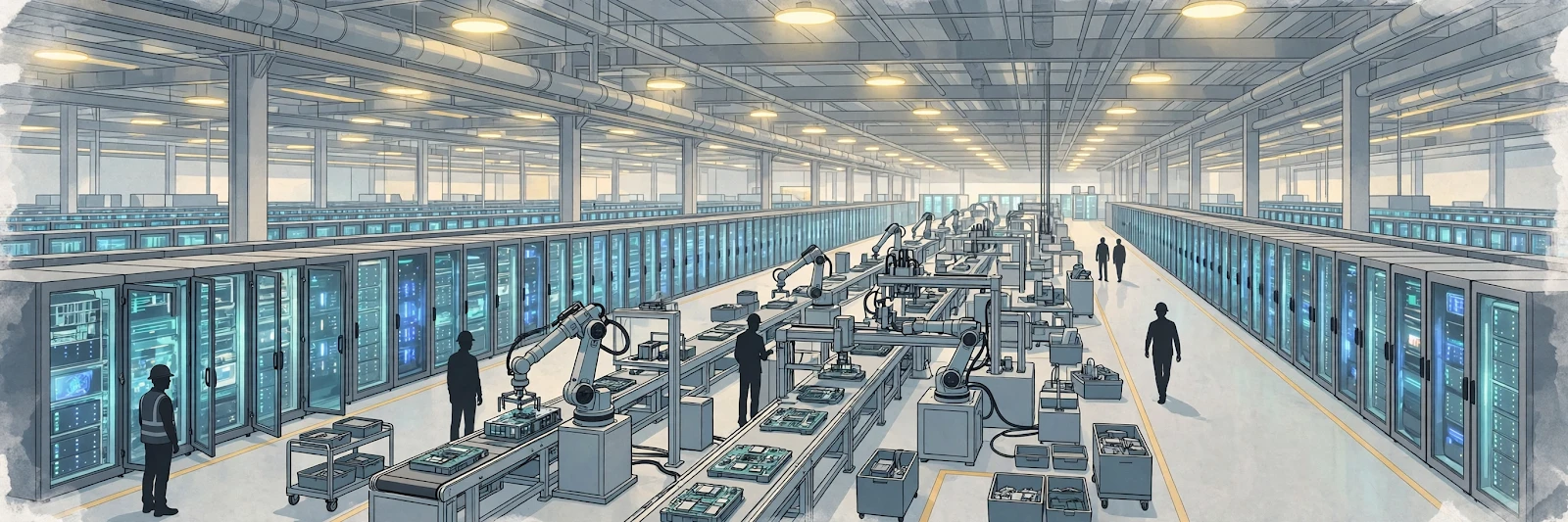
Illustration: Rows of AI server racks inside a modern factory hall. This is an AI-generated illustration, not a real photograph.
What Happened
The headline from Taipei was deliberately short: a collaboration is being prepared, a meeting has taken place, and details will come later. That is all Liu said publicly, Reuters reported, and the absence of detail is itself part of the story — Foxconn chose to flag the direction of travel without committing to terms that are still being worked out.
What Liu did say clearly was his view of the market mood. While AI-sector stocks have been hit hard by concerns that relentless heavy investment is not sustainable amid climbing borrowing costs, Liu said the industry was not in a bubble and that Foxconn expects to maintain double-digit growth next year. It was a direct pushback against the scepticism that has dominated trading in recent days, delivered by a company sitting at the centre of the hardware supply chain.
Separately, Foxconn gave a concrete glimpse of automation inside its own plants. Brand Cheng, chairman of Foxconn unit Foxconn Industrial Internet (FII), told Reuters on Friday that more than 10 humanoid robots had been deployed at its Texas facilities for internal use, and that Foxconn plans to extend deployment beyond Texas. According to presentation materials seen by Reuters, FII introduced two wheeled models in October — one that lifts things vertically and one that can bend at the waist for assembly as well as loading and unloading tasks. The unit is developing AI models for humanoid robots based on Nvidia's GR00T foundation model.

Illustration: A wheeled humanoid robot handling a box on a factory floor. This is an AI-generated illustration, not a real photograph.
Background
Foxconn's shift toward AI infrastructure has been rapid, and the numbers explain why Liu sounds confident. The company said in August that its cloud and networking products segment, which includes AI servers, accounted for 51% of second-quarter revenue, exceeding 50% for the first time. In other words, the business of building the machines that run AI models is no longer a sideline for Foxconn — it is now the majority of its revenue.
That footprint is anchored in the United States as well as Asia. Foxconn has six factory buildings in Houston, Texas, where it manufactures AI servers for Nvidia, and Liu said it sees a need for further expansion there. The Houston site is therefore both a production hub and a testing ground: the same facilities building AI servers are now also deploying humanoid robots for internal tasks, with FII's wheeled models handling lifting, assembly support, loading and unloading.
The OpenAI connection, meanwhile, is not new. Last year's agreement on data-centre racks, components and AI hardware gave the two companies a working relationship in the physical layer of AI — the racks, power and cooling-adjacent hardware that data centres depend on. A new tie-up, if confirmed, would deepen that relationship at a moment when OpenAI's computing needs keep growing and when manufacturers capable of building AI hardware at scale are in short supply.
The timing also matters for market sentiment. Reuters reported on Friday that Nasdaq futures tumbled as Amazon signalled its AI spending boom is far from over and Intel warned it would burn cash this year, deepening concerns over the rising cost of the AI build-out. Amazon shares fell sharply in premarket trading after the company reported a sharp third-quarter cash outflow and signalled another increase in capital expenditure next year, while Intel fell after warning about weak PC demand, manufacturing bottlenecks and heavy spending to expand production. Liu's "no bubble" comment landed directly into that anxiety — a supplier arguing that demand, at least from where it sits, is real and durable.
Why It Matters
First, the statement matters because of who is making it. Foxconn does not sell AI models or run a chatbot; it builds the hardware other companies need to run them. When a manufacturer of that scale says it expects double-digit growth next year and plans to expand in Houston, it is effectively reporting what its order books and factory plans look like — a ground-level signal that cuts through some of the financial-market debate about whether AI spending is sustainable.
Second, the humanoid robot detail matters because it shows where factory automation is heading. More than 10 robots deployed for internal use is a small number in absolute terms, but the two new wheeled models — one for vertical lifting, one that bends at the waist — are designed for the specific, repetitive tasks that dominate assembly and logistics. If Foxconn extends deployment beyond Texas, as Cheng said it plans to do, its own factories become a proving ground for robots built on Nvidia's GR00T foundation model, before any wider commercial sale.
Third, a deeper Foxconn–OpenAI tie-up would matter for the structure of the AI industry itself. OpenAI designs models and products; Foxconn designs and manufactures the hardware those models run on. Closer cooperation between the two could shorten the path from a new model or data-centre design to the racks and components that house it — and could give both companies more leverage in a supply chain where capacity, power and manufacturing expertise are all bottlenecks.

Illustration: A technology partnership handshake in front of an artificial intelligence network graphic. This is an AI-generated illustration, not a real photograph.
What Happens Next
The immediate question is what Foxconn and OpenAI actually announce, and when. Liu said an announcement would come once details are confirmed, but gave no date, and neither company has elaborated further. Until then, the tie-up should be treated as in preparation rather than concluded — any reporting that describes a signed deal would be going beyond what was said in Taipei.
Watch also for three follow-ups. One is expansion in Houston: Liu said Foxconn sees a need for further growth at its six-building site, and any concrete investment or hiring announcement there would test his double-digit growth forecast. A second is the robot rollout: whether deployment does extend beyond Texas, and whether FII's wheeled models move from internal use to a product offered to other manufacturers. A third is the market reaction: if Foxconn's confidence is shared by its customers' orders, the "bubble" debate may cool; if Amazon-style cash burn and Intel-style warnings keep dominating earnings season, even confident suppliers will face harder questions.
For now, the picture from Taipei is a company straddling two stories at once: a hardware giant whose AI server business has crossed the halfway mark of its revenue, a factory operator putting humanoid robots to work on its own floors, and a would-be partner of OpenAI — with the details of that partnership still to come.
Sponsored: explore today's featured sponsored offers
FAQ
What did Foxconn actually announce about OpenAI?
Foxconn said a collaboration with OpenAI is in the works and that an announcement will follow once details are confirmed. Chairman Young Liu said he had met OpenAI chief Sam Altman earlier on 30 October 2026, but did not elaborate — so the tie-up is flagged as in preparation, not described as a signed deal.
Why does Foxconn say there is no AI bubble?
Liu argued the industry is not in a bubble despite recent stock falls driven by concerns that heavy AI investment is unsustainable amid climbing borrowing costs, and said Foxconn expects to maintain double-digit growth next year. Foxconn's own AI server business now accounts for more than half its revenue, which underpins that confidence.
How big is Foxconn's AI server business?
Foxconn said in August 2026 that its cloud and networking products segment, which includes AI servers, accounted for 51% of second-quarter revenue — the first time it exceeded 50%. Foxconn is Nvidia's biggest AI server maker and operates six factory buildings in Houston, Texas, making AI servers for Nvidia.
What humanoid robots is Foxconn deploying?
More than 10 humanoid robots have been deployed at Foxconn's Texas facilities for internal use, according to FII chairman Brand Cheng, with plans to extend deployment beyond Texas. FII introduced two wheeled models in October 2026 — one that lifts things vertically and one that bends at the waist for assembly, loading and unloading — and is developing robot AI models based on Nvidia's GR00T foundation model.
What happens next?
Watch for a formal Foxconn–OpenAI announcement once details are confirmed, any concrete Houston expansion plans, and whether humanoid robot deployment extends beyond Texas. Until details are confirmed, the scope, timing and value of any OpenAI tie-up remain undisclosed.
Sources
Reuters, "Foxconn working on a new tie-up with OpenAI, says there is no AI bubble", 30 October 2026 (reporting by Wen-Yee Lee, writing by Eduardo Baptista); Reuters, "Nasdaq futures tumble as Amazon, Intel results deepen AI spending woes", 30 October 2026; Reuters, "Chip designer MediaTek says AI demand growth will continue 'for sure'", 30 October 2026.
Comments
Post a Comment