
A minor G1 geomagnetic storm struck Earth late on October 21, 2026, pushing the planetary K-index to 5 and lighting up auroras over northern latitudes, and forecasters at NOAA's Space Weather Prediction Center say a second burst of fast solar wind expected around October 24 — plus a possible glancing coronal mass ejection around October 26–27 — could bring more disturbances in the days ahead.

Illustration: A G1 geomagnetic storm on October 21 brought auroras to northern skies, with more solar activity expected.
What Happened
At 23:59 UTC on October 21, Earth's planetary K-index reached 5 — the threshold for a G1 (minor) geomagnetic storm on NOAA's five-level scale. According to EarthSky's daily sun news published October 22, the storm arrived about a day later than forecasters had originally predicted.
The disturbance was triggered by a stream of fast solar wind flowing from a coronal hole — a region of the sun's atmosphere where magnetic field lines open out into space, allowing charged particles to stream toward Earth. The stream first stirred an active disturbance reaching Kp 4, then a second surge pushed conditions past the storm threshold at the end of the UTC day on October 21.
NOAA issued a G1 storm alert at 00:03 UTC on October 22 confirming the threshold had been reached. Auroras were reported over Alaska and northern Canada as the auroral oval expanded southward, with the potential for sightings as far south as the northern tier of the United States, including areas like northern Michigan and Maine.
NOAA's official 3-day forecast, issued October 22 at 00:30 UTC, noted that the greatest observed Kp over the previous 24 hours was 5 (G1) and expected storm levels to continue early on October 22 before easing. Solar radiation levels remained below storm thresholds, and no radio blackouts were observed.
Cosmic Herald, covering the event on October 22, noted that EarthSky described the sequence as a Kp 4 surge followed by a Kp 5 surge — and pointed out that skywatchers who went out on the night of the original forecast and saw nothing missed the real show by about 24 hours.
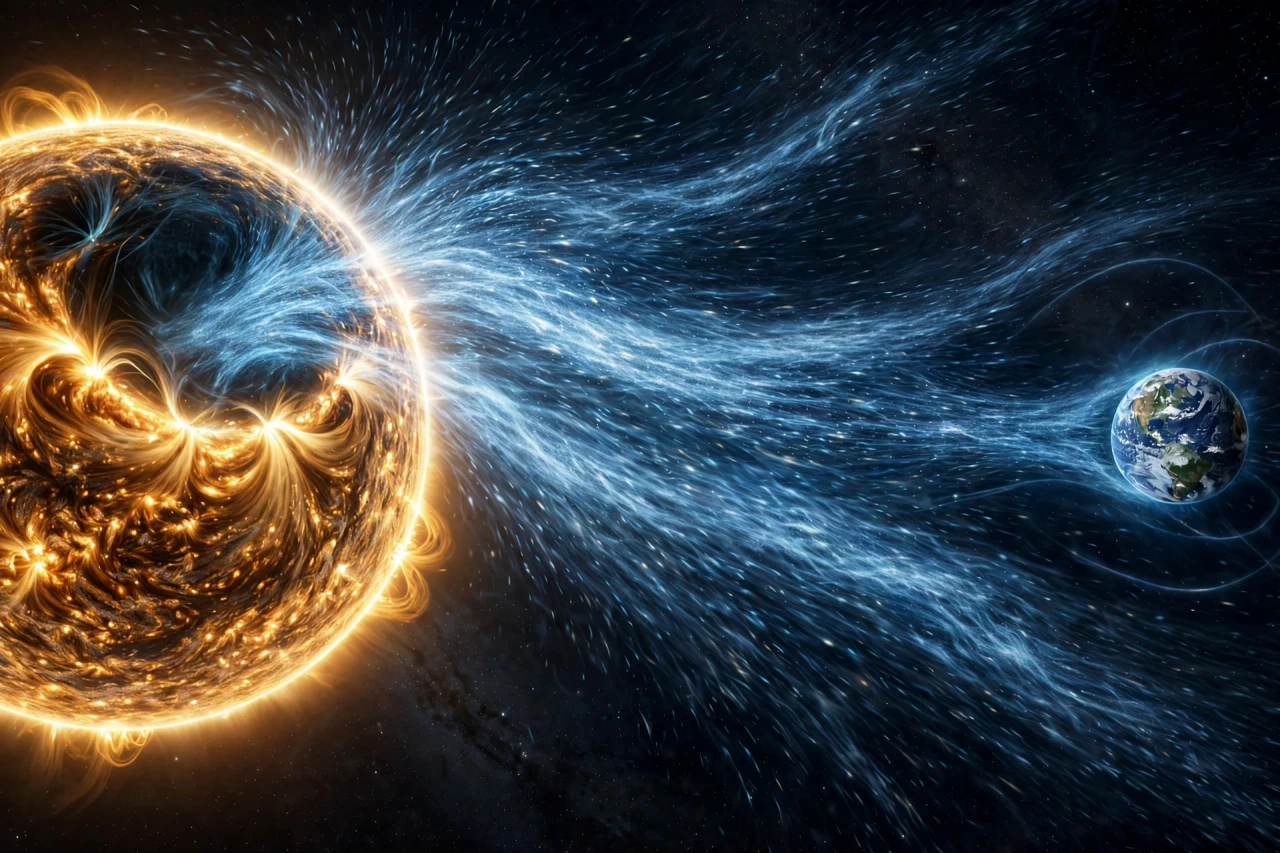
Illustration: Fast solar wind from a coronal hole, not a solar flare, drove the October 21 storm.
Background
Geomagnetic storms occur when bursts of solar wind or plasma clouds from the sun disturb Earth's magnetic field. NOAA classifies them on a scale from G1 (minor) to G5 (extreme). G1 storms are the weakest category and are relatively common — the sun produces many of them each year, particularly during active phases of its roughly 11-year solar cycle.
Coronal hole high-speed streams are one of the most frequent causes of G1-level storms. Unlike coronal mass ejections (CMEs) — explosive eruptions of plasma that can cause major storms — coronal hole streams are steadier flows of fast solar wind that recur as the sun rotates. Because coronal holes can persist for months, Earth can encounter the same stream roughly every 27 days, which is why NOAA publishes a 27-day outlook.
Typical effects of a G1 storm are modest: weak fluctuations in power grids at latitudes poleward of 60 degrees geomagnetic latitude, possible minor impacts on satellite operations, and expanded auroras. More severe storms can disrupt GPS, radio communications, and power infrastructure, but G1 events mainly bring pretty skies.
The auroral displays happen when charged particles from the solar wind collide with gases in Earth's upper atmosphere near the poles. Green auroras come from oxygen at lower altitudes; red and purple displays, seen higher up, require stronger storms.
Why It Matters
Space weather forecasting has matured from a niche science into critical infrastructure. Satellite operators, power grid managers, airlines flying polar routes, and GPS-dependent industries all rely on NOAA's alerts to prepare for disturbances. Each event like this one tests the forecasting chain — and this time, the timing was off by about a day, a reminder that prediction remains an inexact science.
For the public, G1 storms are mostly an opportunity rather than a threat: they bring the northern lights to latitudes that rarely see them. The October 21 event shows why aurora chasers watch forecasts closely — and why patience pays off when the storm runs late.
Scientifically, coronal hole streams offer a natural laboratory for studying how the solar wind couples with Earth's magnetosphere. The double-surge pattern observed this time — Kp 4 followed by Kp 5 — gives researchers data on how successive waves of solar wind interact with the magnetic field.
More broadly, understanding space weather is increasingly urgent as humanity depends more on space-based infrastructure. A moderate storm today is a drill for the major event that will eventually come.
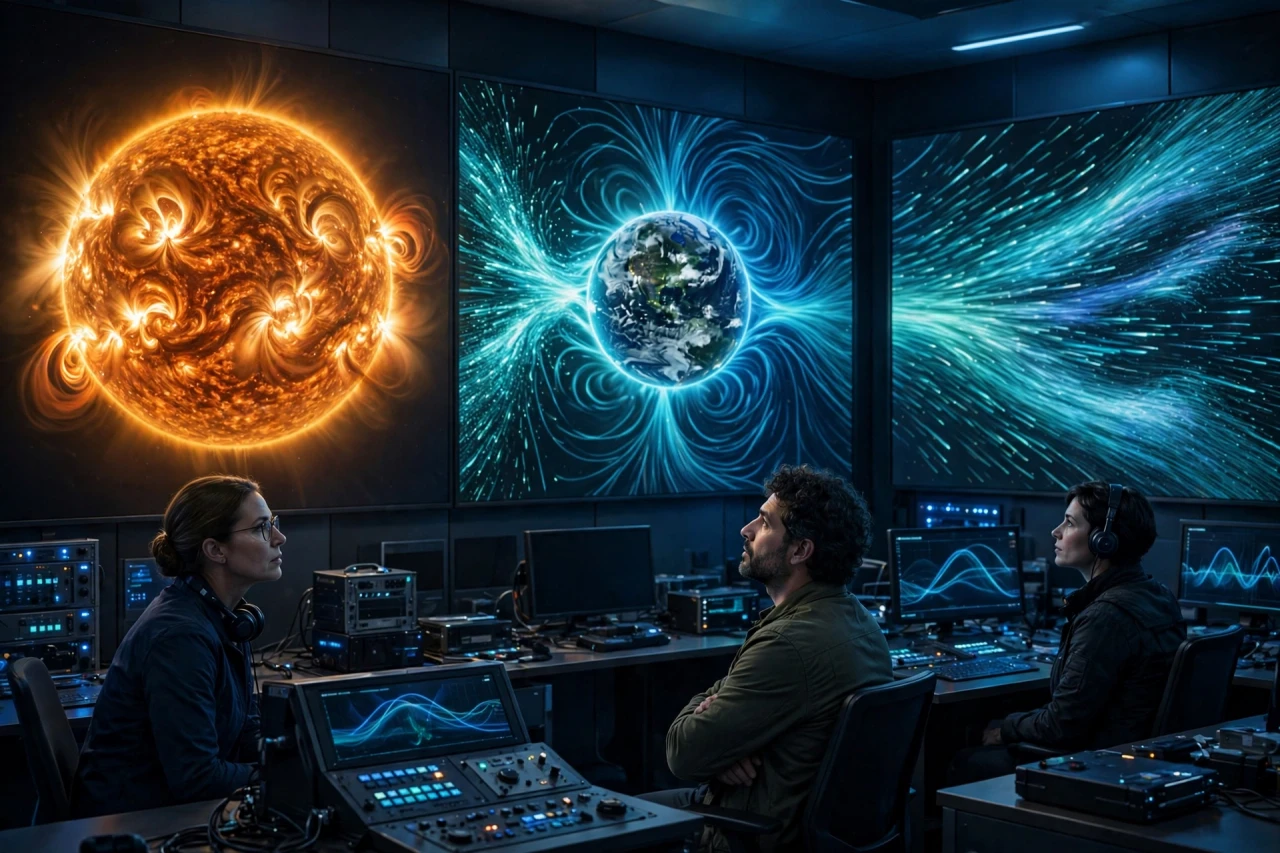
Illustration: Forecasters are watching a second coronal hole stream and a possible glancing CME later this week.
What Happens Next
Forecasters are watching two upcoming developments. A second coronal hole is currently sending its own fast solar wind toward Earth, expected to arrive late on October 23 or early on October 24, which could disturb the magnetic field again and bring a fresh chance of auroras at far northerly latitudes.
Beyond that, a slow coronal mass ejection launched on October 21 might deliver a weak glancing blow around October 26 or 27 — though forecasters give that possibility low confidence, and a glancing blow would likely produce only minor effects even if it arrives.
Looking further out, NOAA's 27-day outlook issued October 19 suggests another possible G1 storm around October 31, though confidence at that lead time is considerably lower.
Skywatchers at high latitudes should keep an eye on NOAA's aurora dashboard and EarthSky's daily sun news for updates as the second stream approaches. Conditions are expected to stay relatively quiet in between disturbances.
Sponsored: explore today's featured sponsored offers
FAQ
What is a G1 geomagnetic storm?
It is the weakest category on NOAA's five-level geomagnetic storm scale (G1 to G5). G1 storms can cause weak power grid fluctuations at high latitudes, minor effects on satellite operations, and expanded auroras — but they pose no danger to people on the ground.
What caused this storm?
A stream of fast solar wind from a coronal hole on the sun — a region where magnetic field lines open into space — reached Earth on October 21. The Kp index hit 5 at 23:59 UTC, crossing the G1 threshold about a day later than forecast.
Where could the auroras be seen?
Auroras were most likely over Alaska and northern Canada, with the potential to extend to the northern tier of the United States, such as northern Michigan and Maine, during the peak of the storm.
Will there be more storms this week?
A second coronal hole stream is expected to reach Earth late on October 23 or early on October 24, and a slow coronal mass ejection launched October 21 might deliver a weak glancing blow around October 26–27, though forecasters have low confidence in that scenario.
How can I track space weather?
NOAA's Space Weather Prediction Center publishes aurora forecasts and 3-day outlooks, and EarthSky posts daily sun news updates — both are reliable sources for planning aurora viewing.
Sources
- EarthSky — "Sun news October 22: Geomagnetic storm arrived last night," October 22, 2026.
- NOAA Space Weather Prediction Center — 3-Day Forecast, issued October 22, 2026, 00:30 UTC.
- Cosmic Herald — "The G1 Storm Arrived a Day Late, and a Second Coronal Hole Is Next," October 22, 2026.
Comments
Post a Comment