
One Year Into Gaza's Fragile Ceasefire: Aid Shipments Resume as Death Toll Tops 1,500
On Monday, October 19, 2026, Israel said it would resume allowing commercial goods shipments into Gaza after a days-long halt over a tax dispute involving Hamas and merchants — restoring a key route for food and other essentials to the aid-dependent enclave — even as the one-year accounting of the U.S.-brokered ceasefire turned sobering: Gaza health authorities say more than 1,522 Palestinians have been killed by Israeli attacks since the truce took effect in October 2025, and more than 100 humanitarian organizations declared on October 9 that the ceasefire "exists in name only."
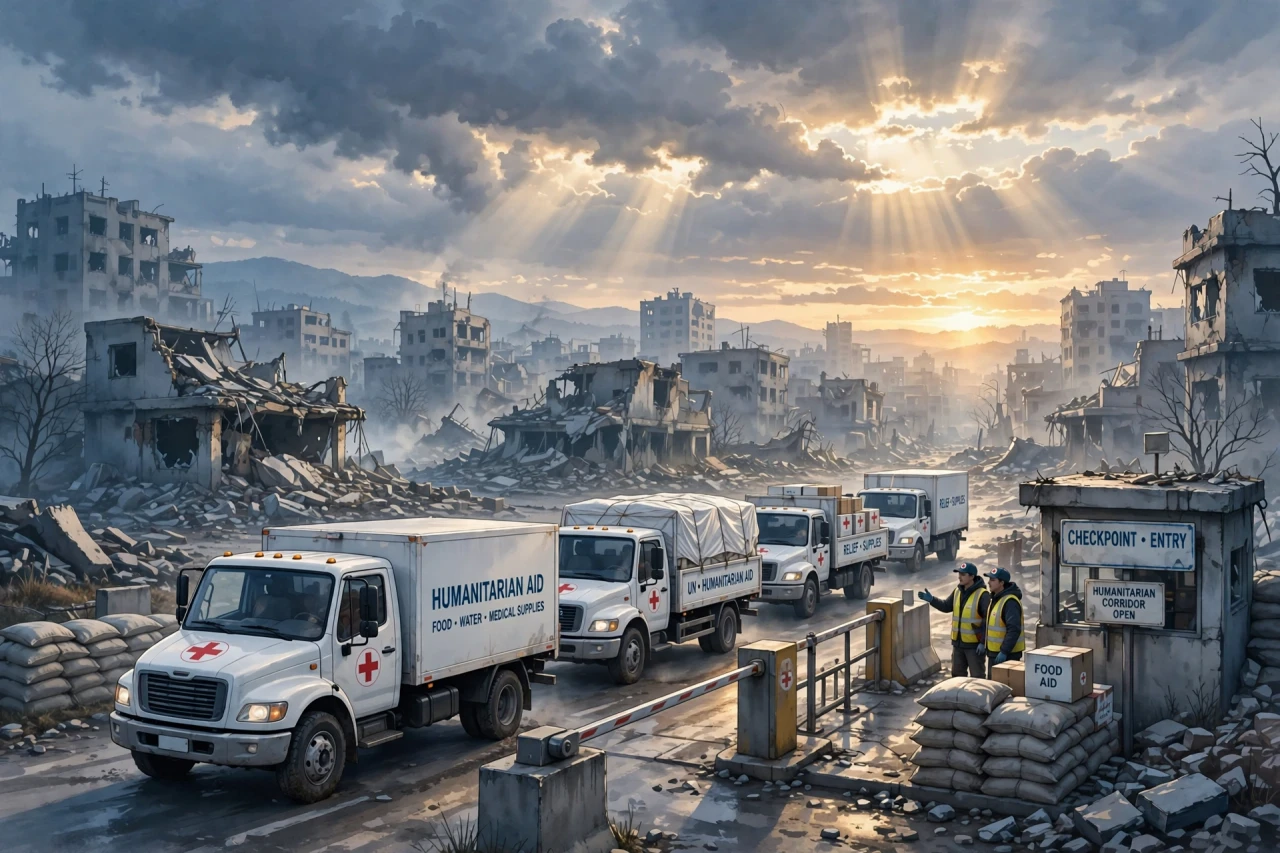
Illustration: Illustration of humanitarian aid trucks crossing a checkpoint into a damaged city at dawn
What Happened
Israel's decision, reported by Reuters on October 19, restores commercial shipments that had been halted for days over a dispute about payments demanded by Hamas authorities. COGAT, the Israeli military agency overseeing humanitarian affairs in Gaza, said it made the decision after merchants reported that Hamas authorities had withdrawn demands for payments of 10,000 shekels — about $3,225 — per truck. "The resumption of coordination is being carried out in accordance with Israel's commitment to the humanitarian provisions of the ceasefire agreement," COGAT said.
According to Reuters, COGAT said the merchants' accounts had not been independently verified and that shipments would resume gradually, with priority given to essential goods ahead of winter. Oversight would be tightened to ensure payments move only through documented bank transfers, with any merchant found to have paid Hamas facing exclusion from the system. Hamas said the 10,000-shekel fee was a voluntary contribution by better-off Gazans to a national fund supporting people in need in the war-ravaged territory.
The announcement came on the same day Gaza's health ministry updated the ceasefire-period death toll: more than 1,522 Palestinians killed and 5,421 injured since October 11, 2025, with 839 bodies recovered from areas Israeli forces withdrew from, according to the Spanish outlet Demócrata, which cited the ministry's statement on October 19. Local health officials also said at least five Palestinians, including a 14-year-old boy, were killed in separate Israeli strikes in Gaza City and Khan Younis on October 19; the Israeli military did not immediately comment, Reuters reported.
Israel says Hamas has continued to rearm and carry out attacks in violation of the ceasefire, while Hamas accuses Israel of undermining the agreement. Gaza health officials say about 1,500 Palestinians have been killed by Israeli fire since the October 2025 ceasefire, while Israel says four of its soldiers have been killed by militants in Gaza over the same period, according to Reuters.
Background
The ceasefire agreement was reached in October 2025 following the United States' proposal regarding the future of the enclave, after indirect negotiations between Hamas and Israel in Sharm el-Sheikh, Egypt. The deal — the first phase of then-President Donald Trump's Gaza plan, announced October 9, 2025 — was intended to end the war, secure an Israeli withdrawal from Gaza, and facilitate a prisoner exchange, according to a year-one assessment published by Veritas Press.
Twelve months later, the core political and security provisions exist largely on paper. In a joint statement issued October 9, 2026, more than 100 humanitarian, human rights and civil society organizations said the ceasefire "exists in name only," reporting that over the past year Israeli strikes, shootings and military operations killed more than 1,400 Palestinians, including at least 327 children. Nearly two million Palestinians still need shelter, not a single one of Gaza's 36 hospitals is fully functioning, and around 1.4 million people face crisis-level acute food insecurity or worse, the organizations said in a document hosted by terre des hommes.
The central deadlock is disarmament versus withdrawal. In July 2026, negotiators appeared to make progress when Hamas accepted gradual, sequenced disarmament linked to phased Israeli withdrawal — but Prime Minister Benjamin Netanyahu subsequently rejected withdrawal before complete disarmament, according to an assessment published by Open Christian Education citing AP reporting. Each side requires the other's irreversible step first: Israel argues withdrawal before disarmament risks renewed attack; Hamas argues surrendering weapons before withdrawal removes its remaining leverage.
The enforcement machinery has also stalled. The international stabilization force announced in February was never established — Indonesia suspended its 8,000-troop pledge last spring — Hamas formally dissolved its government in July while keeping the civil service, and Israel barred the new Palestinian administration from entering through Egypt, according to a Magna Bureau assessment published October 12. Instead of withdrawing, Israel has expanded the area it controls from 53 percent to roughly 64 percent of the territory over the past year, according to northjersey.com citing UN reporting.
Illustration: Illustration of a white dove carrying an olive branch over a divided landscape with barbed wire
Why It Matters
The first anniversary is the moment the world checks the ledger — and the ledger is devastating. The October 9 joint statement from more than 100 organizations translates the child death toll into a rate of nearly one child killed every day since the agreement was announced. Families and rescue workers have recovered hundreds of bodies from the rubble, often with their bare hands, because restrictions keep the heavy machinery needed to reach them out of the territory — and many more bodies remain buried and unreachable, the organizations reported.
The humanitarian picture explains why the commercial-shipments decision matters so much. Most Gazans remain dependent on aid after three years of war, repeated displacement and severe restrictions on deliveries, Reuters noted. The UN's World Food Programme said on October 18 that 1.4 million people in Gaza are suffering acute food shortages and that funding gaps are forcing cutbacks in critical aid, according to an NPR report carried by KVCR. With winter approaching, the resumption of commercial shipments — a route for food and essentials beyond the humanitarian pipeline — is a lifeline, however fragile.
The United States, the deal's broker, has taken a different tone. In an October 13 statement, the State Department hailed "remarkable achievements" that "have built the foundations for a new Gaza," saying the administration was making "real progress toward a demilitarized Gaza, where Palestinians can live without Hamas rule and Israel can have genuine and lasting security." The gap between that assessment and the organizations' "in name only" verdict captures the central dispute of the ceasefire's second year: whether the agreement is a foundation still being built, or a structure that has already failed.
There is also a legal and diplomatic dimension. UN Secretary-General António Guterres appealed ahead of the anniversary: "It is time for the ceasefire to become permanent. It is time to allow humanitarian assistance at scale. And it is time to respect international law," according to the Magna Bureau assessment. Human Rights Watch's Sarah Sanbar warned that "the outside world may be under a dangerous illusion that life in Gaza is returning to normal, but reality tells a very different story."
What Happens Next
The immediate test is the shipment resumption itself: whether commercial goods actually flow in meaningful volume, whether the documented bank-transfer system holds, and whether the Hamas fee dispute stays resolved. With winter weeks away and 1.4 million people facing crisis-level hunger, the margin for another halt is essentially zero.
The larger question is whether the ceasefire's second year can deliver what the first did not: a functioning Palestinian administration inside Gaza, a deployed stabilization force, the start of reconstruction — the World Bank has put the estimated cost of recovery at approximately $71.5 billion — and an end to the daily strikes. None of these has a scheduled date.
The disarmament deadlock will likely define the diplomacy. Until the sequencing dispute — withdrawal before disarmament, or disarmament before withdrawal — is broken, the truce will remain what the past year has shown it to be: a halt to the heaviest fighting, but not an end to the killing, the hunger, or the waiting.
Illustration: Illustration of tents in a refugee camp with construction cranes rebuilding houses on the horizon
Sponsored: explore today's featured sponsored offers
FAQ
What did Israel announce on October 19?
Israel said it would resume allowing commercial goods shipments into Gaza after a days-long halt over a tax dispute involving Hamas and merchants, restoring a key route for food and other essentials. Shipments will resume gradually with priority for essential goods ahead of winter, under tightened oversight requiring documented bank transfers.
How many Palestinians have been killed despite the ceasefire?
Gaza's health ministry reported on October 19 that more than 1,522 Palestinians have been killed and 5,421 injured since October 11, 2025, with 839 bodies recovered from withdrawal areas. More than 100 humanitarian organizations reported that over 1,400 Palestinians, including at least 327 children, were killed in the ceasefire's first year.
Why do more than 100 organizations call the ceasefire "in name only"?
In their October 9 joint statement, the organizations cited daily Israeli strikes, shootings and military operations; restrictions on aid, equipment and rebuilding materials; nearly two million people still needing shelter; no fully functioning hospital; and 1.4 million people facing crisis-level hunger — conditions they say are incompatible with any meaningful definition of a truce.
What is the disarmament deadlock?
In July 2026, Hamas accepted gradual, sequenced disarmament linked to phased Israeli withdrawal, but Prime Minister Netanyahu rejected withdrawal before complete disarmament. Each side demands the other's irreversible step first, while the planned international stabilization force was never deployed.
What comes next for the ceasefire?
The immediate test is whether commercial shipments flow in real volume through winter. The larger unresolved items — a functioning Palestinian administration, a stabilization force, reconstruction estimated at $71.5 billion, and an end to daily strikes — have no scheduled dates, and the second year of the truce will be defined by whether the disarmament sequencing dispute can be broken.
Sources
- Reuters, "Israel to resume commercial shipments to Gaza after Hamas fee dispute" (October 19, 2026) — reuters.com
- Demócrata, "More than 1,520 Palestinians dead in Gaza due to Israeli attacks despite the ceasefire" (October 19, 2026) — democrata.es
- terre des hommes / 100+ organizations, "Gaza ceasefire exists in name only" joint statement (October 9, 2026) — tdh.de
Comments
Post a Comment