
BERLIN — Germany is heading into winter with its natural gas storage at a record seasonal low, prompting the country's gas storage industry to demand stricter filling rules after reserves reached just 61.35% on 30 October 2026, well short of the November target.
Gas storage industry association INES said on Sunday, 1 November 2026, that Germany must review and improve the mechanism for filling its underground caverns, warning that the failure to meet storage targets shows reserves for coming winters must be guaranteed more rigorously. Berlin has said there will be no supply bottlenecks, but the shortfall has reignited a dispute with Italy and raised fears about winter energy costs across Europe.

Illustration: An underground natural gas storage cavern in Germany with a low fill gauge. This is an AI-generated illustration, not a real photograph of the facility.
What Happened
As of 30 October, German gas storage stood at 61.35%, according to data cited by Reuters, compared with an 80% target Germany had set for 1 November. The level is a record low for this point in the year in Gas Infrastructure Europe data going back to 2011, according to reporting on the figures, and sits well below the European Union average of about 75%.
INES managing director Sebastian Heinermann said in a statement that the main driver of the lower storage levels has been the Iran war and its impact on prices, which made filling caverns over the summer uneconomical. He said it was right and important that the Federal Ministry for Economic Affairs is open to introducing an obligation on suppliers, and that specific options for the design of a storage obligation should be discussed at the earliest opportunity so it can be enshrined in law without delay.
INES said it has prepared a report together with gas grid operator association FNB Gas that it says will help inform the political process around any change to the storage rules.
Germany on Friday rejected accusations from Italy that it had failed to fill its gas stores ahead of winter in order to reduce costs for its gas import companies to prepare them for privatisation, Reuters reported. Italy, which filled its own stores to about 91% after early state intervention, has publicly blamed German buying patterns for raising European wholesale prices, and Italian officials have warned the European benchmark could rise to €150–€180 per megawatt-hour in a cold January.
Background
Germany's storage shortfall did not appear overnight. Since the Iran war began in late February 2026, disruptions to shipping through the Strait of Hormuz have removed a large share of liquefied natural gas exports from Qatar and the United Arab Emirates, tightening global supply and pushing European prices sharply higher.
The Dutch TTF benchmark, Europe's price reference, briefly crossed €100 per megawatt-hour on 28 October for the first time since December 2022, according to market reporting. That is more than triple the level seen before the Iran war began, and it made summer refilling commercially unattractive: with wholesale prices high, storage operators had little incentive to inject gas that might later be sold at a loss.
Germany's own rules add a layer of complexity. A 2025 ordinance cut the 1 November requirement from 90% to 80% for most sites, while a handful of sites, including Rehden, must reach only 45%. Reporting on the regulator's figures puts the effective average target at roughly 70% — meaning Germany missed even that lower effective benchmark by a wide margin.
The federal network regulator, the Bundesnetzagentur, has said supplies remain secure, pointing to Germany's LNG terminals, Norwegian pipeline supplies and access to a highly integrated European gas network. It has also acknowledged, however, that current storage levels are significantly lower than in comparable periods in recent years and that it is taking the situation seriously. The Economy Ministry has maintained that even an exceptionally cold winter could be managed, while acknowledging that higher storage would be preferable.
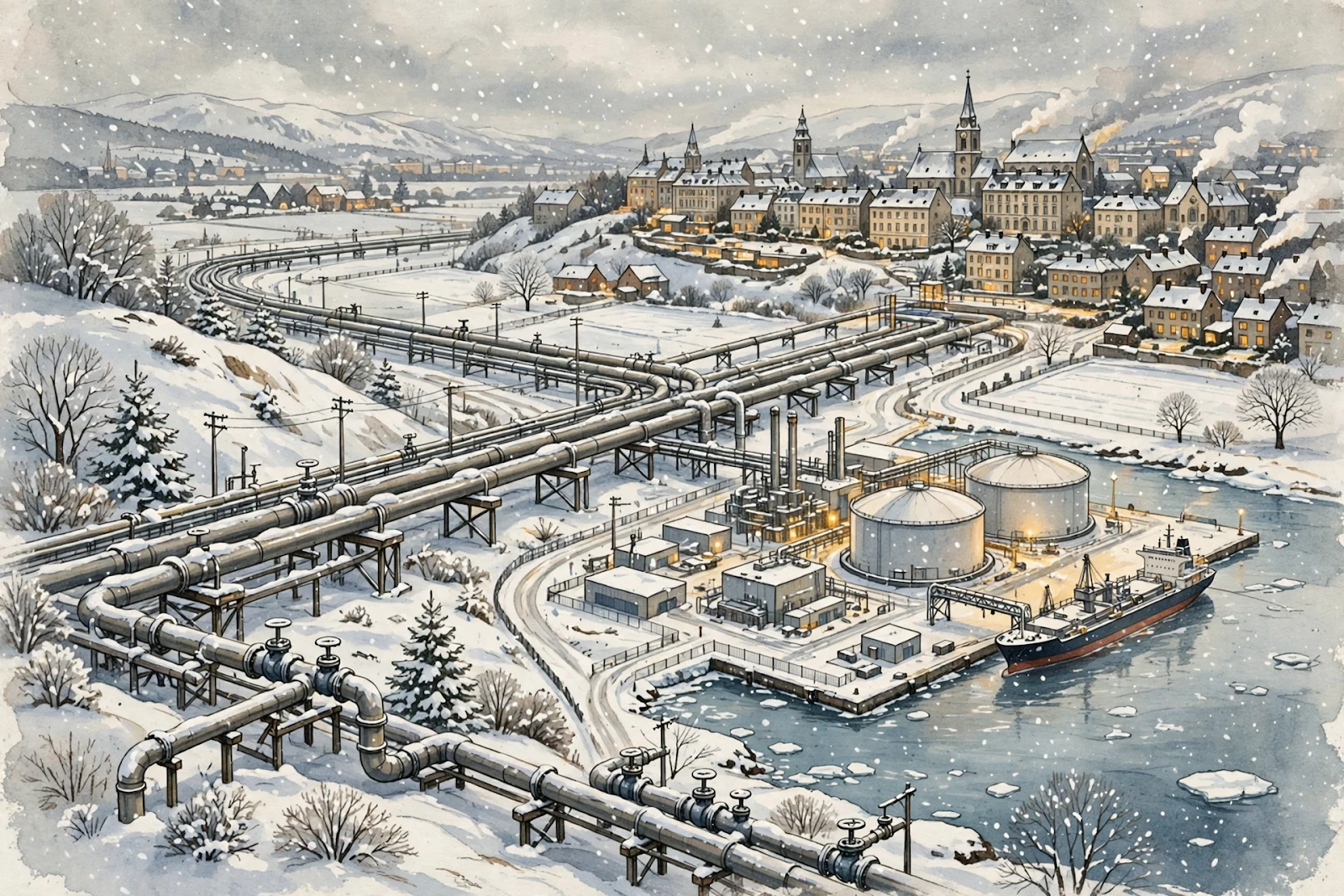
Illustration: European gas pipelines and an LNG terminal in winter. This is an AI-generated illustration, not a real photograph of the infrastructure.
Why It Matters
Storage is Europe's winter buffer. It typically supplies 25%–30% of the gas consumed in the EU during winter, so a thin cushion leaves the bloc more exposed to cold snaps, supply disruptions and competition for spot LNG cargoes with Asia, where prices have also jumped to their highest since 2022.
The cost channel matters as much as the physical one. Wholesale gas prices feed into electricity prices through gas-fired power plants, which often set the marginal price at peak demand, and into household bills as fixed contracts come up for renewal. Reporting on German retail tariffs says gas prices for new customers have already risen 55% this year, from 8 euro cents to 12.4 euro cents per kilowatt-hour, and analysts warn consumers are likely to feel the full effect of this year's wholesale rally in 2027.
For German industry, the stakes are competitiveness. German front-year baseload electricity contracts have hit their highest since June 2023, and a further price spike would widen the gap with the United States, where comparable gas prices sit far lower. For households, the question is how much of the wholesale surge governments absorb through subsidies — the EU has already spent €17.9 billion in 2026 subsidising energy costs, according to reporting — and how much lands on bills.
The dispute with Italy also matters politically. It exposes tensions inside the EU's post-2022 storage framework, under which member states retain a 90% filling target but have greater flexibility over when it is achieved, between 1 October and 1 December. Germany's level alone does not by itself establish a breach of EU requirements, but the row shows how national storage choices now spill across borders through prices.

Illustration: Policymakers debating energy policy in Berlin with gas storage charts. This is an AI-generated illustration, not a real photograph of a meeting.
What Happens Next
The immediate test is the weather. A normal winter would, according to the regulator, be covered, but storage would end very low by winter's end. A colder-than-normal winter could push European storage down sharply and, according to analysts cited in market reporting, could send the benchmark past €200 per megawatt-hour in the worst case.
The policy test follows quickly. INES and FNB Gas want a storage obligation for suppliers discussed and legislated without delay, so the failure is not repeated next summer. Berlin is separately preparing to replace mandatory storage-filling targets with a national strategic gas reserve from 2027, with a draft reported to envisage a reserve of about 24 terawatt-hours, designed to cover the loss of Germany's largest gas-import infrastructure for around 30 days and financed by a consumer levy.
Traders will also watch whether the Strait of Hormuz disruption eases and whether Asian LNG demand competes with Europe for cargoes as temperatures fall on both continents. Even if winter proves mild, analysts expect at least another year of high prices, because Europe will need to restock reserves depleted to record lows — and restocking itself will keep prices elevated into 2027.
Sponsored: explore today's featured sponsored offers
FAQ
How full is Germany's gas storage?
German gas storage stood at 61.35% on 30 October 2026, according to Reuters, a record low for this time of year and well below the 80% target set for 1 November.
Why is German storage so low?
According to INES, the Iran war pushed prices higher, making it uneconomical to fill caverns over the summer. High wholesale prices removed the commercial incentive to inject gas during the usual refilling season.
Does this mean Germany will run out of gas?
Berlin and the network regulator say supply for the coming winter is secure, citing LNG terminals, Norwegian pipeline gas and the integrated European network. The risk is higher prices and a very low buffer, not an outright shortage, according to officials and analysts.
What is INES asking for?
INES wants Germany to review and improve its filling mechanism and to discuss a legal storage obligation for suppliers at the earliest opportunity, so storage levels for coming winters are guaranteed more rigorously.
What happens to the storage targets after 2026?
Berlin plans to replace mandatory filling targets with a national strategic gas reserve from 2027, reported to hold about 24 terawatt-hours and financed by a consumer levy.
Sources
- Reuters, "Germany must do more to boost gas reserves as storage levels hit record low, lobby group says," 1 November 2026.
- Reuters reporting on European gas prices, German storage levels and the Italy-Germany dispute, 28–31 October 2026.
- Gas Infrastructure Europe (AGSI+) storage data, via Reuters and market reporting, October 2026.
Comments
Post a Comment