
BERLIN, 28 October 2026 — Germany's trade deficit with the Asia-Pacific region is set to hit a record of nearly €146 billion ($163 billion) in 2026, according to a report by the state-owned trade promotion agency Germany Trade & Invest (GTAI) seen by Reuters, as falling exports to China outweigh growing sales elsewhere in Asia.

Illustration: A busy container port with cargo ships and cranes at sunrise.
What Happened
The GTAI report, published as Chancellor Friedrich Merz tours Asia, projects that German exports to 29 core Asia-Pacific economies will fall 3.2 percent this year to €185.3 billion, while imports from the region will rise 6.4 percent to €330.9 billion. The resulting deficit of almost €146 billion would be the largest Germany has ever recorded with the region, and it underlines how sharply the country's export engine has slowed in its most important growth market of recent decades.
China is the dominant factor. The country accounts for around half of Germany's goods trade with Asia-Pacific, and its weakening demand for German products has an outsized effect on the overall figures. Excluding China, German exports to the region would actually grow by 2.8 percent in 2026, and the trade deficit with Asia-Pacific would narrow to just under €35 billion — a striking illustration of how concentrated the problem has become.
The sectoral detail is stark. German machinery exports to China fell 18 percent in the first seven months of 2026 compared with a year earlier, according to the report, while automotive exports dropped 30 percent over the same period. German car sales in China have nearly halved from a peak of more than five million vehicles, GTAI said, as local manufacturers gain ground in electric cars and benefit from their control over battery supply chains.
Not every Asian market is shrinking for Germany. India is becoming a more important market and supplier for German companies, the report found, with German exports to India nearly doubling over the past decade — as have imports from the South Asian country. But India's growth, from a much smaller base, cannot yet offset the scale of the China slowdown.
Background
Germany's post-war economic model was built on exporting high-quality machinery, vehicles and chemicals to the world, and China was its great success story of the past quarter-century. German carmakers built vast businesses serving Chinese consumers, German machine-tool firms equipped Chinese factories, and German engineering became shorthand for the industrial quality China's rising middle class wanted to buy.
That relationship has been transformed by China's own industrial rise. Chinese companies have expanded domestic production of advanced technology, machinery and electric vehicles, displacing German suppliers in their home market and increasingly competing with them abroad. Beijing's push for self-sufficiency in strategic sectors, from semiconductors to batteries, has narrowed the space in which German firms once enjoyed a near-monopoly on quality.
The shift has been accompanied by a political rethink in Berlin. Germany now describes China as simultaneously a partner, a competitor and a systemic rival, and successive governments have urged companies to reduce risky dependencies on single markets — a strategy known as de-risking. The GTAI figures show why that debate has become urgent: the deficit is not a one-year blip but the product of structural change in what China buys, and from whom.
The report landed in the middle of Merz's week-long trip to Asia, which takes in Japan, South Korea and Singapore from Monday to Friday. On Tuesday, Merz called for European and Asian middle powers to build a strategic alliance in trade, technology and security, and in Tokyo on Wednesday he urged Japan to back a proposed global alliance to defend rules-based trade. "Should the rules of the global trading system be violated by others, or should economic coercion be employed, we could coordinate our actions within the alliance and present a united front," he told a business summit in Tokyo, according to prepared remarks reported by Reuters.

Illustration: A German car factory assembly line with robotic arms.
Why It Matters
The record deficit matters because it challenges the central assumption of Germany's economic model: that world-class manufacturing will always find buyers. If the world's second-largest economy no longer needs German machines and cars at the old scale, Germany must find new markets, new products or new sources of growth — and none of those adjustments is quick or painless.
It matters for Europe, too. Germany is the European Union's largest economy and its export performance shapes the bloc's overall trade balance and fiscal room. A weaker German export sector means slower growth, lower tax revenues and less political appetite for the costly transitions — to green energy, to digital infrastructure, to higher defence spending — that European leaders have promised.
The figures also sharpen the debate about how Europe should handle China. Merz has warned against full economic decoupling from China but said Europe and Asia must reduce what he called "unhealthy, one-sided dependencies." China, for its part, responded to his alliance proposal by saying it hoped Germany and the European Union would remain "objective and rational" and be reliable partners, with foreign ministry spokesperson Guo Jiakun telling a regular briefing that Beijing was committed to working with all parties to maintain the stability of global industrial and supply chains.
That exchange captures the dilemma. Europe wants to keep trading with China — a market too large to abandon — while reducing its vulnerability to Chinese pressure and competition. The GTAI numbers suggest the market itself is already doing part of that decoupling, whether policymakers want it or not, as Chinese demand for German goods falls away.
What Happens Next
Merz's Asia trip continues through South Korea and Singapore, where trade, technology and security cooperation will dominate the agenda. His middle-powers alliance idea — echoing calls this year by Canadian Prime Minister Mark Carney for smaller economies to work together against pressure from larger ones — will be tested by how many partners are willing to sign up to coordinated action. "If we move forward together, the question will no longer be whether we are 'on the menu' or 'sitting at the table'," Merz said in Tokyo, invoking a line used by Carney in January. "Because in that case, the restaurant itself belongs to us."
German companies, meanwhile, face a strategic choice that no summit can make for them: whether to localise more production in China to defend market share, pivot harder toward India and Southeast Asia, or retrench toward higher-margin niches where Chinese competitors cannot yet follow. The GTAI data suggests the India and Southeast Asia pivot is already under way, but at a scale that will take years to replace the China business.
Economists will also watch the full-year trade data for confirmation of the GTAI forecast, and Brussels for any shift in the EU's trade stance toward Beijing. European Trade Commissioner Maros Sefcovic has pressed for tangible results from trade talks with China, warning that the bloc's widening trade gap with Beijing is not sustainable. The record German deficit will add weight to that argument — and to the case, made by critics of engagement, that Europe's China strategy needs a fundamental rethink.
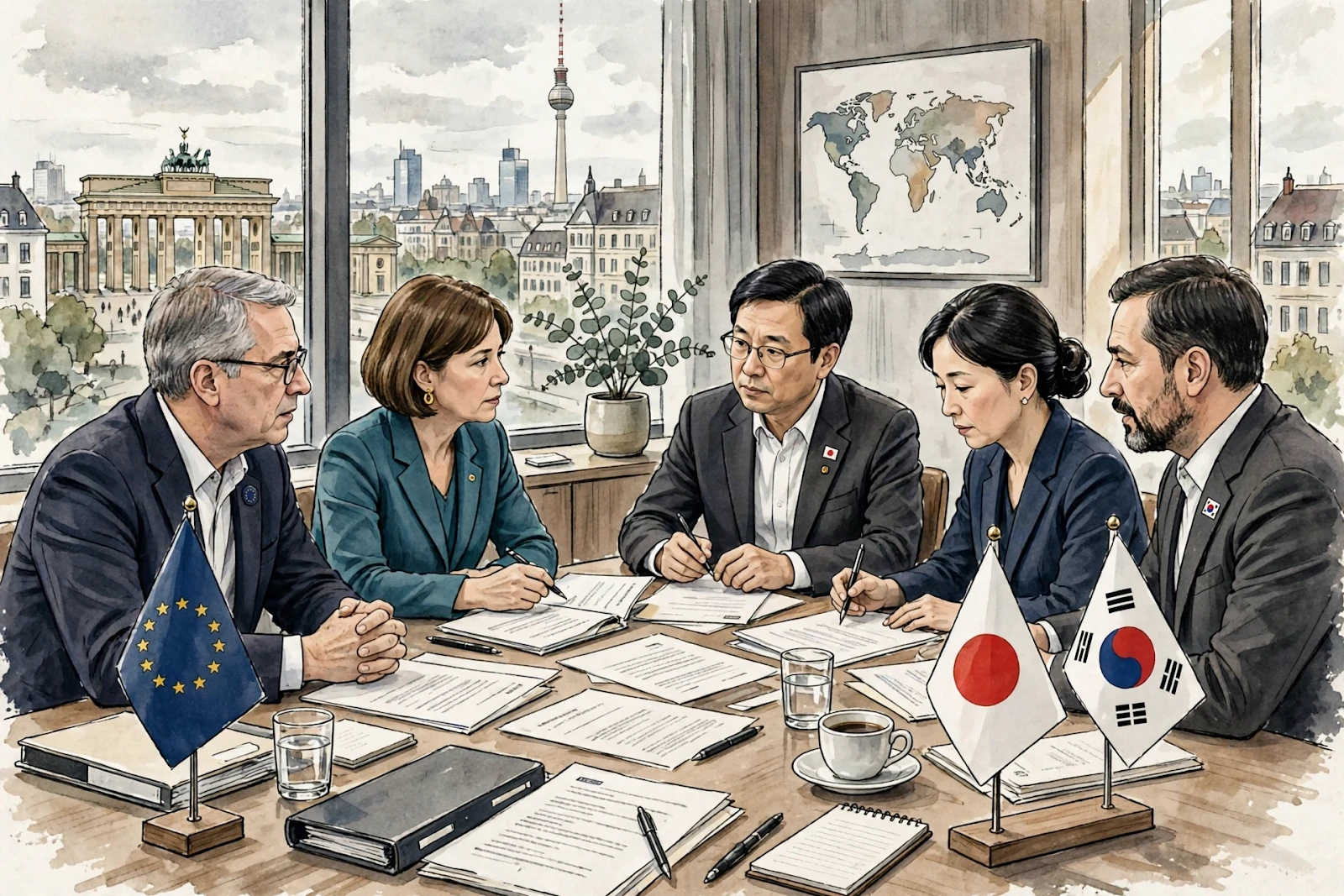
Illustration: Trade officials meeting around a table with European and Asian flags.
Sponsored: explore today's featured sponsored offers
FAQ
How large is Germany's projected trade deficit with Asia-Pacific in 2026?
Nearly €146 billion ($163 billion), according to the Germany Trade & Invest (GTAI) report seen by Reuters — a record for Germany's trade with the region.
Why is the deficit so large?
German exports to 29 core Asia-Pacific economies are expected to fall 3.2 percent to €185.3 billion while imports rise 6.4 percent to €330.9 billion. Falling exports to China, which accounts for around half of Germany's goods trade with the region, are the main driver.
Which German industries are hit hardest in China?
Machinery exports to China fell 18 percent in the first seven months of 2026 from a year earlier, and automotive exports dropped 30 percent. German car sales in China have nearly halved from a peak of more than five million vehicles.
Is every Asian market shrinking for German exporters?
No. Excluding China, German exports to the region would grow by 2.8 percent in 2026. India is a bright spot: German exports to India have nearly doubled over the past decade, as have imports from India.
What is Chancellor Merz proposing in response?
During his Asia trip, Merz urged Japan and other middle powers to back an alliance of "like-minded partners" to defend rules-based trade and coordinate against tariffs and economic coercion, while warning against full economic decoupling from China.
Sources
- Reuters, "Germany set for record trade deficit with Asia-Pacific in 2026, report says" (GTAI report), 28 October 2026
- Reuters, "Merz invites Japan to back trade alliance as China asks Germany to be 'rational'", 28 October 2026
- Reuters, "China calls on Germany, EU to be rational on trade, supply chain", 28 October 2026
Comments
Post a Comment