
ACCRA — Ghana has closed its type 2 poliovirus outbreak, health officials announced on 24 October 2026 as the country marked World Polio Day, after keeping national immunisation coverage above 95% and passing rigorous assessments that verified transmission had been halted.

Illustration: A health worker vaccinating a young child at a community clinic in Ghana, representing the immunisation campaign behind the outbreak closure.
What Happened
The Ghana Health Service (GHS) confirmed in a statement signed by its Director-General, Dr Samuel Kaba Akoriyea, and issued on Saturday 24 October 2026, that Ghana's type 2 poliovirus outbreak was formally closed in August 2026. The announcement was timed to World Polio Day 2026, observed this year under the theme "One Day, One Focus: Ending Polio for Good".
The closure was verified through Outbreak Response Assessments (OBRA), the formal evaluations that judge whether a country's response has actually stopped poliovirus transmission. Ghana is one of five African countries to have closed type 2 poliovirus outbreaks in August 2026; the others are Burundi, Guinea-Bissau, the Republic of the Congo and Uganda, according to the GHS statement and the global Make Polio History campaign.
The achievement was delivered by Ghana's Ministry of Health and the GHS in partnership with the World Health Organization (WHO), UNICEF, Gavi, Rotary International and the United States Centers for Disease Control and Prevention (CDC). "This milestone, confirmed through rigorous Outbreak Response Assessments, demonstrates Ghana's strong surveillance, immunisation, and rapid response systems," the GHS said.
Background
Polio is a viral disease that can cause irreversible paralysis, and in a small proportion of cases death, by attacking the nervous system. It mainly affects children under five, and there is no cure — prevention rests entirely on vaccination. The type 2 poliovirus at issue here is the strain targeted by the global eradication effort's current phase: wild poliovirus type 2 was declared eradicated in 2015, but vaccine-derived type 2 viruses can still circulate in under-immunised populations, which is why outbreaks of this kind require a full response even in countries without endemic polio.
Ghana's result rests on years of investment rather than a single campaign. The country introduced the Inactivated Polio Vaccine (IPV) into its routine immunisation programme in 2018 and added a second IPV dose in 2024. Since then, according to the GHS, national immunisation coverage has consistently remained above 95% — the level generally needed to keep poliovirus from finding enough susceptible children to sustain transmission.
That coverage was built on four pillars the GHS itself names: routine immunisation, supplementary vaccination campaigns, outbreak response measures, and sustained mobilisation within communities. Community mobilisation matters more than it may sound: in practice, closing an outbreak means reaching every child in every settlement, including in areas where families may be wary of vaccinators, hard to reach, or simply unaware a campaign is running. "These strategies have ensured the absence of endemic polio cases in the country," the GHS statement said.
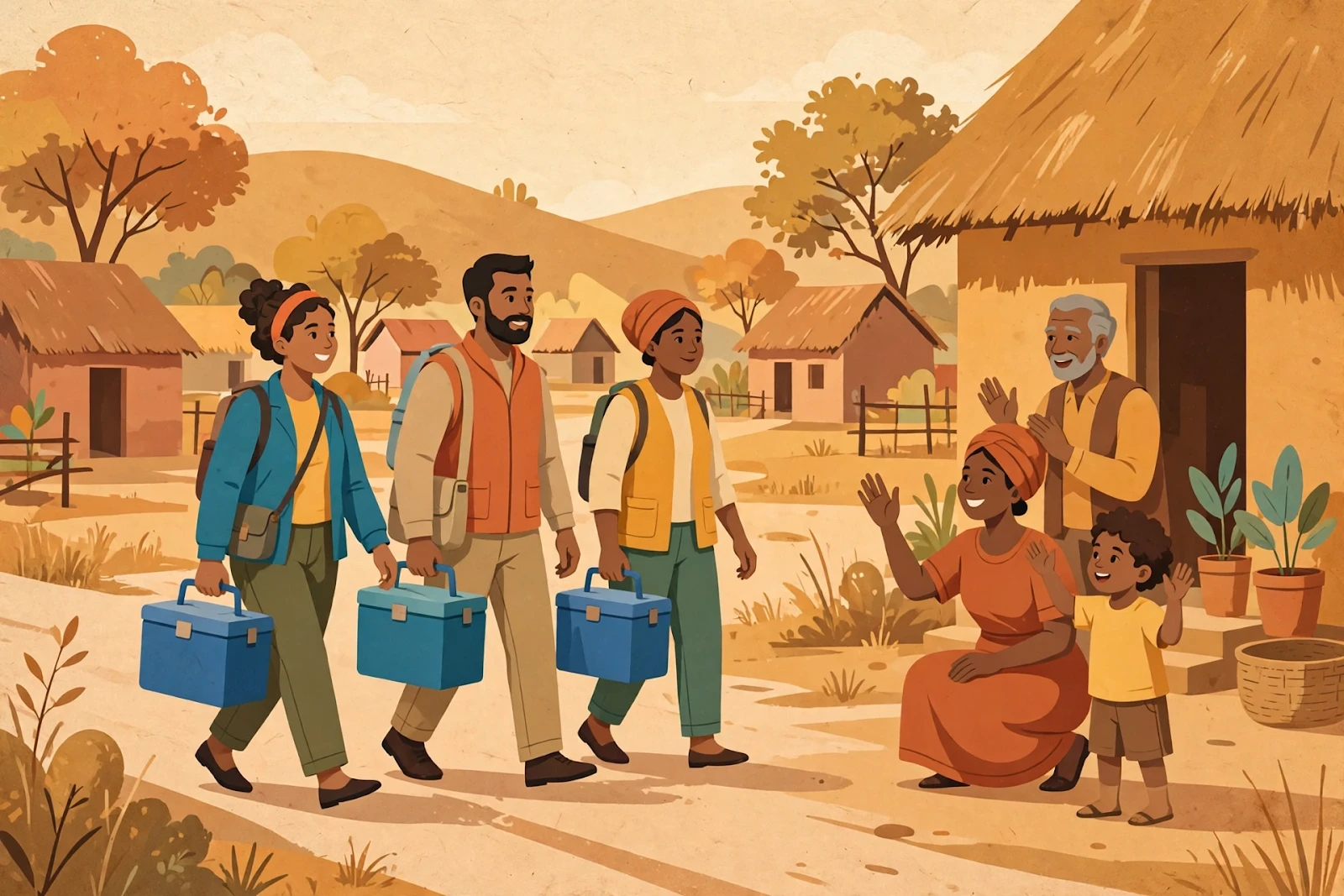
Illustration: Community health workers walking through a village with vaccine cool boxes, representing the community mobilisation behind Ghana's polio campaign.
Why It Matters
Ghana's closure is significant for two reasons. First, it is proof — in a year when global health funding is under strain and several outbreaks elsewhere continue to spread — that the basic eradication playbook still works when it is actually carried out: high routine coverage, fast outbreak response, verified surveillance, and community trust built over years rather than weeks.
Second, it is a reminder that progress is fragile and reversible. The GHS itself warned against complacency, and its warning is the oldest one in the eradication campaign: "A polio case anywhere is a polio case everywhere." As long as poliovirus circulates anywhere in the world, any country that lets coverage slip, or surveillance lapse, risks re-importation. That is why the GHS stressed that continued vigilance through active surveillance and cooperation with health partners remains essential, and why officials urged parents and caregivers to ensure every eligible child receives the required vaccinations.
The five-country August milestone also matters as a collective signal. When Burundi, Guinea-Bissau, the Republic of the Congo, Ghana and Uganda all close outbreaks in the same month, it suggests that the systems for detecting and stopping type 2 transmission across the African region are functioning — not perfectly, and not everywhere, but well enough to produce verified results in five countries at once. For a campaign that has repeatedly seen its end date pushed back, that kind of evidence is what keeps donors and governments engaged.

Illustration: Laboratory scientists reviewing disease surveillance charts and sample vials, representing the polio surveillance behind the outbreak closure.
What Happens Next
For Ghana, the immediate task is maintenance: keeping routine coverage above 95%, sustaining the supplementary campaigns that reach children missed by routine services, and keeping surveillance sensitive enough to catch any re-imported virus before it spreads. The GHS has said continued disease surveillance and vaccination will remain essential to detect and prevent any future outbreaks.
For the wider campaign, World Polio Day 2026 serves as both a celebration and a fundraising moment. Rotary International's Make Polio History campaign is using the day to spotlight eradication champions and to press governments and donors to sustain funding until the job is finished. The gap between "outbreaks closed" and "polio eradicated" is precisely the period in which fatigue sets in — and in which the virus, historically, has returned.
Parents in Ghana are being urged to check that their children's vaccinations are up to date, and health workers to report any case of sudden limb weakness in a child promptly, since early detection is what makes surveillance work. If Ghana can hold its coverage and its surveillance, its August 2026 closure will stand as more than a milestone: it will be one more country that the virus has run out of places to go.
Note: This article provides general health information only and is not medical advice. For vaccination questions, consult a qualified health professional or your local health authority.
Sponsored: explore today's featured sponsored offers
FAQ
What did Ghana announce on World Polio Day 2026?
The Ghana Health Service announced that Ghana's type 2 poliovirus outbreak was formally closed in August 2026, verified through Outbreak Response Assessments.
How was the outbreak closed?
Through routine immunisation, supplementary vaccination campaigns, outbreak response measures and sustained community mobilisation, with coverage consistently above 95%.
What is the Inactivated Polio Vaccine, and when did Ghana introduce it?
IPV is the injectable polio vaccine used in routine immunisation; Ghana introduced it in 2018 and added a second dose in 2024.
Which other countries closed outbreaks in August 2026?
Burundi, Guinea-Bissau, the Republic of the Congo and Uganda also closed their type 2 poliovirus outbreaks in August 2026.
Does closing an outbreak mean polio is gone for good?
No. Health officials warn against complacency: as long as poliovirus circulates anywhere, continued surveillance and high vaccination coverage are needed to prevent re-importation.
Sources
- Ghana Health Service statement, signed by Director-General Dr Samuel Kaba Akoriyea (24 October 2026), as reported by Ghana Guardian
- Ghanamma — "Ghana closes type 2 Polio outbreak as it marks World Polio Day 2026" (24 October 2026)
- Make Polio History (Rotary International) — World Polio Day 2026: outbreaks declared closed in August 2026 in Burundi, Republic of the Congo, Ghana, Guinea-Bissau and Uganda
Comments
Post a Comment