
Food Prices Near Four-Year High: Why Your Grocery Bill Is Set to Rise Further in 2026
London, October 20, 2026 — Shoppers around the world are about to feel a new squeeze at the checkout. Global food inflation is expected to intensify in the months ahead as a pile-up of supply shocks — from attacks on Black Sea grain infrastructure and Red Sea shipping chaos to the war-driven disruption of fuel and fertilizer, plus a dry El Niño — pushes up the cost of staples from wheat and rice to cooking oil, according to reporting by Reuters on October 19, 2026.
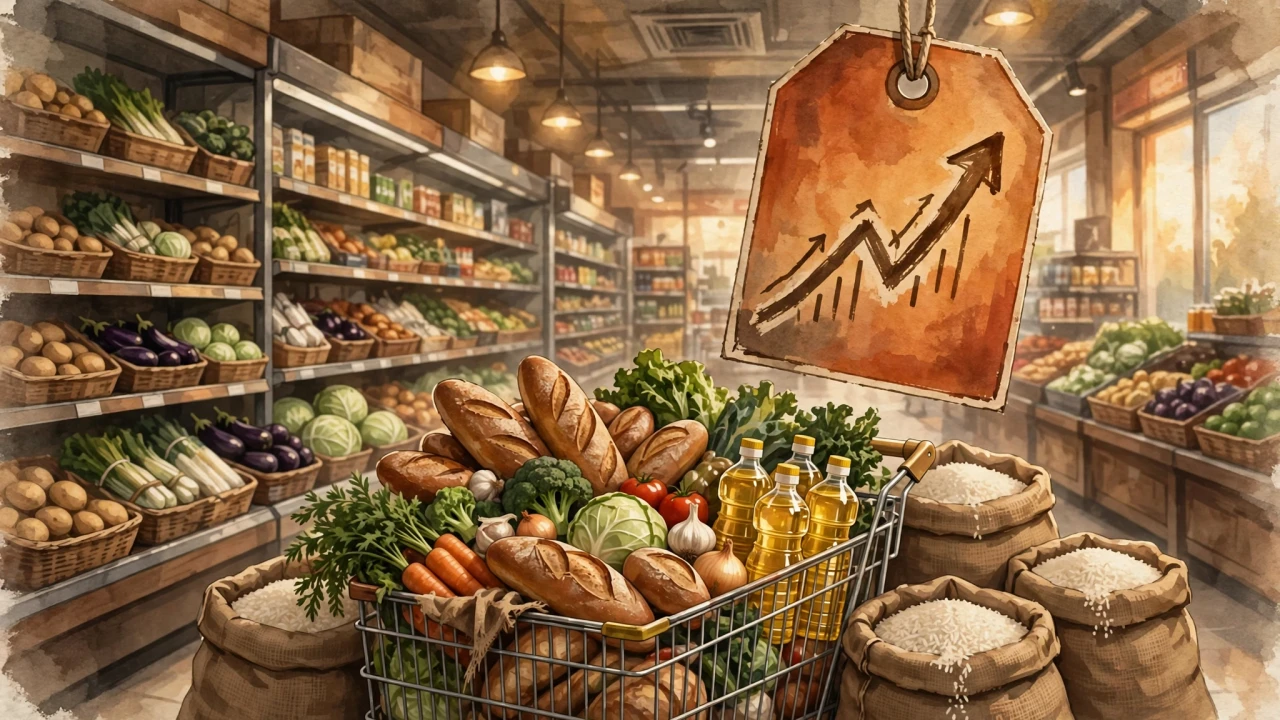
Illustration: A shopping cart overflowing with groceries beneath soaring price tags, symbolizing the global food inflation surge.
What Happened
A Reuters analysis published on October 19, 2026, warns that global food inflation — the rate at which food prices rise for ordinary households — is likely to intensify as multiple supply shocks land at once. The warning builds on United Nations data showing that world food prices climbed in September to their highest level in nearly four years, with the UN Food and Agriculture Organization (FAO) food price index averaging 136.0 points, up from a revised 134.0 in August and the highest reading since November 2022.
The numbers behind the warning are stark. Wheat prices are up more than 30 percent in 2026, while rice prices in key Asian exporting countries have risen 10 to 13 percent this year despite large stockpiles. Sugar, onion and pulse prices in India jumped more than 10 percent in September alone compared with the month before, driven by production shortfalls. In Egypt, the price of an unsubsidized loaf of bread has risen to around 5 Egyptian pounds (about $0.09) from 4 pounds in July. Cooking oil prices have climbed roughly 40 percent in the United Arab Emirates, and vegetable oil in Indonesia — the world's largest palm oil producer — is up 7 percent this year.
Corporate leaders are already sounding the alarm. Manish Tiwary, chairman and managing director of Nestle India, told reporters this month that "rising inflation, particularly food inflation, is a reality," pointing to what he called "a challenging environment" driven by higher commodity costs. At street level, the pain is visible: Sayed Abdel Hamid Mohamed, a baker in downtown Cairo, says it is not just the flour — skilled labor, electricity, water and yeast have all risen in cost. One of his customers, Tarek Azab, says prices have kept rising "not once, twice, or three times" in recent years.
Background
The current squeeze is the result of several overlapping crises rather than a single bad harvest. Attacks on Black Sea grain infrastructure have disrupted wheat shipments, forcing top importers such as Egypt and Indonesia to hunt for alternative suppliers. Insecurity in the Red Sea has diverted vessels onto longer, costlier routes around Africa. The US-Israeli war on Iran has pushed fuel prices higher and disrupted fertilizer exports through the Strait of Hormuz, raising the cost of growing food — even as dry El Niño weather curtails harvests in India and Southeast Asia. Fertilizer prices have eased from the peaks seen earlier in the Iran war but remain elevated, and freight rates have risen by roughly 50 percent on key routes such as the Black Sea to Southeast Asia as oil prices and war-risk premiums surge.
The FAO's data confirms the breadth of the pressure. International sugar prices were pushed to an 18-month high by fears of a severe El Niño, while a war-related collapse in Black Sea trade pushed wheat futures to a three-year peak in early September. The FAO's benchmarks for cereal, sugar and vegetable-oil prices all rose in September, even as meat and dairy prices fell. Looking ahead, the agency kept its forecast for global cereal production in 2026 almost unchanged at 2.979 billion metric tons — 2.1 percent below the previous year's record but still the second-largest harvest on record — while cutting its forecast for world cereal trade in 2026/27 by 0.7 percent, citing lower wheat and maize export expectations linked largely to constrained Black Sea shipping routes.
"We are seeing a persistent and increasingly broad-based build up in global commodity prices, as disruptions in the Strait of Hormuz and the Black Sea combine with climate shocks, putting pressure on energy, transport and key food commodities," FAO Chief Economist Maximo Torero said in a statement earlier this month. "If sustained, these pressures will soon pass through to consumer food prices, especially in food and energy import-dependent countries."

Illustration: Grain cargo ships crossing a stormy Black Sea, symbolizing the disrupted wheat shipments straining global supply.
Why It Matters
Food inflation hits hardest where households spend the largest share of income on eating — developing economies, where food can account for a large portion of family budgets. Rising prices heighten the risk of social unrest and could prompt governments in key supplier countries to impose export bans, which would further squeeze global supply and push prices even higher. Reuters notes that this vicious cycle has begun before: when governments restrict exports to protect domestic consumers, world markets tighten and the poorest importers pay the price.
The pressure is also a political problem in rich countries. In Britain, industry groups predict food inflation could approach 7 percent in 2027, driven by Middle East disruption, rising input costs and El Niño-linked extreme weather, even though fierce supermarket competition has so far kept British grocery inflation below earlier forecasts. In Canada, annual inflation rose to 3.1 percent in September, largely on the back of a 19 percent annual jump in energy prices that feeds straight into farming, transport and refrigeration costs. With the US midterm elections barely two weeks away and Brazil's presidential runoff due this weekend, affordability — especially the price of food — has become a dominant issue in national conversations worldwide.
The United Nations Development Programme warned earlier this month that rising energy costs, a super El Niño and soaring borrowing costs are piling pressure on developing countries, with the strongest El Niño weather effect since 1950 expected to drive more floods in some regions and droughts in others — and plunge an estimated 49 million more people into food insecurity by the end of 2027. UNDP Administrator Alexander De Croo said the war had morphed from a regional conflict into "a crisis which has an impact on approximately 100 countries."
What Happens Next
Analysts say the key question is whether the current pile-up of shocks eases or deepens over the coming months. Several near-term events will set the tone:
- El Niño's path: How dry weather develops across India and Southeast Asia will determine whether rice and sugar output recovers or shrinks further in the next harvest cycle.
- Shipping lanes: Any easing of Black Sea or Red Sea insecurity would cut freight rates and reopen cheaper grain routes; any escalation would do the opposite.
- Energy and fertilizer costs: Fuel and fertilizer prices remain the biggest swing factor for farming costs worldwide, and both are tied to the trajectory of the Iran war and oil prices near $110 a barrel.
- Export policy: Watch whether major grain exporters move to restrict shipments. Any new export ban would likely send international prices spiking within days.
- Central bank decisions: With inflation expectations climbing, central banks — including Bank Indonesia, which decides on October 21, and the Bank of Canada, which meets October 28 — face harder choices between defending currencies and supporting growth.

Illustration: Stacks of rice sacks at a Southeast Asian market, symbolizing climbing rice prices across the region.
For households, the FAO's advice embedded in its data is sobering: sustained commodity pressure will "soon pass through to consumer food prices." That means the rising prices visible in wholesale markets today are likely to show up on supermarket shelves and street stalls in the coming months — in Egypt's bakeries, India's vegetable markets and Britain's supermarkets alike.
Sponsored: explore today's featured sponsored offers
FAQ
Why are global food prices rising in 2026?
A combination of shocks: attacks on Black Sea grain infrastructure, Red Sea shipping diversions, higher fuel and fertilizer costs linked to the war in Iran, and dry El Niño weather cutting harvests in India and Southeast Asia. The UN's food price index hit a near four-year high in September 2026.
How much have key food prices risen?
Wheat prices are up more than 30 percent in 2026, rice prices in key Asian exporters have risen 10 to 13 percent, and in India sugar, onion and pulse prices jumped over 10 percent in September from a month earlier. Egypt's unsubsidized bread rose from 4 to 5 pounds a loaf since July.
What is El Niño's role in food inflation?
El Niño is a Pacific Ocean warming pattern that shifts rainfall, bringing drier weather to India and Southeast Asia. The current strong El Niño has reduced farm output and pushed international sugar prices to an 18-month high, while the UNDP expects it to worsen food insecurity.
Could governments make food inflation worse?
Yes. Reuters warns that rising prices heighten the risk of social unrest, which can push key supplier governments to impose export bans to protect domestic consumers — further tightening global supply and raising prices for importers.
When will food prices come down?
Analysts say much depends on shipping security, the Iran war's trajectory, and the next harvest cycle. Freight rates and fertilizer costs remain elevated, so sustained relief is unlikely before harvests recover and shipping routes reopen — a process that could take months.
Sources
- Reuters, "Global food inflation is expected to intensify as supply shocks pile up," October 19, 2026
- Reuters, "World food prices near four-year high in September, UN says," October 2, 2026
- Reuters, "Developing countries hit by overlapping crises, UNDP chief warns," October 2, 2026
- Reuters, "Canada's annual inflation rate rose 3.1% in September," October 19, 2026
- Reuters, "UK grocery inflation accelerates over last month, says Worldpanel," October 13, 2026
Comments
Post a Comment