
SYDNEY — The New South Wales Parliament has passed landmark legislation creating the Great Koala National Park, the state government announced on October 23, 2026, adding 178,000 hectares of state forest and other Crown land — home to around 12,000 koalas and more than 100 other threatened species — to the national parks estate after more than a decade of campaigning by conservationists, scientists and First Nations communities.

Illustration: A koala resting on a eucalyptus branch in an Australian forest.
What Happened
The National Park Estate (Great Koala National Park Reservations) Bill 2026 passed the NSW Parliament, delivering on a key election commitment of the Minns Labor Government and securing lasting protection for one of the state's most significant koala populations. The NSW Government said the passage of the legislation, combined with the Clean Energy Regulator's approval of the park's carbon project, cleared the final hurdles to establishing the park, which is on track to open before the end of the year.
The new parkland will be added to existing national park reserves on the NSW Mid North Coast, creating one of the largest protected areas in the state, spanning more than 475,000 hectares. The forests are home to around 12,000 koalas, 36,000 greater gliders and more than 100 threatened species, according to conservation groups. The Wilderness Society said the forests hold approximately 20 per cent of all koalas in New South Wales, along with greater gliders, spotted-tailed quolls and gang-gang cockatoos.
The legislation also changes the economics of forestry in the state. A joint statement from conservation groups said the park would cut the timber harvested from New South Wales' native forests by approximately 20 per cent, with safeguards to prevent logging from simply being shifted elsewhere — making the reduction permanent and, in their words, a significant step towards ending native forest logging across the state. In what the groups called a major and unexpected development, the NSW Liberal Party voted in support of the park, with the legislation passing the lower house following minor amendments.
The government said the park will protect important environmental and cultural values while still allowing visitors to enjoy activities including camping, canoeing and mountain-bike riding, and that it will create opportunities for nature-based tourism and local businesses. Around 100 new NSW National Parks and Wildlife Service roles are being created to strengthen park operations, fire management and conservation, and the Bill provides for affected Forestry Corporation of NSW employees to transition into suitable parks roles if they choose. A comprehensive assistance package for workers, businesses and communities affected by the transition includes redundancy payments, retraining, upskilling and other financial assistance.
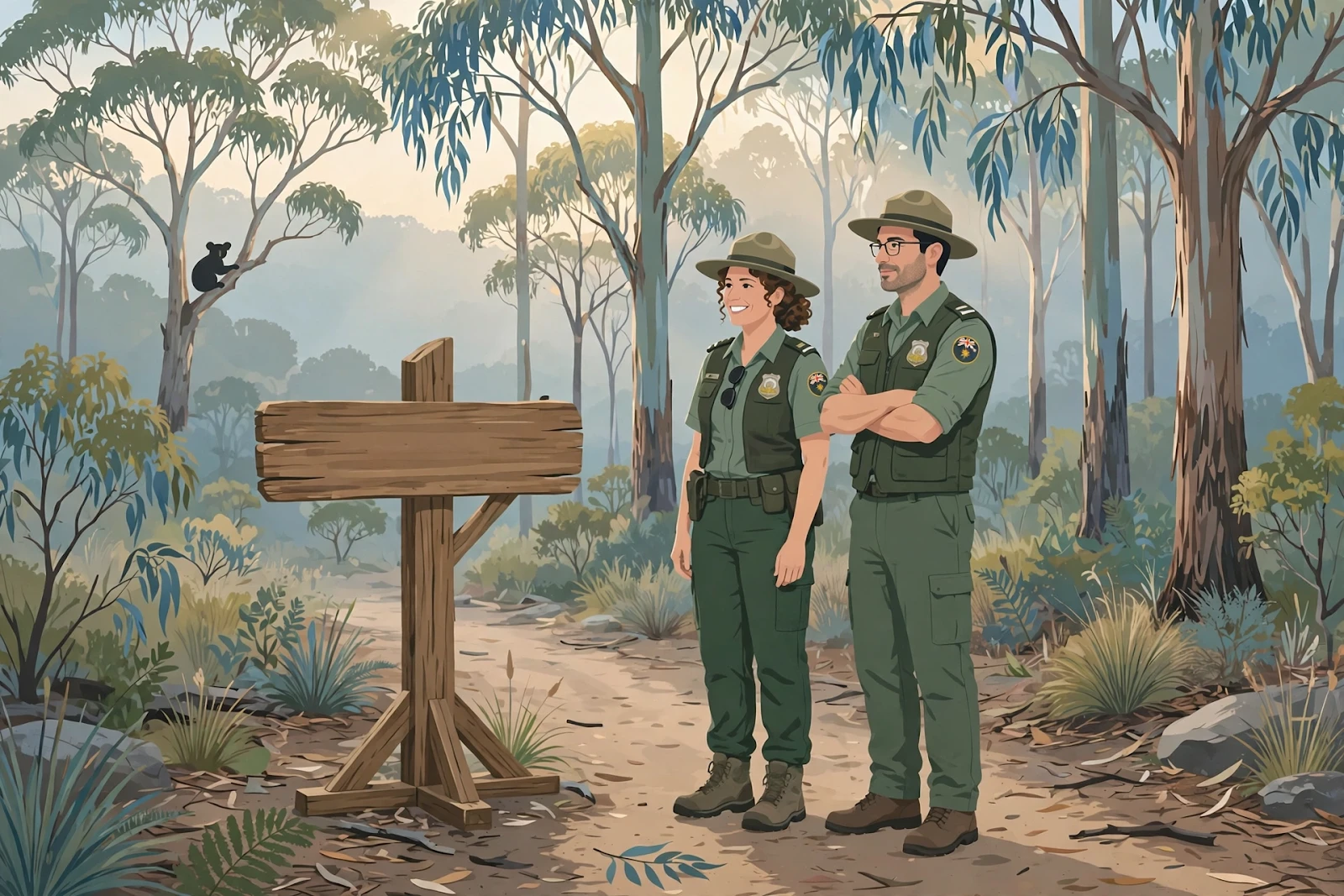
Illustration: National park rangers beside a park entrance sign on a forest trail.
Background
The park is the product of more than a decade of campaigning. Koala ecologists, conservation groups, First Nations communities, local residents, politicians and businesses pushed for protection of the Mid North Coast forests as koala numbers came under pressure from habitat loss, logging, bushfires and disease. The forests sit on Gumbaynggirr and Dunghutti Country, and the campaign drew on the knowledge and advocacy of Traditional Owners alongside scientific research on koala populations.
The creation of the park continues a Labor conservation legacy in New South Wales, the government said, pointing to the Wran and Carr governments, which protected vast areas of native forest in earlier decades. The Minns Government made the park a key election commitment, and its delivery was repeatedly described by ministers as the government's biggest environmental commitment. The Bill was introduced earlier in October 2026 and moved through Parliament after extensive consultation with industry, community and Aboriginal groups.
Koalas were listed as endangered in New South Wales, Queensland and the Australian Capital Territory in 2022, and habitat protection has long been identified by ecologists as the single most important measure for their survival. Connected habitat matters as much as total area: isolated patches of forest leave koalas vulnerable to inbreeding, road strikes and local extinctions after fire, while a continuous 475,000-hectare estate gives populations room to move, feed and recover. That connectivity is central to the park's design, joining former state forest to existing reserves in a single protected landscape.
The park's carbon project approval is a quieter but significant part of the story. The Clean Energy Regulator's approval means the avoided deforestation and forest protection within the park can be recognised under Australia's carbon framework, linking conservation to climate policy and providing a further rationale for keeping the forests standing rather than logging them.

Illustration: An aerial view over a vast connected eucalyptus forest canopy stretching towards the coast.
Why It Matters
The park matters first for the species it protects. Twelve thousand koalas is a nationally critical population, and the greater glider — a nocturnal marsupial that glides between trees — is itself listed as endangered. Protecting 178,000 hectares of forest from logging removes one of the most direct threats to both, and the connected estate gives wildlife room to adapt as the climate changes, a point WWF-Australia's chief executive Dermot O'Gorman stressed when he called the legislation "conservation at the scale nature needs."
It matters second as a test of whether large-scale conservation can still happen in a contested political landscape. The park survived a decade of campaigning, industry opposition and parliamentary negotiation, and ultimately passed with support from across the political divide, including the Liberal Party's vote in favour. For conservationists, that breadth of support is evidence that protecting nature has become a mainstream expectation rather than a fringe demand — and a precedent they hope to extend to the remaining 1.76 million hectares of native state forest in New South Wales.
It matters third for the people who live and work around the forests. The transition package, the new ranger roles and the emphasis on nature-based tourism reflect an attempt to show that conservation and livelihoods can move together rather than against each other. The government has also pointed to new Aboriginal ranger positions to help manage the park and care for Country, and conservation groups are urging engagement with the Gumbaynggirr and Dunghutti communities about joint management and the possible handback of public native forests.
What Happens Next
The park is on track to open before the end of 2026, with new walking trails, campsites and recreational opportunities alongside strict protections for sensitive ecosystems and safeguards to prevent grazing leases from returning to protected areas. The next practical steps include appointing the new parks staff, finalising visitor infrastructure and settling management arrangements with Traditional Owners.
Conservation groups have been clear that they do not regard the job as finished. The Wilderness Society noted that important habitat at Pine Creek and Tucker's Nob was left outside the park and is still being logged by Forestry Corporation of NSW, and its chief executive Dr Kirsty Howey said the organisation would not stop until those forests are protected too. Campaigners are also pressing for greater investment in restoration, First Nations joint management and a potential World Heritage listing for the park.
The wider question is whether the Great Koala National Park becomes a model or an exception. If the park delivers thriving koala populations, new tourism jobs and a smooth forestry transition, it will strengthen the case for protecting more of Australia's native forests. If the transition falters or excluded habitats keep falling, it will show how much work remains even after a historic legislative win. Either way, the forests that were the subject of a decade-long fight are now, by law, protected.
Sponsored: explore today's featured sponsored offers
FAQ
What is the Great Koala National Park?
It is a new national park on the New South Wales Mid North Coast, created by legislation passed by the NSW Parliament in October 2026. It adds 178,000 hectares of state forest and other Crown land to existing reserves, forming a protected area of more than 475,000 hectares.
How many koalas will the park protect?
The forests are home to around 12,000 koalas — approximately 20 per cent of all koalas in New South Wales — along with 36,000 greater gliders and more than 100 other threatened species, according to the NSW Government and conservation groups.
When will the park open?
The NSW Government said the park is on track to open before the end of 2026, following the legislation's passage and the Clean Energy Regulator's approval of the park's carbon project.
Will people still be able to visit and use the forests?
Yes. The government said the park will allow camping, canoeing, mountain-bike riding, bushwalking and kayaking, with new walking trails and campsites, alongside strict protections for sensitive ecosystems.
What do conservation groups say still needs to be done?
Groups including the Wilderness Society say important habitat at Pine Creek and Tucker's Nob was left outside the park and is still being logged, and they are calling for protection of the remaining native state forest, greater restoration investment, First Nations joint management and a possible World Heritage listing.
Sources
- NSW Government, Department of Climate Change, Energy, the Environment and Water, "Historic day for koalas as landmark legislation passes NSW Parliament," October 23, 2026.
- WWF-Australia, "Historic win for koalas as Great Koala National Park legislation passes," October 2026.
- The Wilderness Society, "Koalas win: Great Koala National Park locked into law after decade-long fight," October 2026.
- Joint media release by NSW conservation groups, "Historic victory for koalas as Great Koala National Park legislation passes NSW Parliament," October 22, 2026.
Comments
Post a Comment