
UNITED NATIONS — Former Costa Rican Vice President Rebeca Grynspan has extended her lead in the race to become the next United Nations secretary-general, winning 11 votes in favour and 4 against in an informal Security Council straw poll held on Friday, 30 October 2026, according to Reuters, which cited two people close to the process. The result, reported by Reuters on 30 October, marks her strongest showing yet in seven closed-door ballots held in recent months to choose a successor to António Guterres, who finishes his second five-year term at the end of this year.
The poll brought no consensus, however. No candidate has yet secured the backing needed for a formal recommendation, and the contest continues with nine weeks left before Guterres leaves office on 31 December. The next straw poll has not yet been scheduled, according to PassBlue, which also reported the results of the 30 October ballot.

Illustration: The United Nations Security Council chamber in New York, where delegates hold informal straw polls to test support for secretary-general candidates.
What Happened
On Friday, the 15-member Security Council held its seventh informal straw poll in the process to select the organisation's 10th secretary-general. In the ballot, Grynspan received 11 "encourage" votes and 4 "discourage" votes, Reuters reported. PassBlue, which said it had seen the results, reported the same tally and described it as Grynspan maintaining a firm lead.
Argentina's Rafael Grossi, the director general of the UN nuclear watchdog, came second with 9 votes in favour, 4 against and 2 marked "no opinion", according to Reuters and PassBlue. Carolyn Rodrigues-Birkett of Guyana came third with 8 in favour, 6 against and 1 "no opinion".
In fourth place was Lana Nusseibeh, the United Arab Emirates diplomat and former ambassador to the UN, who received 7 votes in favour, 6 against and 2 "no opinion" votes. Friday's ballot was her first since she entered the race: she was nominated by the United Arab Emirates on 21 October, PassBlue reported. Ivonne A-Baki, nominated by Tonga, had the least favourable result, with 1 vote in favour and 14 against — the same count she received in the previous poll, according to PassBlue.
Because the ballots are informal and the process is closed-door, the figures are reported by news outlets citing sources close to the process, rather than announced by the Council itself. Reuters cited two people close to the process; PassBlue cited results it said it had seen. The Council has not publicly confirmed the tallies.

Illustration: A plain paper ballot being cast in a closed-door diplomatic vote, as used in the Security Council's 30 October straw poll.
Background
The search for the next secretary-general has been running for months through a series of informal straw polls. These polls are not binding votes: they are a way for Council members to test how much support each candidate commands before any formal recommendation is made. A candidate who is to be recommended to the 193-member General Assembly needs at least 9 positive votes and no "discourage" vote from any of the five permanent members — France, Britain, the United States, Russia and China.
That last condition is why Friday's result, strong as it looks, does not settle the race. The 30 October ballot was not coded in a way that would reveal how the permanent members voted, Reuters reported. PassBlue likewise noted that it was unclear whether any of the "discourage" votes for Grynspan came from a permanent member, because the ballots were undifferentiated.
The Council returned to voting on plain paper on 30 October, after using colour-coded ballots in the 16 October straw poll, PassBlue reported. Colour-coded ballots allow members — and, in reporting, observers — to distinguish the votes of permanent members from those of elected members. A future poll could return to that format, which PassBlue said would be more useful in revealing a candidate's standing with the five permanent members.
Grynspan, a former Costa Rican vice president, led the UN body responsible for trade and development until about six months ago, according to PassBlue. She has been the frontrunner through the straw-poll process, and Friday's 11-4 result is her best showing so far across the seven ballots, Reuters reported. Seven candidates are now in the race in total, PassBlue said.
The contest is taking place against a difficult backdrop for the organisation. Whoever wins will have to handle several wars, cutbacks in American contributions to the UN, and questions about the body's political relevance as Washington has withdrawn from dozens of its agencies, Reuters reported.
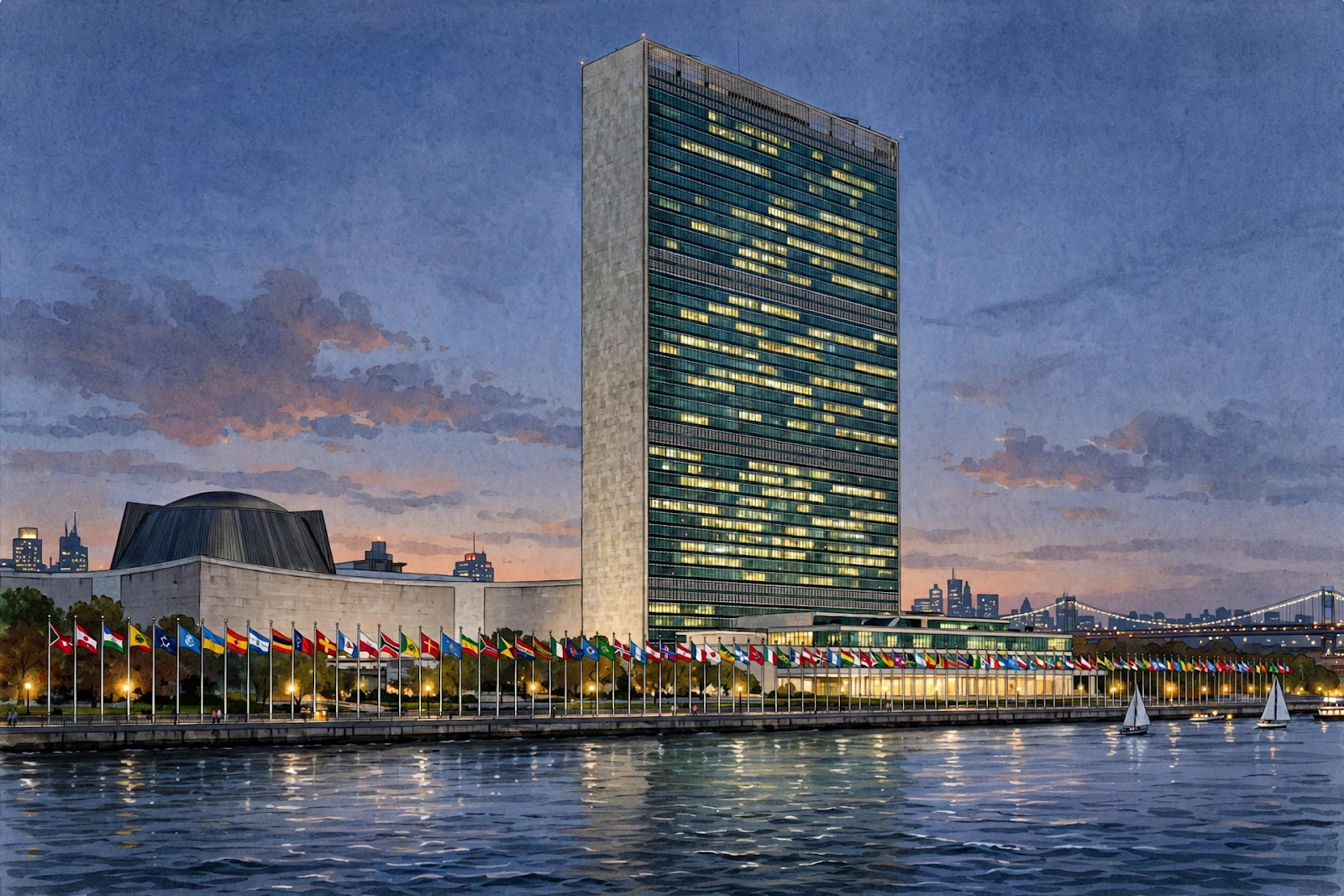
Illustration: The United Nations headquarters in New York, home of the Security Council and the General Assembly.
Why It Matters
The secretary-general is the UN's chief administrative officer and, in practice, its public face in crises — from wars and humanitarian emergencies to climate negotiations and peacekeeping. The choice shapes how the organisation speaks, mediates and sets priorities for the next five years, and the selection process itself is a test of whether the Council's most powerful members can agree on anything at all in a period of deep division.
Friday's numbers matter for three reasons. First, 11 positive votes clear the nine-vote threshold for a recommendation — but only if none of the four negative votes came from a permanent member, which the un-coded ballot cannot confirm. Second, the gap between Grynspan and the rest of the field widened: Grossi, her nearest rival, sits two positive votes behind her, and the newcomer Nusseibeh, in fourth, faces what PassBlue described as major ground to cover. Third, the calendar is tightening. With nine weeks until Guterres departs on 31 December, the Council still needs a formal vote, a recommendation and a General Assembly appointment — a sequence that leaves little room for a prolonged deadlock.
The result also shows the limits of momentum in this process. A frontrunner can lead every informal poll and still be blocked if a single permanent member objects in a formal vote. Until a colour-coded ballot — or a formal vote itself — shows where the permanent members stand, Grynspan's lead remains a lead in an informal exercise, not a guarantee.
What Happens Next
The next step is another straw poll, whose date has not yet been determined, according to PassBlue. Whether that poll uses colour-coded ballots will be closely watched, because it would reveal whether Grynspan's support includes the permanent members whose backing she ultimately needs.
If a candidate emerges with a strong chance of prevailing, the Council is expected to move to a formal vote, Reuters reported. A successful candidate would then be recommended to the General Assembly, which formally appoints the secretary-general. If no candidate breaks through, further rounds of straw polls would follow — and the prospect of a contested or delayed appointment would grow as the 31 December deadline approaches.
For Nusseibeh, the next poll is a first test of whether her debut tally of 7-6-2 can improve once Council members have had more time to weigh her candidacy. For Grossi and Rodrigues-Birkett, the question is whether they can close a gap that widened on Friday. And for Grynspan, the task is to convert an informal lead into a formal recommendation that survives the permanent members' veto.
Sponsored: explore today's featured sponsored offers
FAQ
Who leads the race for UN secretary-general?
According to Reuters and PassBlue reporting on the 30 October 2026 straw poll, Rebeca Grynspan of Costa Rica leads, with 11 votes in favour and 4 against — her strongest showing in seven informal ballots.
What were the other candidates' results on 30 October?
Rafael Grossi of Argentina received 9 in favour, 4 against and 2 "no opinion"; Carolyn Rodrigues-Birkett of Guyana received 8 in favour, 6 against and 1 "no opinion"; Lana Nusseibeh of the United Arab Emirates received 7 in favour, 6 against and 2 "no opinion"; Ivonne A-Baki, nominated by Tonga, received 1 in favour and 14 against.
Does 11 votes mean Grynspan has won?
No. The straw polls are informal and non-binding. A formal recommendation requires at least 9 positive votes and no "discourage" vote from any of the five permanent members — and the 30 October ballot was not coded to show how those members voted.
When does António Guterres leave office?
Guterres finishes his second five-year term on 31 December 2026. PassBlue noted there were nine weeks left from the 30 October poll.
What happens next in the selection process?
Another straw poll is expected, on a date yet to be determined, possibly using colour-coded ballots. If a candidate shows a strong chance of prevailing, the Council would move to a formal vote and recommend a candidate to the General Assembly for appointment.
Sources
Reuters, "Costa Rica's Grynspan extends lead in informal UN chief poll, sources say", by Antoni Slodkowski, 30 October 2026; PassBlue, "UAE Candidate Showed Mixed Results in Latest UN Security Council Poll", 30 October 2026.
Comments
Post a Comment