
Hay Festival Returns to Arequipa: Peru's White City Hosts a Week of Books, Ideas and Music in November 2026
AREQUIPA, Peru — Hay Festival Arequipa returns to southern Peru in November 2026, bringing writers, musicians, thinkers and readers together in the historic White City for a week of conversations, concerts, workshops and community events, according to the festival's published programme.
The festival's programme lists events from Tuesday, November 3, through Sunday, November 8, 2026, in venues across Arequipa's historic centre. The line-up mixes celebrated international authors with Peruvian voices, alongside music, children's activities and a community programme designed to take literature beyond the main stages.
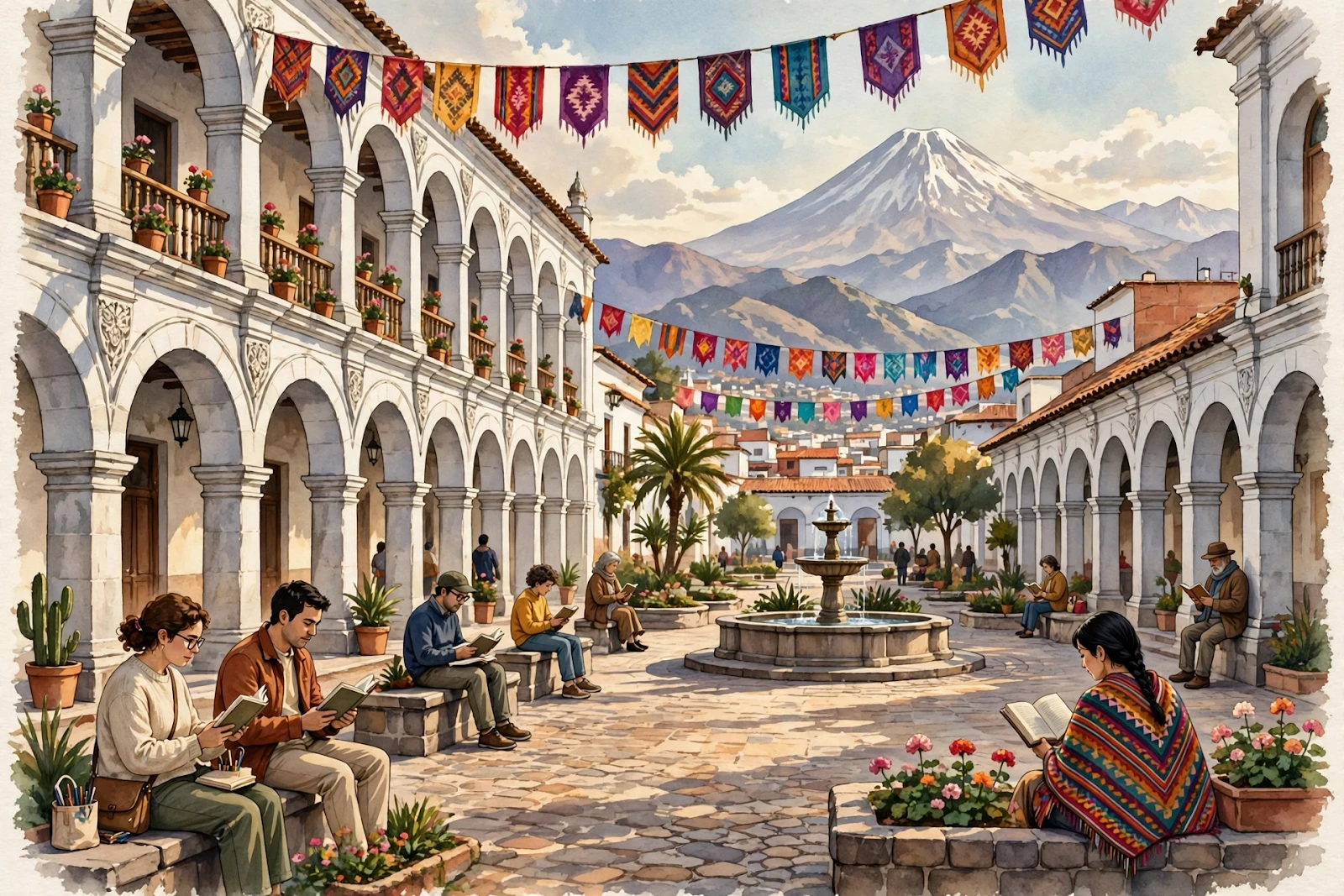
Illustration: Arequipa's white-stone Plaza de Armas during the Hay Festival, with readers and festival banners. This is an AI-generated illustration, not a photograph of the event.
What Happened
Hay Festival has published the full programme for its Arequipa edition, confirming a six-day run of events in early November. The schedule includes author conversations, a concert, workshops, children's sessions and a reading in homage to Mario Vargas Llosa, the Peruvian Nobel laureate whose work remains central to the country's literary life.
Among the headline names, Romanian novelist Mircea Cărtărescu appears in conversation on Wednesday, November 4, at 7 p.m., while Nobel laureate J. M. Coetzee joins Valerie Miles for a conversation on Saturday, November 7, at 8 p.m. Argentine writer Patricio Pron discusses literature as resistance on Thursday, November 5, at 4 p.m.
Music opens the festival's main public programme in style: the KNM Berlin Ensemble gives the opening concert on Thursday, November 5, at 8 p.m. Peruvian stories also take centre stage, with Luis Carlos Arias Schreiber discussing the Peruvian who conquered Wimbledon on Saturday, November 7, at 6 p.m., the same evening as the homage to Vargas Llosa.
The programme also reaches beyond the headline stages. Community and children's strands include body-movement and wellbeing workshops, storytelling sessions and reading activities, reflecting the festival's long-standing effort to make its events open to local audiences, not only to visiting book lovers.
Background
Arequipa, Peru's second city, is known as the White City for its buildings of pale volcanic sillar stone. Its historic centre, with arcaded plazas, churches and mansions built from that stone, is listed by UNESCO as a World Heritage site, and it gives the festival a setting unlike any other literary gathering in South America.
Hay Festival began in the Welsh town of Hay-on-Wye and has grown into a global network of festivals held in Spanish and English around the world. Its Arequipa edition is part of its Spanish-language programme, bringing international writers into conversation with Peruvian authors and audiences in the city itself.
The festival's Arequipa programme is published in both Spanish and English, and many events are conversations between two writers rather than solo lectures. That format — one author questioning another — has become the festival's signature, encouraging debate about books, politics, history and the environment rather than simple promotion of new titles.
Previous editions have drawn writers, students, teachers and families from across southern Peru, and the 2026 programme continues that pattern, pairing big international names with Peruvian historians, novelists, poets and journalists.
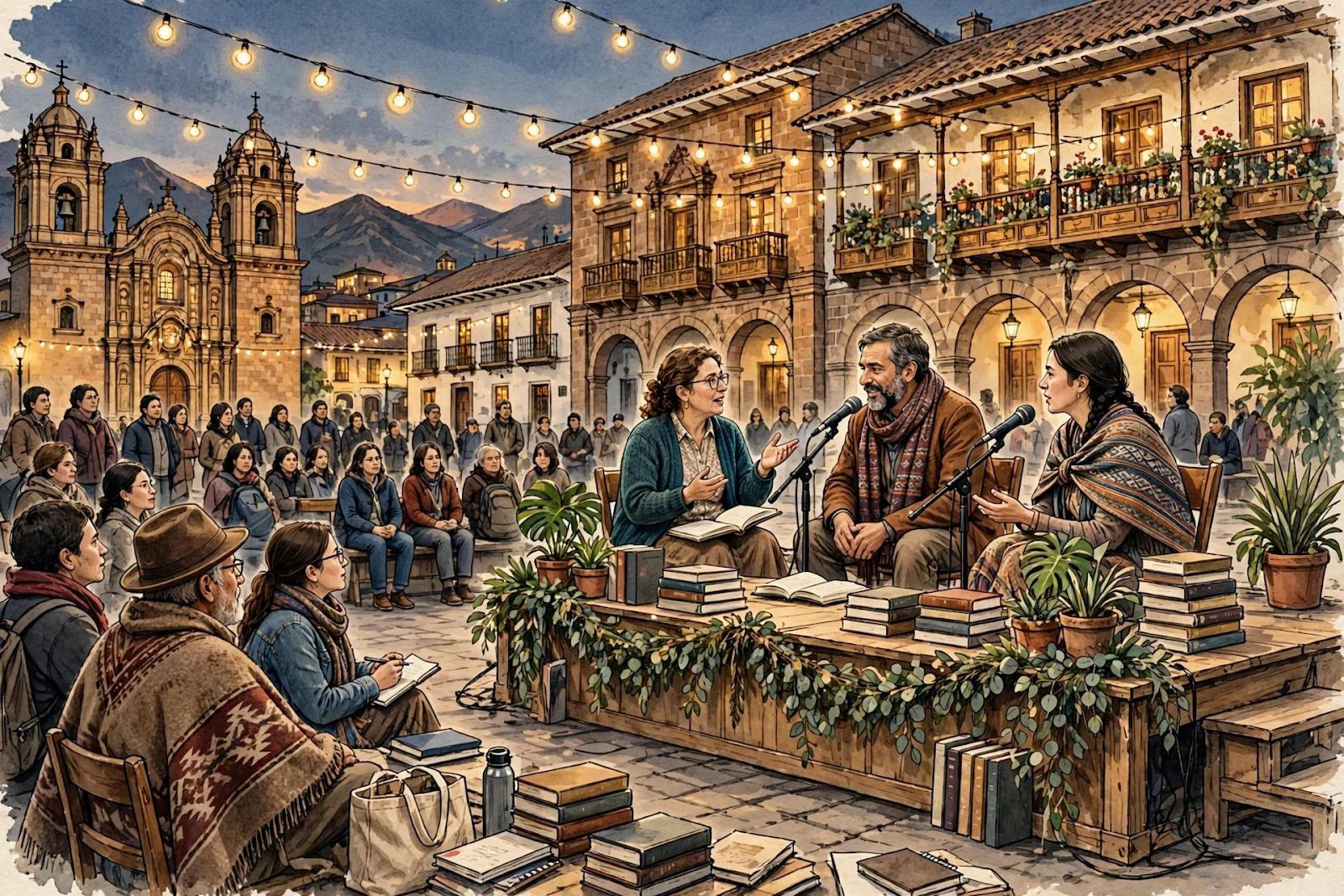
Illustration: Authors in conversation on an outdoor stage at the Hay Festival Arequipa. This is an AI-generated illustration, not a photograph of the event.
Why It Matters
A literary festival in Arequipa matters for more than the week itself. For a city outside the capital, Lima, hosting an international festival puts local writers, bookshops and schools in direct contact with a global literary conversation — and gives international visitors a reason to discover a region better known for the Colca Canyon and the volcanoes that ring the city.
It also matters for reading culture. Events for children and young readers, workshops and community sessions are not side attractions; they are how festivals build new audiences. A child who joins a storytelling workshop in Arequipa in November may become the reader, writer or teacher who sustains the city's literary life for decades.
The choice of themes matters too. Conversations about literature as resistance, about Peru's past and present, and about the environment reflect questions that Peruvian readers are asking now. A festival that stages those debates in public — in a historic plaza city rather than behind closed doors — treats literature as part of civic life, not as a luxury.
For Peru's cultural economy, the festival brings visitors, hotel stays, restaurant meals and book sales to Arequipa in early November, a benefit that spreads well beyond the venues themselves.
What Happens Next
The festival runs from November 3 to 8, 2026. Visitors planning to attend should check the official programme for venue details, times and any booking requirements, as popular conversations can fill quickly and some events may require advance registration.
After Arequipa, the Hay Festival network continues with further editions around the world, and the conversations started in Arequipa — about Peruvian literature, Latin American history and the future of reading — are likely to echo in reviews, podcasts and translations in the months that follow.
For readers who cannot travel, many festival conversations are later shared through the festival's own channels, so the ideas debated in Arequipa can reach audiences far beyond southern Peru.

Illustration: A children's street reading workshop in Arequipa's historic centre. This is an AI-generated illustration, not a photograph of the event.
Sponsored: explore today's featured sponsored offers
FAQ
When is Hay Festival Arequipa 2026?
The published programme lists events from Tuesday, November 3, through Sunday, November 8, 2026, in Arequipa, Peru.
Where does the festival take place?
Events are held in venues across Arequipa's historic centre, the UNESCO-listed White City built largely from pale volcanic sillar stone.
Who are some of the headline guests?
The programme includes Mircea Cărtărescu, J. M. Coetzee in conversation with Valerie Miles, Patricio Pron, and Peruvian writers including Luis Carlos Arias Schreiber, alongside the KNM Berlin Ensemble's opening concert.
Is there a tribute to Mario Vargas Llosa?
Yes. The programme includes a reading in homage to Mario Vargas Llosa on Saturday, November 7, at 6 p.m.
Are there events for children and local communities?
Yes. The programme includes community and children's strands with workshops, storytelling sessions and reading activities alongside the main author conversations.
Sources
- Hay Festival official programme, Hay Festival Arequipa 2026, hayfestival.com (events listed November 3–8, 2026, accessed October 24, 2026).
- Hay Festival Arequipa historic-centre listing, ad-hoc-news.de, October 24, 2026 (venue context: historic centre, volcanic sillar, November 4–8 festival dates).
Comments
Post a Comment