
A Hidden Carbon Source in the Himalaya: Glacier-Fed Indus Rivers Release More CO2 Than They Trap, Study Finds
A Hidden Carbon Source in the Himalaya: Glacier-Fed Indus Rivers Release More CO2 Than They Trap, Study Finds
Glaciated river catchments in the upper Indus basin are quietly releasing more carbon dioxide than they absorb, according to a new study from researchers at the Indian Institute of Science Education and Research Pune published October 19, 2026. Using water chemistry and isotope analysis across the northwestern Himalaya, the team found that the oxidation of the mineral pyrite in eroding mountain rocks produces enough CO2 to outweigh the carbon trapped by natural rock weathering — making these spectacular landscapes a net source of atmospheric carbon over long geological timescales.
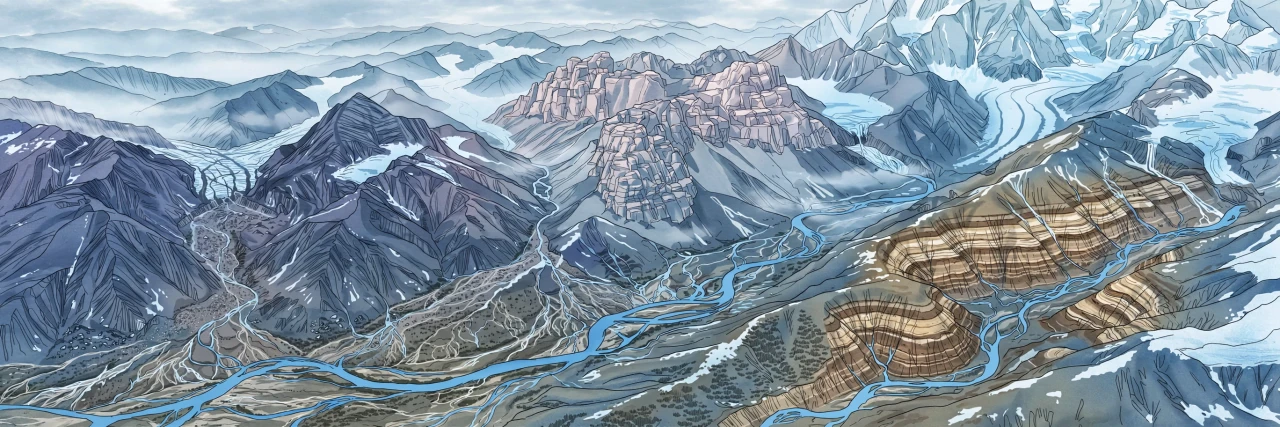
Illustration: the upper Indus River system winding through the glaciated Himalayan landscape of the northwestern Himalaya.
What Happened
The research, highlighted by Nature India on October 19, 2026, is a geochemical detective story written in river water. The IISER Pune team set out to map how carbon moves through one of the world's most dramatic landscapes — the upper Indus basin, where steep mountains, glacial valleys, and geologically diverse rocks funnel meltwater into the Indus River and its tributaries. The rivers act as a natural record of the chemical reactions taking place across the entire basin.
To read that record, the researchers analyzed the chemistry of the river water itself — including dissolved sulfur isotopes and oxygen isotopes — which allowed them to quantify exactly how much carbon dioxide was being released by a specific reaction: the oxidation of pyrite, an iron-sulfide mineral, within carbonate rocks.
The result was striking. In the glaciated regions of the basin, the CO2 released through pyrite oxidation exceeds the CO2 trapped through silicate weathering — the natural process in which atmospheric carbon dioxide dissolves in water, forms weak carbonic acid, and reacts with silicate rocks to lock the carbon away as oceanic carbonates. In other words, the balance that scientists long assumed tilted toward carbon capture in these mountains actually tilts the other way: these rapidly eroding glaciated landscapes act as a net source of carbon dioxide rather than a carbon sink.
The team concluded that glacier-fed river catchments are an important geological source of carbon dioxide, one that may influence long-term carbon cycles and contribute to climate warming over million-year timescales. The study was published as a research highlight (DOI: 10.1038/d44151-026-00201-x).
Background
To understand why this matters, it helps to step back into the deep mechanics of Earth's climate. Over millions of years, the planet's temperature is governed in large part by a slow thermostat: rock weathering. Rainwater absorbs atmospheric CO2, becomes mildly acidic, and gradually dissolves silicate rocks. The dissolved carbon washes down rivers to the ocean, where it is locked into carbonate minerals on the seafloor. On these timescales, weathering is one of the main processes pulling carbon out of the atmosphere.
But carbonate rocks tell a more complicated story. When sulfide minerals — particularly pyrite, often called fool's gold — are exposed and oxidize, they can indirectly release carbon dioxide back into the atmosphere. The net effect of a mountain range on atmospheric carbon therefore depends on a race between two processes: the CO2 trapped by weathering versus the CO2 released by mineral oxidation.
The Himalaya is the natural laboratory for this question. It is the most aggressively eroding mountain range on Earth, with glaciers grinding rock into fresh powder and rivers carrying the debris away. Conventional thinking often treated such glaciated landscapes as powerful carbon sinks, because fresh silicate surfaces should weather fast and trap large amounts of CO2.
The IISER Pune team tested that assumption directly by measuring the isotopic fingerprints of sulfur and oxygen dissolved in Indus tributaries. Isotopes work like barcodes: the sulfur isotopes reveal how much pyrite is being oxidized, and the oxygen isotopes help pin down the weathering pathways. By combining the two, the researchers could quantify both sides of the ledger — carbon released versus carbon captured — across a basin that drains thousands of square kilometers of steep, glaciated terrain.
The finding lands at a moment when the cryosphere is under extraordinary pressure. The seventh edition of the annual "planetary vital signs" analysis, published this month in the journal BioScience by William Ripple of Oregon State University and colleagues, reported that atmospheric carbon dioxide breached 428 parts per million in May 2026 — about 50 percent higher than pre-industrial levels. Global glacier thickness, the mass of the Greenland ice sheet, global sea level, and ocean heat content are all at record extremes, and the rate of global warming has roughly doubled, from about 0.19 degrees Celsius per decade between 1970 and 2010 to about 0.36 degrees per decade since 2010, according to the analysis carried by Eos.
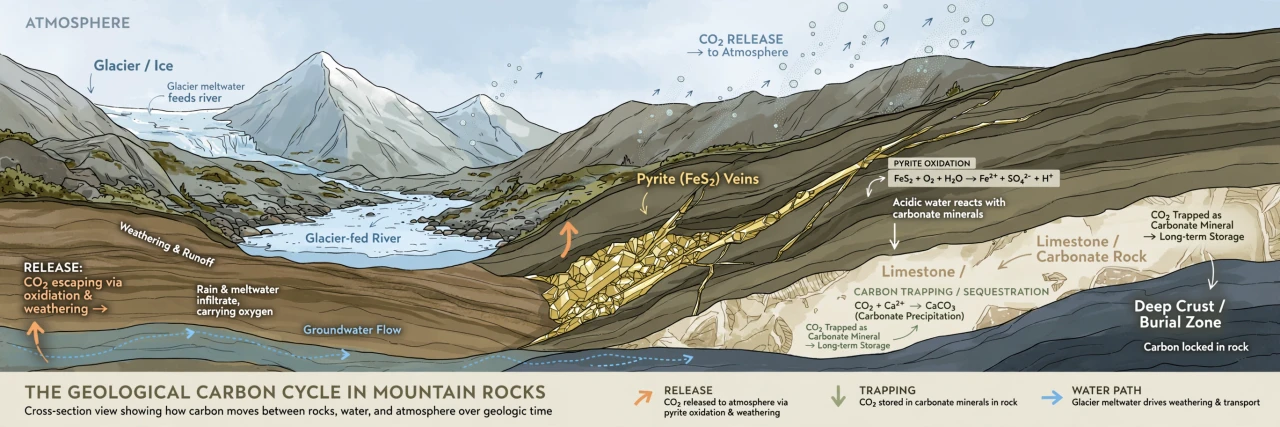
Illustration: a cross-section diagram showing pyrite veins inside mountain rock releasing carbon dioxide as glacier-fed rivers flow above.
Why It Matters
The study matters for three reasons — a scientific correction, a potential climate feedback, and a timing coincidence that sharpens both.
First, it corrects a basic assumption built into models of the long-term carbon cycle. If some of the world's most actively weathering mountain landscapes are net emitters rather than net sinks, then the geological thermostat is set a little differently than previously thought. The effect operates over millions of years, not decades, so it does not change the urgency of cutting human-caused emissions — which, at 428 ppm and climbing, are driving warming on a timescale thousands of times faster. But it does mean that reconstructions of past climates and projections of the very long-term carbon budget may need to be revised.
Second, there is a plausible feedback loop with today's warming. Glaciers are retreating almost everywhere, exposing fresh, unweathered rock to air and water. The 2026 vital-signs analysis found worldwide glacier thickness at a record low, and New Zealand's "Our Atmosphere and Climate 2026" report — released earlier this month — documented that the country's roughly 3,000 glaciers have lost nearly half their volume since 1997, with models projecting losses of up to 86 percent by 2100 even under lower emissions scenarios. As glaciers retreat across the Himalaya, newly exposed rock surfaces could accelerate pyrite oxidation, releasing more CO2, which adds — over long timescales — to warming, which melts more glaciers. The researchers describe this as a mechanism that operates over million-year timescales, so it is not a runaway feedback in the human sense, but it is a reminder that Earth's carbon plumbing has more pipes than the textbook diagrams show.
Third, the timing is striking. The new research arrived just days after the BioScience report warned that the planet's vital signs are "flashing red," with July 2026 recorded as the hottest month ever for both the contiguous United States and global ocean surfaces, and climate-driven wildfires destroying 10.8 million hectares of tree cover in 2025 — the third-highest ecological loss footprint on record. Against that backdrop, the discovery of a previously underappreciated carbon source inside one of the planet's most iconic mountain ranges underscores a theme climate scientists keep returning to: the carbon cycle still holds surprises, and most of them are not in humanity's favor.
What Happens Next
For the IISER Pune team, the next step is likely to broaden the survey. The upper Indus is one basin in one corner of the Himalaya; the question now is how general the finding is. Similar measurements in other glaciated mountain ranges — the Andes, the Southern Alps of New Zealand, the ranges of Central Asia — could reveal whether net-CO2-emitting river catchments are common or unusual. Other research groups are expected to test the isotope-based approach in their own field areas, and the peer-reviewed paper behind the highlight will face the usual scrutiny over how precisely the two sides of the carbon ledger can be separated.
For climate modelers, the finding is a candidate for inclusion in the long-term carbon-cycle models that set the baseline against which shorter-term, human-driven changes are measured. Revising the "natural" carbon balance of mountain weathering would adjust estimates of how the Earth system responds to CO2 over hundreds of thousands of years — the scale on which the planet eventually digests our emissions.
For policymakers, the implications are more indirect but real. The study strengthens the case for treating glacier loss as a multi-hazard problem: melting ice threatens water supplies for hundreds of millions of people downstream of the Indus, raises flood risks from glacial lakes, and now appears to nudge the long-term carbon balance in the wrong direction. Protecting the cryosphere remains, above all, a matter of cutting emissions — but the hidden carbon chemistry of the Himalaya is one more reason the mountains deserve a seat at the climate-policy table.
And for the rest of us, the study is a vivid reminder that the landscapes we think of as pristine — milky glacial rivers winding through the highest mountains on Earth — are also chemical reactors, quietly negotiating the planet's carbon accounts in ways science is only now learning to measure.
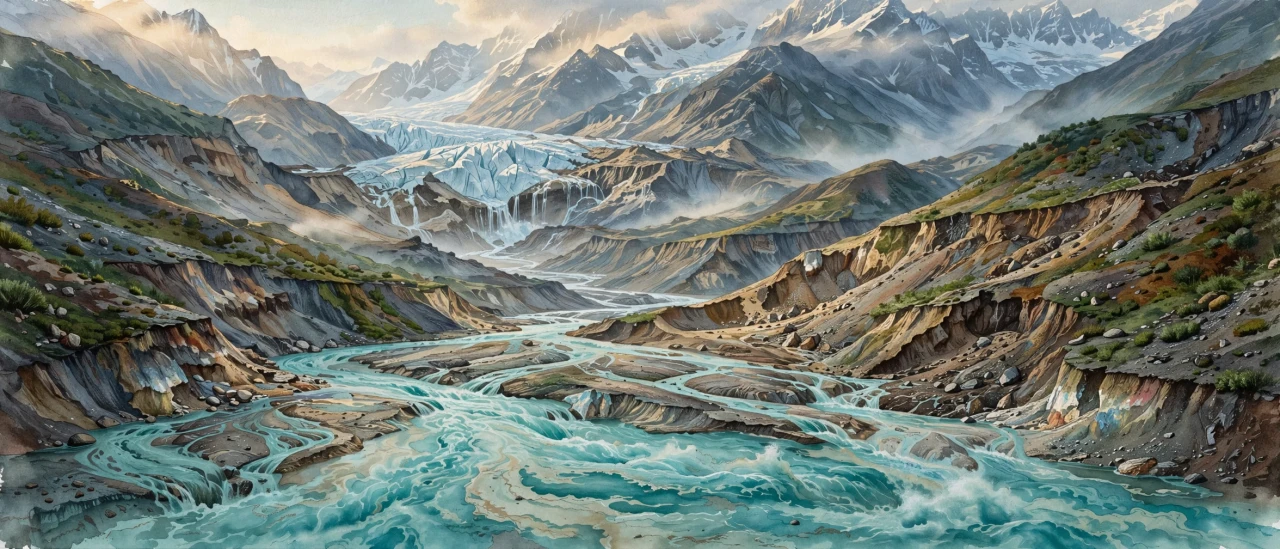
Illustration: milky turquoise glacial meltwater carrying dissolved minerals through a rapidly eroding Himalayan valley.
Sponsored: explore today's featured sponsored offers
FAQ
1. What did the new Himalayan study find?
Researchers at IISER Pune found that in the glaciated regions of the upper Indus basin, carbon dioxide released by pyrite oxidation in mountain rocks exceeds the carbon dioxide trapped by silicate weathering — making these landscapes a net source of CO2 over geological timescales, according to the Nature India research highlight of October 19, 2026.
2. What is pyrite oxidation, and why does it release carbon dioxide?
Pyrite is an iron-sulfide mineral. When it is exposed by erosion and reacts with oxygen and water in carbonate rocks, the reaction indirectly releases carbon dioxide back into the atmosphere. In the rapidly eroding, glacier-scoured valleys of the Indus basin, this release outweighs the carbon captured by weathering, the team found.
3. How did the scientists measure this?
The team analyzed the chemistry of river water across the upper Indus basin, including dissolved sulfur isotopes and oxygen isotopes. Those isotopic "fingerprints" let them quantify how much CO2 was being released through pyrite oxidation versus how much was being trapped through silicate weathering — essentially auditing the basin's carbon accounts.
4. Does this change the urgency of cutting human emissions?
No. The researchers describe a process that influences the carbon cycle over million-year timescales. Human emissions are driving warming thousands of times faster — atmospheric CO2 hit 428 parts per million in May 2026, about 50 percent above pre-industrial levels. The finding refines scientists' understanding of the long-term carbon cycle; it does not alter the need to cut emissions now.
5. Could glacier retreat make this effect stronger?
Possibly. Retreating glaciers expose fresh, unweathered rock, which can accelerate mineral oxidation. With global glacier thickness at a record low and New Zealand's glaciers having lost nearly half their volume since 1997, the study raises the question of whether more exposed rock could release more CO2 — a feedback the researchers say warrants further investigation in other mountain ranges.
Sources
- Nature India — "A hidden carbon dioxide source in the Himalaya," research highlight, October 19, 2026 (DOI: 10.1038/d44151-026-00201-x).
- Eos — "2026 State of the Climate Report Shows a Planet Reaching Its Limits," covering Ripple et al., BioScience 2026 (planetary vital signs: CO2 at 428 ppm, record glacier loss, warming rate doubled).
- RocketNews / Guardian coverage — "New Zealand greenhouse gas levels hit record highs threatening catastrophic glacier melts," on the Our Atmosphere and Climate 2026 report, October 2026.
Comments
Post a Comment