
PARIS — A chemical mystery that sat unsolved in the archive of the NASA/ESA Hubble Space Telescope for more than a quarter of a century may have been cracked: researchers say the white dwarf star HS 0209+0832 could host a planet that formed not from its star's birth, but from its death.

Illustration: A white dwarf star with a close-orbiting gas giant trailing material.
What Happened
In a study published in Nature Astronomy on 5 October 2026 and announced by ESA/Hubble the same day, researchers led by Jamie Williams, a doctoral candidate at the University of Warwick in the United Kingdom, report that unidentified chemical signatures in a Hubble spectrum of the white dwarf taken in 1999 match the element niobium. Niobium had never before been reported in a white dwarf's atmosphere, and the levels found were more than 1,000 times higher than those seen in the Sun, alongside other unusual chemical abundances.
That pattern, the team argues, is the fingerprint of a so-called second-generation planet: a world that condensed from the gas and dust cast off by its own star as it died, rather than from the cloud that formed the star in the first place. While a handful of planets have been found orbiting white dwarfs, the researchers say this is the first candidate with the hallmarks of a planet born from stellar death material.
"Rather than the white dwarf stage being a kind of epilogue to the story of a star and its planets, this research points to the systems we are familiar with only being the first chapter of a potentially much longer tale, with some new characters showing up," Williams said in the ESA/Hubble release. "That's a really exciting prospect to pursue."
Background
A white dwarf is the dense, remnant core left behind when a low-mass star — like the Sun — exhausts its nuclear fuel and sheds its outer layers into space. Planets in our own Solar System, including Earth, are first-generation worlds: they formed from the same cloud of gas and dust that gave birth to the Sun.
Second-generation planets, by contrast, would form later, from the material the dying star expels. Such worlds have long been suspected around pulsars, the rapidly spinning remnants of more massive dead stars, but a second-generation planet around a white dwarf — a far more common type of stellar remnant — would be a first.
The clue lay in how niobium is made. Elements heavier than iron are not forged by ordinary fusion in stellar cores; niobium is produced by the slow neutron-capture process, known as the s-process, that operates inside bloated red giants near the ends of their lives. "Elements heavier than iron are not formed in the cores of stars by thermonuclear fusion," said Nicholas Stone, a theoretical astrophysicist at the University of Wisconsin-Madison and a member of the research team, describing the observed pattern as a telltale sign of that dying-star chemistry. In other words, the white dwarf appears to be accreting material produced during its own red giant phase — not leftover birth material.
The case was built from three generations of space missions. Hubble recorded the unexplained features in 1999; archival ultraviolet data from NASA's retired Far Ultraviolet Spectroscopic Explorer (FUSE) mission later confirmed the niobium signatures; and NASA's Transiting Exoplanet Survey Satellite (TESS) watched the star for four months and recorded a repeating brightness variation on a roughly four-and-a-half-day cycle, consistent with a close-orbiting giant world.

Illustration: A space telescope above Earth, surrounded by archival observation data.
Why It Matters
If confirmed, the discovery would rewrite part of the story of how planets form. Planet formation would no longer be something that happens only at a star's birth; it could happen again, from recycled stellar material, long after the star has died. That opens a new chapter in which dead stars can host new worlds — and, eventually, new environments that might one day become temperate.
The candidate itself faces a harsh existence today. The team estimates it is a gas giant roughly the size of Jupiter, orbiting only about 6 million kilometres (3.7 million miles) from the white dwarf — far closer than Mercury's 58-million-kilometre orbit around the Sun. Because HS 0209+0832 is relatively young, it is still very hot, and its intense radiation is reported to be rapidly stripping the planet's atmosphere, producing a comet-like tail of material that falls back onto the star. That infalling, niobium-rich material is what Hubble detected.
Yet the researchers suggest the planet may endure. "If the second-generation planet is there, I think it is likely to survive," Williams said, as reported by Universe Today. "Eventually the white dwarf will cool and then maintain a consistent temperature, with the planet in its stable habitable zone for millions of years." The word "habitable" here refers to temperature, not to any claim that the world is inhabited or Earth-like.
What Happens Next
Caution is essential: this is a candidate, not a confirmed planet. The evidence is chemical and photometric — a distinctive elemental pattern plus a repeating brightness signal — rather than a direct image of the world itself. The team plans to examine the system for several more years, and other researchers will test the interpretation against alternative explanations.
The next steps are twofold. First, follow-up observations of HS 0209+0832 will aim to firm up the planet's existence and properties. Second, astronomers will search for similar systems, to learn how common second-generation planets are and how planetary systems around dead stars evolve. If more turn up, the "second act" of stars could become a recognised field of study — one that also shapes how we think about the far-future fate of our own Solar System, billions of years from now.
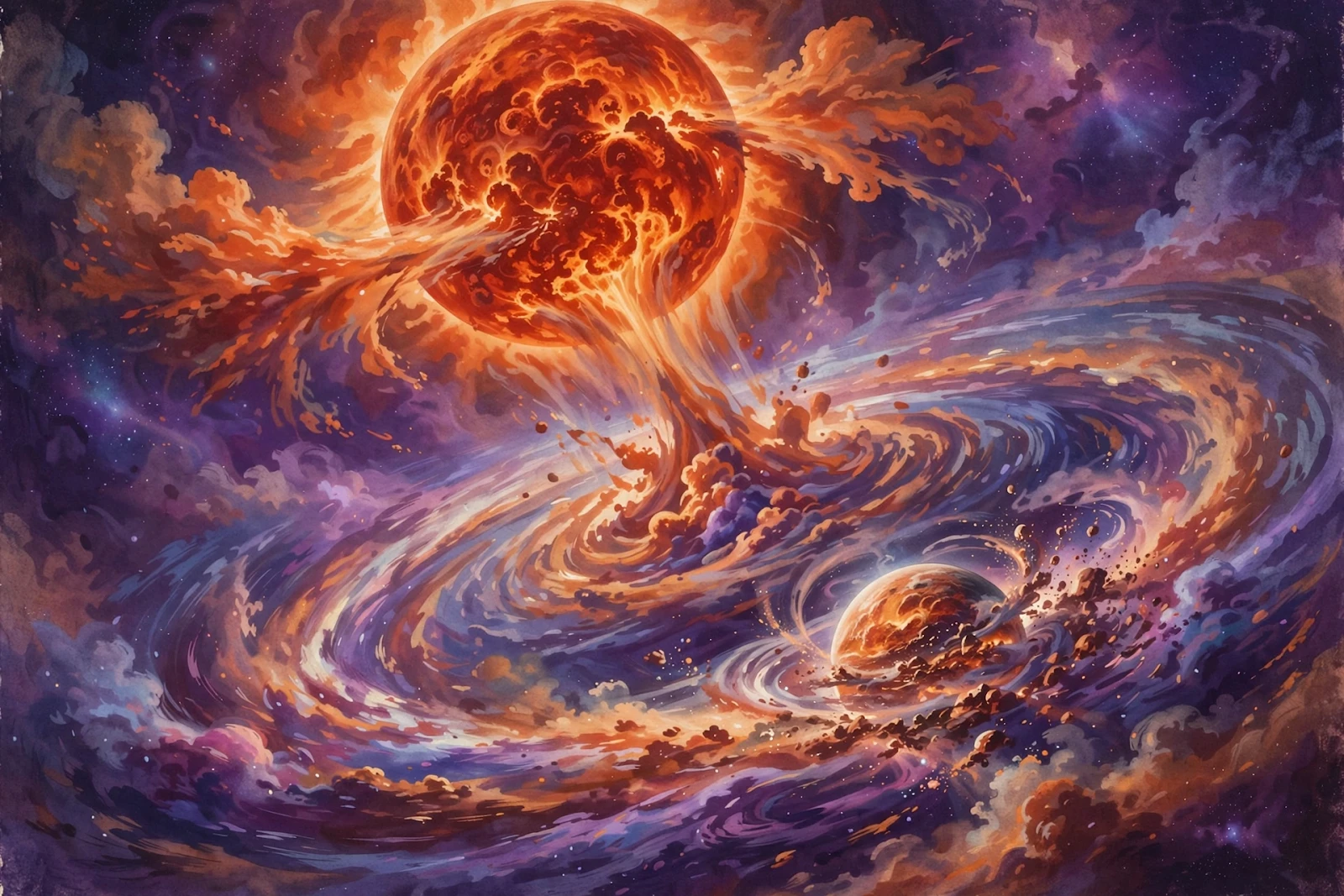
Illustration: A dying star sheds its layers into a disk where a new planet forms.
Sponsored: explore today's featured sponsored offers
FAQ
What is a white dwarf?
A white dwarf is the dense remnant core of a low-mass star that has burned through its nuclear fuel and shed its outer layers into space. It is the eventual fate of stars like the Sun.
What is a second-generation planet?
A second-generation planet is a world that forms from material cast off by a dying star, rather than from the cloud that formed the star. The candidate around HS 0209+0832 would be the first such world identified around a white dwarf.
How did researchers find the clue?
They revisited a Hubble spectrum of HS 0209+0832 from 1999 and matched its unexplained features to niobium using updated chemical databases. Archival FUSE data confirmed the niobium, and TESS recorded a repeating brightness signal consistent with a close-orbiting giant planet.
Why is niobium the smoking gun?
Niobium is produced by the s-process inside dying red giants, not by ordinary stellar fusion. Finding it at more than 1,000 times the Sun's level around a white dwarf points to material from the star's own death, not its birth.
Is the planet confirmed?
No. It remains a candidate. The team plans years of follow-up observations, and astronomers will search for similar systems to test how common second-generation planets around white dwarfs really are.
Sources
- ESA/Hubble, "Suspected second-generation planet solves Hubble cold case" (heic2613), 5 October 2026.
- Williams et al., "Discovery of a second-generation planet candidate accreting onto a white dwarf," Nature Astronomy, 5 October 2026 (doi:10.1038/s41550-026-02983-7).
- Universe Today, "Hubble Spots a Suspected Second-Generation Planet," October 2026; Engadget, "Scientists find evidence of a second-generation planet born from a dying star," October 2026.
Comments
Post a Comment