
The International Monetary Fund has warned that global public debt is on course to pass 100 percent of world economic output by the end of this decade, urging governments to rebuild their fiscal room now while borrowing costs climb and before market pressure forces harsher adjustments. The warning came in the IMF's October 2026 Fiscal Monitor, presented on October 14, 2026, during the IMF and World Bank Annual Meetings in Bangkok, Thailand, and in an accompanying IMF blog titled "Taxing Better to Boost Growth."
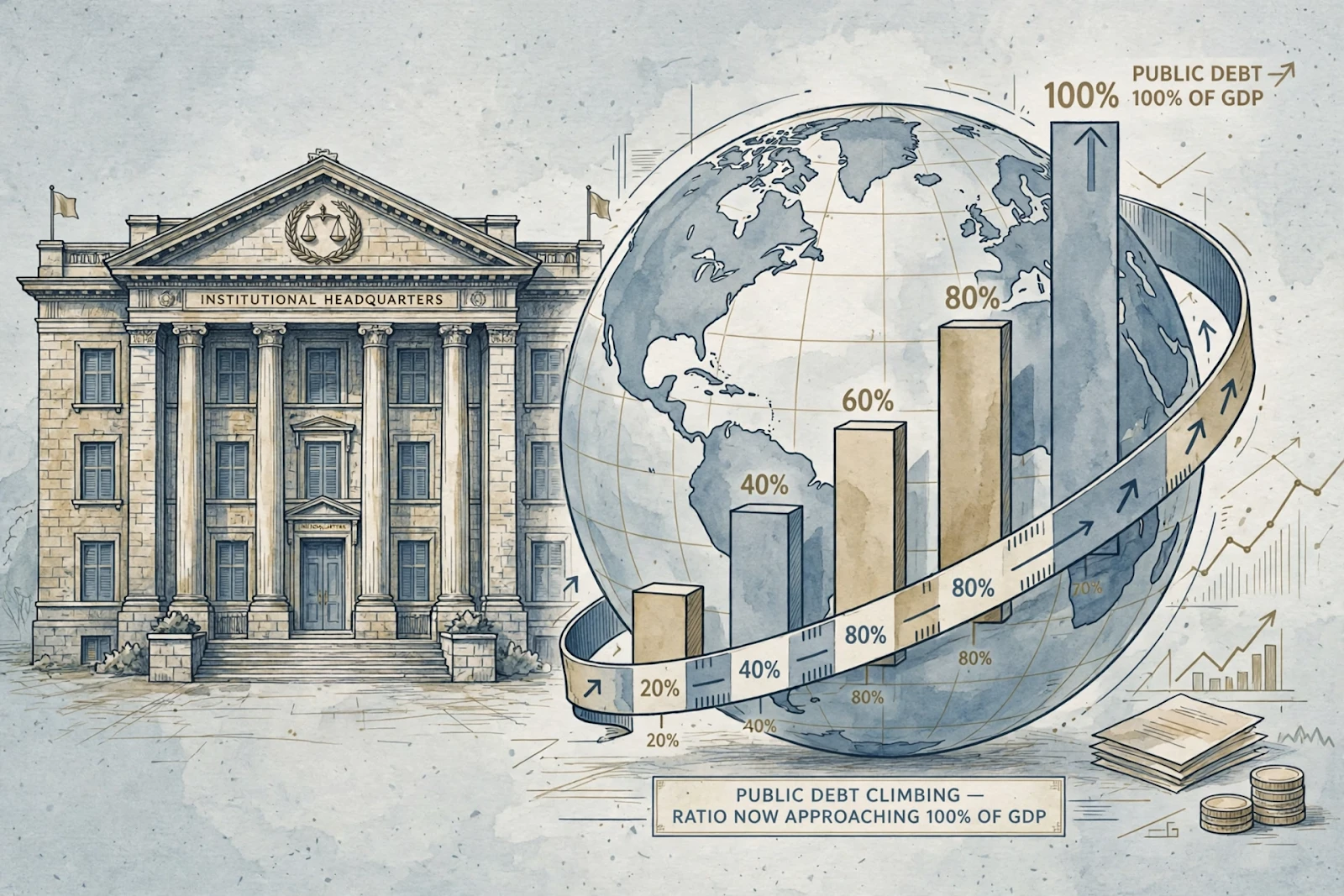
Illustration: A stylised view of global public debt climbing toward 100 percent of world GDP, as projected by the IMF.
What Happened
According to the IMF's October 2026 Fiscal Monitor, global public debt rose to 94 percent of GDP in 2025 and is projected to reach 100 percent of GDP by 2029, with the Fund's blog framing the path as exceeding 100 percent by 2030, a level last seen in the immediate aftermath of World War II. The accumulation has been driven largely by major economies, while rising interest rates and mounting spending commitments are making it harder for governments to stabilise their debt burdens.
Presenting the report, Rodrigo Valdés, Director of the IMF's Fiscal Affairs Department, said that the resilience of global economic activity had not translated into a meaningful improvement in fiscal outcomes, and warned that the window for orderly fiscal adjustment was narrowing. Governments, he said, needed to act before worsening market conditions forced more painful adjustments, even as they faced competing demands from social spending, defence, healthcare and other development priorities.
IMF Managing Director Kristalina Georgieva had already set out the warning in a curtain-raiser speech at the Lee Kuan Yew School of Public Policy in Singapore ahead of the Bangkok meetings, describing excessive fiscal deficits, record public debt and high debt-servicing costs as a major factor affecting the global economy today. She cautioned that expectations that stronger growth from artificial intelligence could eventually ease debt pressures risked encouraging governments to delay difficult fiscal decisions, saying that the size of the growth pick-up needed to reduce debt ratios without fiscal effort looked out of reach in the near term.
Background
The Fiscal Monitor warning lands at a moment when government borrowing has become markedly more expensive. The IMF blog reported that the average 10-year government bond yield across the Group of Seven advanced economies rose by more than one percentage point between February and September 2026, reaching its highest level in nearly two decades. Georgieva noted in her speech that yields on 10-year government bonds in the United States, Germany and Japan had risen sharply, reaching levels not seen since 2007, 2009 and 1996 respectively, according to reports of the speech.
Higher benchmark yields raise borrowing costs for governments refinancing existing obligations or issuing new debt. They also increase competition for available savings, as private companies, including firms financing AI infrastructure, seek more capital. The IMF said the effective average interest cost of government financing is projected to rise from 2.3 percent in 2021 to 3.7 percent by 2031. United States interest payments alone are projected to climb from about 2.8 percent of GDP before the pandemic to 5.7 percent in 2031, while in low-income countries interest payments today already consume more than 15 percent of tax revenues.

Illustration: Rising bond yields are pushing up the cost of financing public debt around the world.
The global primary deficit, which excludes interest payments, stands at about 3.3 percent of GDP in 2026, the Fund said. Stabilising the debt ratio this year would require cutting that deficit to around 2.6 percent, implying an adjustment of roughly 0.7 percentage points of GDP. The IMF stressed that although it expected fiscal balances to improve, that outcome was not guaranteed, particularly as governments juggle social, defence and climate spending alongside energy subsidies.
The debt warning is part of a broader IMF message from the Bangkok meetings. In its October World Economic Outlook, the Fund projected global growth of 3.1 percent in 2026 and 3.4 percent in 2027, with global headline inflation climbing to 4.7 percent in 2026, driven mainly by higher energy and food prices. In a separate Global Financial Stability Report, the Fund flagged stretched valuations in AI-related assets and the build-up of debt linked to the AI investment boom as risks to financial stability. The Fiscal Monitor's message connects the two: even a powerful technology boom cannot substitute for credible budget plans.
Why It Matters
When public debt approaches 100 percent of GDP, governments have less room to respond to the next shock, whether it is a war, a pandemic, a financial crisis or a natural disaster. High debt also means a larger share of every budget goes to interest payments rather than to schools, hospitals, infrastructure or climate adaptation. For low-income countries, where interest already eats more than 15 percent of tax revenue, the squeeze is most acute, leaving less money for basic services and development.
The warning also matters for ordinary households and businesses. Government bond yields set a benchmark for borrowing costs across the economy, influencing mortgage rates, corporate loans and investment decisions. When yields rise because investors demand more compensation for holding government debt, credit becomes more expensive for everyone. And when governments eventually do consolidate, the choices, between tax rises, spending cuts or both, shape jobs, services and growth for years.
There is also a political dimension. Fiscal consolidation is rarely popular, and the IMF itself acknowledged that the measures will be difficult. But the Fund's argument is that planned, gradual adjustment is far less painful than adjustment imposed suddenly by markets, when investors lose confidence and borrowing costs spike. The experience of past debt crises, the Fund argues, shows that credibility, clear medium-term plans that markets and voters can believe, is itself a valuable economic asset.

Illustration: Governments must balance protecting public services against the weight of rising debt.
What Happens Next
The IMF is calling on governments to present credible medium-term fiscal consolidation plans that protect growth and vulnerable groups. In practice, that means budgets over the coming months, including autumn budget season in many advanced economies, will be watched closely for signs that governments are acting on the warning rather than postponing it. The Fund's blog title points to one of its preferred tools: better tax design that raises revenue while supporting growth, rather than relying on borrowing alone.
Markets will also be watching the major central banks. The Fund's Europe report, released alongside the Fiscal Monitor, said the European Central Bank would likely need at least one more 25-basis-point rate rise in 2026 to keep core inflation contained, after increases in June and September, while the Bank of Japan was expected to raise rates gradually toward a neutral setting. The United States Federal Open Market Committee was due to meet on October 28 to 29, following a high September consumer price reading, according to weekly market summaries. Each of those decisions feeds into the borrowing costs that shape the debt path.
For developing economies, the next test is access to finance itself. The IMF warned that emerging markets and low-income countries are vulnerable because of low budget revenues and limited access to financing. If global yields stay high, those countries could face harder choices sooner, including seeking IMF support or restructuring debts. The Fund's message to all governments is the same: the longer adjustment is delayed, the narrower the window becomes.
Sponsored: explore today's featured sponsored offers
FAQ
What exactly did the IMF warn about global debt?
The IMF warned in its October 2026 Fiscal Monitor that global public debt, which stood at 94 percent of GDP in 2025, is projected to reach 100 percent of GDP by 2029, with its blog framing the path as exceeding 100 percent by 2030, a level last reached after World War II.
Why is debt rising if the global economy is still growing?
According to the IMF's Fiscal Affairs chief Rodrigo Valdés, resilient economic activity has not translated into better fiscal outcomes, because governments still run large primary deficits of about 3.3 percent of GDP, while higher interest rates steadily raise debt-servicing costs as old, cheaper debt is refinanced.
How much are interest payments costing governments?
The IMF projects the effective average interest cost of government financing will rise from 2.3 percent in 2021 to 3.7 percent by 2031. United States interest payments are projected to reach 5.7 percent of GDP in 2031, and in low-income countries interest already consumes more than 15 percent of tax revenues.
Can artificial intelligence growth solve the debt problem?
Not on its own, according to IMF Managing Director Kristalina Georgieva, who warned that the size of the AI-driven growth pick-up needed to reduce debt ratios without fiscal effort looks out of reach in the near term, and that expecting AI to fix the problem risks delaying necessary decisions.
What does the IMF want governments to do?
The Fund urges governments to present credible medium-term fiscal consolidation plans, including better tax design, that stabilise debt while protecting growth and vulnerable groups, acting before market pressure forces more painful adjustments.
Sources
- IMF, October 2026 Fiscal Monitor, presented October 14, 2026, at the IMF and World Bank Annual Meetings in Bangkok, as reported by multiple outlets covering the presentation.
- IMF blog, "Taxing Better to Boost Growth," published October 14, 2026, with the October Fiscal Monitor.
- IMF Managing Director Kristalina Georgieva, curtain-raiser speech at the Lee Kuan Yew School of Public Policy, Singapore, ahead of the 2026 Annual Meetings, as reported in October 2026.
- Reuters, "IMF expects at least one more 25 bps ECB rate hike in 2026," October 16, 2026, and "IMF expects gradual BOJ rate hike towards neutral setting," October 13, 2026.
Comments
Post a Comment