
WASHINGTON — Iran has substantially increased its efforts to target United States personnel, and lethal plots by Tehran against American citizens have reached "advanced stages," the United States' top intelligence official warned in a memo dated October 23, 2026 — a warning that coincided with Washington pulling diplomats' families out of Saudi Arabia and updating travel advisories for more than a dozen countries across the Middle East.

Illustration: An embassy building with flags at dusk — an artist's impression, not a photograph of a particular mission.
What Happened
The alert came from Director of National Intelligence Jay Clayton, in a message to Secretary of State Marco Rubio dated October 23, 2026, according to a memo seen by Reuters. CIA Director John Ratcliffe was also copied on the unclassified memo, which was first reported by Axios and then reported by Reuters on October 24, 2026.
"Specifically, through various channels, we have received intelligence that Iran has substantially increased efforts to target US personnel," Clayton wrote, according to Reuters. "The lethal plotting efforts by the Iranians against US citizens have reached advanced stages in both the Middle East and certain other countries," he added.
The warning followed Washington's decision earlier in the week to scale back staffing at its mission in Saudi Arabia, in response to intensified attacks by Iran-allied Houthi forces. On Wednesday, the State Department ordered non-emergency government employees and their family members to leave United States diplomatic missions in Saudi Arabia and planned to withdraw family members from a number of other missions in the region, United States officials told Reuters.
On Saturday, the State Department updated travel advisories for more than a dozen countries across the Gulf and the Middle East, including Saudi Arabia, Qatar, the United Arab Emirates, Iraq and Israel, citing an increased threat from Iran-aligned Houthis. A United States official, asked about the embassy staffing changes, told Reuters: "When it comes to our staffing at embassies, we constantly evaluate new information about the security environment."
Background
The memo lands in the middle of a regional conflict that Reuters describes as nearly eight months old, triggered by the war involving Iran. One front of that conflict is Yemen, where Houthi forces allied with Iran have intensified attacks — and those attacks, Reuters reported, have coincided with a rise in attacks on commercial shipping in the Strait of Hormuz, the narrow waterway through which a large share of the world's oil travels.
Earlier in October, sources told Reuters that Iran was preparing a more forceful response if the United States resumes large-scale military attacks on its territory. That reported warning gives the Clayton memo its context: it is not an isolated alarm but part of an escalation ladder in which each side's moves — strikes, threats, embassy drawdowns, travel warnings — are read by the other side as signals of what may come next.
The memo's distribution list is itself a signal. A message from the Director of National Intelligence to the Secretary of State, copied to the CIA director, is how the most serious threat assessments travel inside the United States government. That it was unclassified, and that it reached the press within a day, suggests the administration wanted the warning to be heard beyond the classified system — by allies, by American citizens in the region, and by Tehran itself.
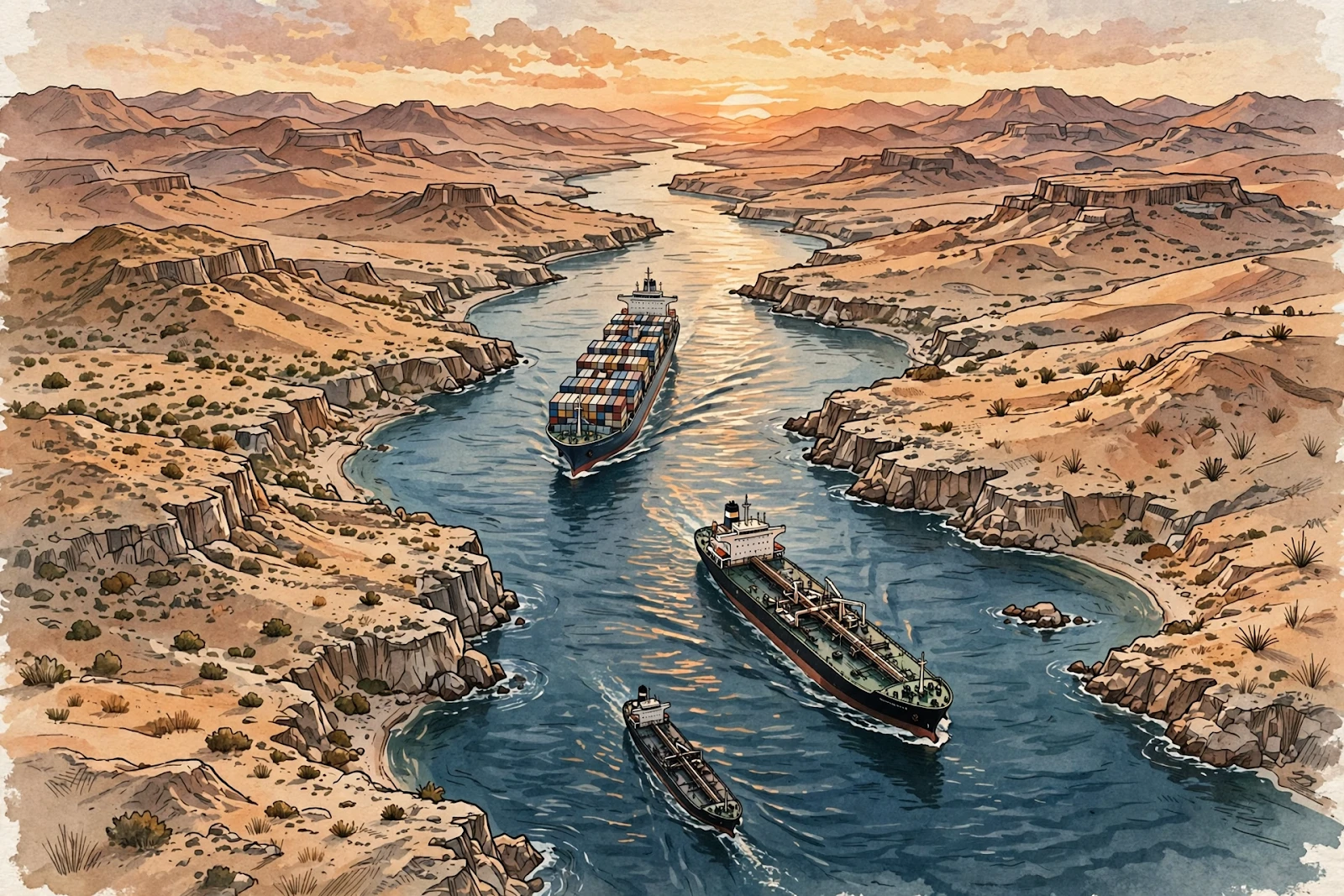
Illustration: Cargo ships passing through a narrow strait at sunset — an artist's impression, not a photograph of the Strait of Hormuz.
Why It Matters
The immediate stakes are the safety of Americans across the Middle East. Embassy drawdowns are among the most visible steps a government can take short of breaking relations: they tell staff, families and citizens that the risk assessment has changed, and they tell host governments that Washington is prepared to reduce its footprint rather than leave its people exposed. Travel advisories for more than a dozen countries extend that message to tourists, business travellers and dual nationals.
The wider stakes are escalation. The Strait of Hormuz is one of the world's most consequential chokepoints: attacks on shipping there raise insurance costs, push up oil prices and force navies to escort commercial vessels. A cycle in which Houthi attacks prompt American drawdowns, which prompt Iranian threats, which prompt further military preparation, is precisely how regional conflicts widen — not through a single decision to go to war, but through a series of defensive steps that each side reads as provocation.
The timing adds a political dimension. Reuters has separately reported that President Donald Trump has promised not to order any new attack on Iran before the United States midterm elections, while the United States and Israel are widely reported to be preparing for a possible major escalation after the vote. A public intelligence warning about "advanced" plotting, issued days before Americans vote, therefore sits at the intersection of security policy and electoral politics — and will be read, by supporters and critics alike, through both lenses.
There is also a credibility question that runs in both directions. If the plots are as advanced as the memo says, the warning may save lives and justify the drawdowns. If the threat is overstated, the drawdowns and advisories could deepen a crisis that diplomacy might still contain. The memo itself offers no public evidence — intelligence warnings rarely do — which means the public must judge it by the actions that accompany it: the embassy orders, the travel advisories, and what allies do next.
What Happens Next
Several things are worth watching in the coming days. First, whether other governments follow Washington's lead with their own staff reductions or travel warnings — allied moves would suggest shared intelligence, while silence would suggest a uniquely American assessment. Second, whether the Houthi attacks on shipping and on targets in the region intensify or pause, and whether any incident is attributed to Iranian direction. Third, whether any further details of the alleged plots emerge, either through official statements or through arrests or disruptions that officials link to the warning.
Beyond the immediate crisis, the longer question is whether the current posture — reduced diplomatic presence, heightened warnings, and reported preparations for escalation after the midterms — becomes the new normal for the region, or whether a diplomatic channel reopens. Embassy drawdowns are reversible; so is the rhetoric. But each week that passes with diplomats' families out of the region and warships shadowing tankers makes the return to normal diplomacy harder, not easier.
For now, the memo stands as the clearest public statement of how Washington currently sees the threat: not as a distant risk, but as plotting that has reached an advanced stage, against Americans in the Middle East and beyond. The drawdowns and advisories are the visible consequences. What remains unseen — the intelligence itself, and Tehran's intentions — will determine whether this warning is remembered as a precaution or as a prelude.

Illustration: Officials in a briefing room studying a regional map — an artist's impression, not a photograph of a government meeting.
Sponsored: explore today's featured sponsored offers
FAQ
What did the intelligence memo actually say?
According to Reuters, which saw the memo, Director of National Intelligence Jay Clayton wrote to Secretary of State Marco Rubio on October 23, 2026, that Iran had substantially increased efforts to target US personnel and that lethal plotting against US citizens had reached "advanced stages" in the Middle East and certain other countries.
Who wrote and received the memo?
It was written by Director of National Intelligence Jay Clayton, addressed to Secretary of State Marco Rubio, and copied to CIA Director John Ratcliffe. The unclassified memo was first reported by Axios and then by Reuters on October 24, 2026.
What has the US government done in response?
The State Department ordered non-emergency employees and family members to leave US missions in Saudi Arabia, planned family withdrawals from other regional missions, and updated travel advisories for more than a dozen Gulf and Middle East countries, citing the threat from Iran-aligned Houthis.
What is the role of the Houthis and the Strait of Hormuz?
Reuters reported that intensified attacks by Iran-allied Houthi forces coincided with a rise in attacks on commercial shipping in the Strait of Hormuz, a vital oil-transit waterway. Earlier in October, sources told Reuters Iran was preparing a more forceful response if the US resumes large-scale military attacks on its territory.
Why does the timing matter?
Reuters has separately reported that President Donald Trump promised no new attack on Iran before the US midterm elections, while the US and Israel are widely reported to be preparing for a possible major escalation after the vote — making the memo part of a politically charged moment as well as a security warning.
Sources
- Reuters (Humeyra Pamuk and Enas Alashray), "Iran has ramped up efforts to target US personnel, intelligence memo warns," October 24, 2026 (memo first reported by Axios).
- Reuters, "Trump foreign policy hits voters in the pocketbook, imperiling Republicans in midterms," October 24, 2026.
Comments
Post a Comment