
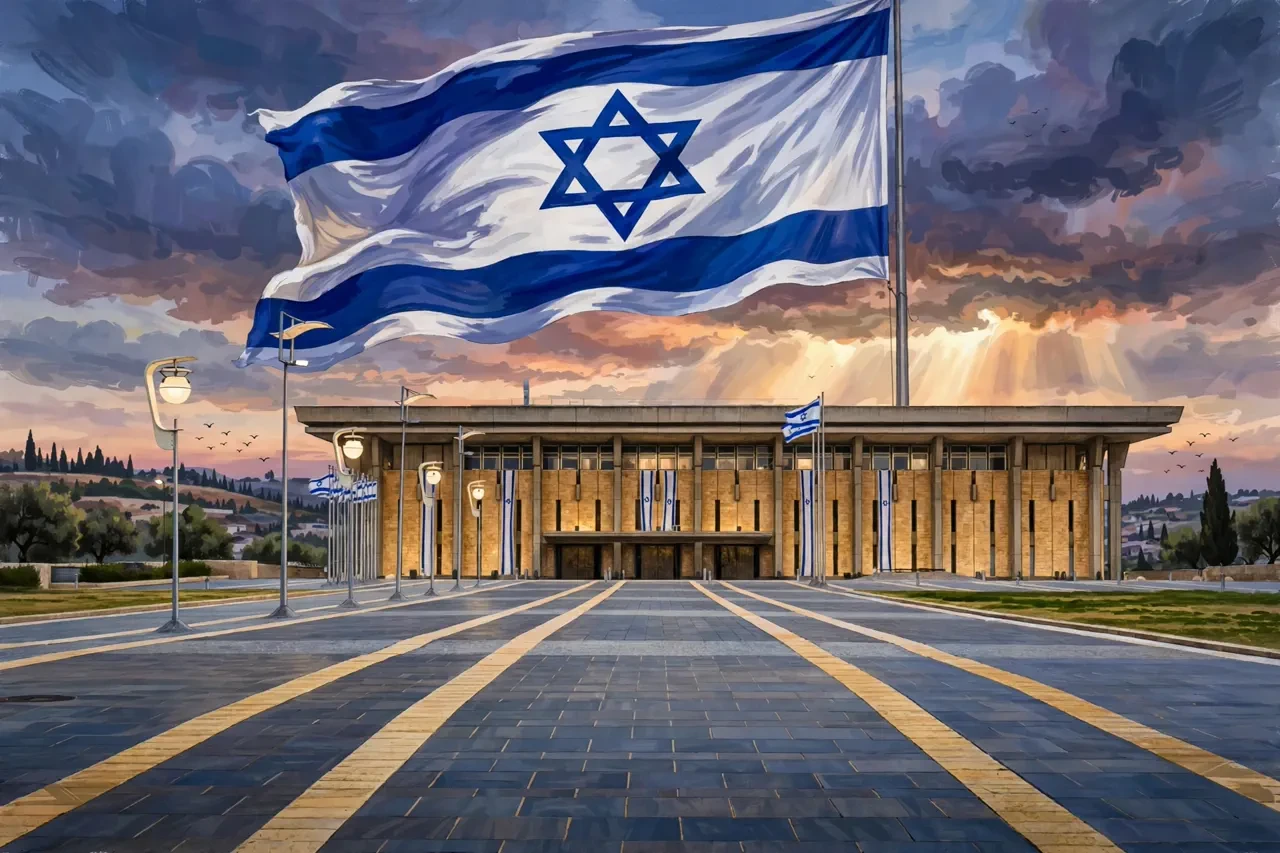
Illustration of the Knesset parliament building in Jerusalem beneath an Israeli flag at dusk
Jerusalem — Six days from now, Israelis will vote in the most consequential election in a generation. On Tuesday, October 27, 2026, all 120 seats of the Knesset will be contested in the country's first national election since the Hamas-led attacks of October 7, 2023 — and the first Israeli parliamentary vote held on its statutory schedule in nearly four decades. The polls tell a story of deadlock: neither Prime Minister Benjamin Netanyahu's bloc nor the opposition appears able to secure the 61 seats needed to govern, raising the prospect of weeks of coalition bargaining — and of smaller parties, including Arab parties, holding the balance of power.
What Happened
Israel is in the final week of its 2026 legislative election campaign, and the picture painted by the polls is remarkably consistent: a near-tie that nobody can break. According to the poll tracker maintained by israel.com, which aggregates 207 polls published since January from 10 outlets, the parties of the outgoing government average just 49 seats in the latest surveys, 12 short of a majority, with no individual poll in the last two weeks giving the coalition 61 seats. Gadi Eisenkot's centrist Yashar party averages 22.4 seats and has come first in eight of the eight most recent polls, ahead of Netanyahu's Likud on 19.6.
The deadlock is not a quirk of one pollster's method. A Channel 13 News survey reported this week via Haaretz put Eisenkot's bloc at 51 seats against 50 for the bloc backing Netanyahu, while a Channel 12 News poll showed 55 to 51, according to the same reporting. A Channel 14 poll conducted by NEXT DATA on October 12 gave Netanyahu's bloc exactly 61 seats, the barest possible majority. A combined estimate of polls published by The Jerusalem Post on October 12 had the opposition bloc led by Eisenkot, Yair Lapid and Naftali Bennett on 54 seats, matching Netanyahu's bloc, with Arab parties forecast at eight.
Betting markets tell a similar story: The Jerusalem Post reported Polymarket odds of roughly 49 percent for Eisenkot becoming prime minister, versus 31 percent for Netanyahu and 16 percent for Bennett.
This is the first Knesset election since the October 7, 2023 attacks that triggered the Gaza war — and many Israelis blame failures by Netanyahu's government for the deadliest attacks in the country's history. Reuters reported this week that Likud, which holds 32 of the Knesset's 120 seats, is on course to lose around a third of them. Yet it is, as Reuters noted, too early to say whether Netanyahu's opponents can finally unseat the most right-wing government in Israel's history — because many voters, especially the young, have moved even further to the right.
Background
The outgoing 25th Knesset became the first Israeli legislature to complete its full four-year term without early dissolution since 1988, ending the prolonged political crisis of 2018–2022 that saw five consecutive snap elections, according to Wikipedia's election overview. The 37th government, formed by Netanyahu in December 2022 with Likud, far-right partners and ultra-Orthodox parties, thus served a complete term — an institutional milestone that produced no political calm.
That government's tenure was marked by turmoil almost from the start: mass protests over the judicial overhaul, the October 7 attacks and the subsequent Gaza war, and recurring coalition crises over ultra-Orthodox military conscription. The Knesset dissolved in July, setting the October 27 date — the first time in decades that an Israeli election has arrived on schedule rather than being triggered by a government's collapse.

Illustration of two podiums facing each other under spotlights, symbolizing an election contest
Israel's electoral system makes small parties kingmakers. The entire country votes as a single district under proportional representation, with a 3.25 percent threshold. No party has ever won an outright majority, so governments are built from coalitions — and the current polls suggest both large blocs will need partners who may not want to join them.
The cast reflects a political system in flux. Netanyahu, Israel's longest-serving prime minister, leads Likud into what many analysts describe as the fight of his political life. His principal challenger is Gadi Eisenkot, the former military chief of staff, whose new centrist party Yashar has led the polls for months on a platform of accountability, political reform and national unity. Naftali Bennett — the former prime minister now leading the Together party — is polling as a third force.
On the right flank, Itamar Ben-Gvir's Otzma Yehudit (Jewish Power), which in 2022 needed a joint list with two other far-right groups to clear the threshold, is now forecast to win eight or more seats standing on its own, according to Reuters — a shift the agency attributes to young voters moving right.
Why It Matters
This election is, in the most literal sense, a referendum on the October 7 era. No Israeli government has ever faced voters after a catastrophe of that scale, and the campaign has been shadowed by unresolved questions: the failures that allowed the attacks, the conduct and aftermath of the Gaza war, the hostages, the economy, and the deep social divisions the war years exposed. The outcome will determine not just who governs, but what kind of country Israel understands itself to be after the most traumatic period in its history.
The arithmetic matters as much as the symbolism. With neither major bloc polling at 61 seats, the election could produce a hung parliament — and in that scenario, the Arab parties, forecast at around 8 to 12 seats, could become the decisive force in post-election negotiations, a historic shift given they have almost never been part of a governing coalition.

Illustration of voters queuing at ballot boxes in front of a city skyline at sunrise
There are regional stakes too. Israel's next government will shape the country's posture toward Gaza's reconstruction, relations with a United States heading into its own midterm elections on November 3, and the fragile diplomacy around Iran. A government led by Eisenkot, Bennett or a weakened Netanyahu would each read that landscape differently.
And there is the generational signal Reuters identified: the young voters moving right, toward Ben-Gvir's camp, even as the country debates accountability for October 7. Whichever bloc forms the next government, that rightward drift among the young will shape Israeli politics for years.
What Happens Next
Israelis vote on Tuesday, October 27. Polls close in the evening Israel time, with exit polls expected immediately after and official results typically certified in the days that follow. If the polls are right and no bloc reaches 61 seats, the president will consult with the parties and task a candidate with forming a government — a process that can take weeks.
Watch three things on election night: whether Yashar finishes first and by how much, which would strengthen Eisenkot's claim to form the next government; whether Netanyahu's bloc lands at or above 61, which would defy nearly every recent poll; and the size of the Arab parties' representation, which could determine whether anyone can govern at all. The polls have been wrong before — Channel 14's survey showing a 61-seat Netanyahu bloc is a reminder that the race is within the margin of polling error.
Six days out, the only certainty is the date. Everything else — the prime minister, the coalition, the direction of the country — is on the ballot.
Sponsored: explore today's featured sponsored offers
FAQ
When is Israel's 2026 election?
Israelis vote on Tuesday, October 27, 2026, to elect all 120 members of the Knesset — the first national election since the October 7, 2023 attacks, and the first held on schedule since 1988.
Who are the main candidates for prime minister?
The leading contenders are incumbent Benjamin Netanyahu of Likud, former military chief Gadi Eisenkot of the centrist Yashar party — which has led most recent polls — and former prime minister Naftali Bennett of the Together party.
What do the polls say?
The polls consistently show a deadlock. According to the israel.com tracker, Netanyahu's outgoing coalition averages 49 seats — 12 short of the 61 needed for a majority — while Yashar averages 22.4 seats and has finished first in eight of the eight latest polls. Individual surveys range from a razor-thin 61-seat Netanyahu majority (Channel 14) to a narrow opposition edge (Channel 13, Channel 12).
Why could Arab parties decide the election?
With neither major bloc polling at 61 seats, the Arab parties — forecast at roughly 8 to 12 seats — could hold the balance of power in coalition negotiations, enough to make or break either bloc's path to a majority.
What happens after the vote?
Exit polls are expected on election night, with official results certified in the following days. If no bloc wins 61 seats, the president will consult the parties and task a candidate with forming a coalition government — a process that can take weeks and has previously failed, forcing new elections.
Sources
- Reuters — "Israel's Ben-Gvir poised for election gains as young voters turn far right" (October 20, 2026).
- israel.com — Israel Election 2026 poll tracker: polls average and coalition tracker (updated October 21, 2026; 207 polls since January from 10 outlets).
- Wikipedia — "2026 Israeli legislative election" (accessed October 21, 2026): election date, seat arithmetic, electoral threshold, Knesset term history.
- newscord.org — Channel 13 News poll via Haaretz: Eisenkot bloc 51 vs. Netanyahu bloc 50 (October 20, 2026).
- votendi.com — Channel 14/NEXT DATA poll: Netanyahu bloc at 61 seats (October 12, 2026).
- theglobaljournal.news — Jerusalem Post combined poll estimate: opposition bloc 54, Netanyahu bloc 54, Arab parties 8 (October 12, 2026).
- michaelrcronin.com — "Israel Heads Toward a Tight October Vote as Blocs Deadlock and Courts Weigh Who Can Run" (September 2026).
Comments
Post a Comment