
HOUSTON — Two astronauts will step outside the International Space Station on October 29 and November 5, 2026, to install the station's final two roll-out solar arrays, NASA announced, completing a power upgrade that began in 2021 and will raise the orbiting laboratory's electricity supply by up to 30 percent.
The spacewalks, designated U.S. spacewalks 100 and 101, will be carried out by NASA astronaut Anil Menon and Canadian Space Agency astronaut Joshua Kutryk. Together, the two new arrays will complete a set of eight International Space Station Roll-Out Solar Arrays (IROSAs), lifting the station's power generation capacity from 160 kilowatts to approximately 215 kilowatts — electricity needed for science, daily operations and, eventually, the station's safe and controlled deorbit.
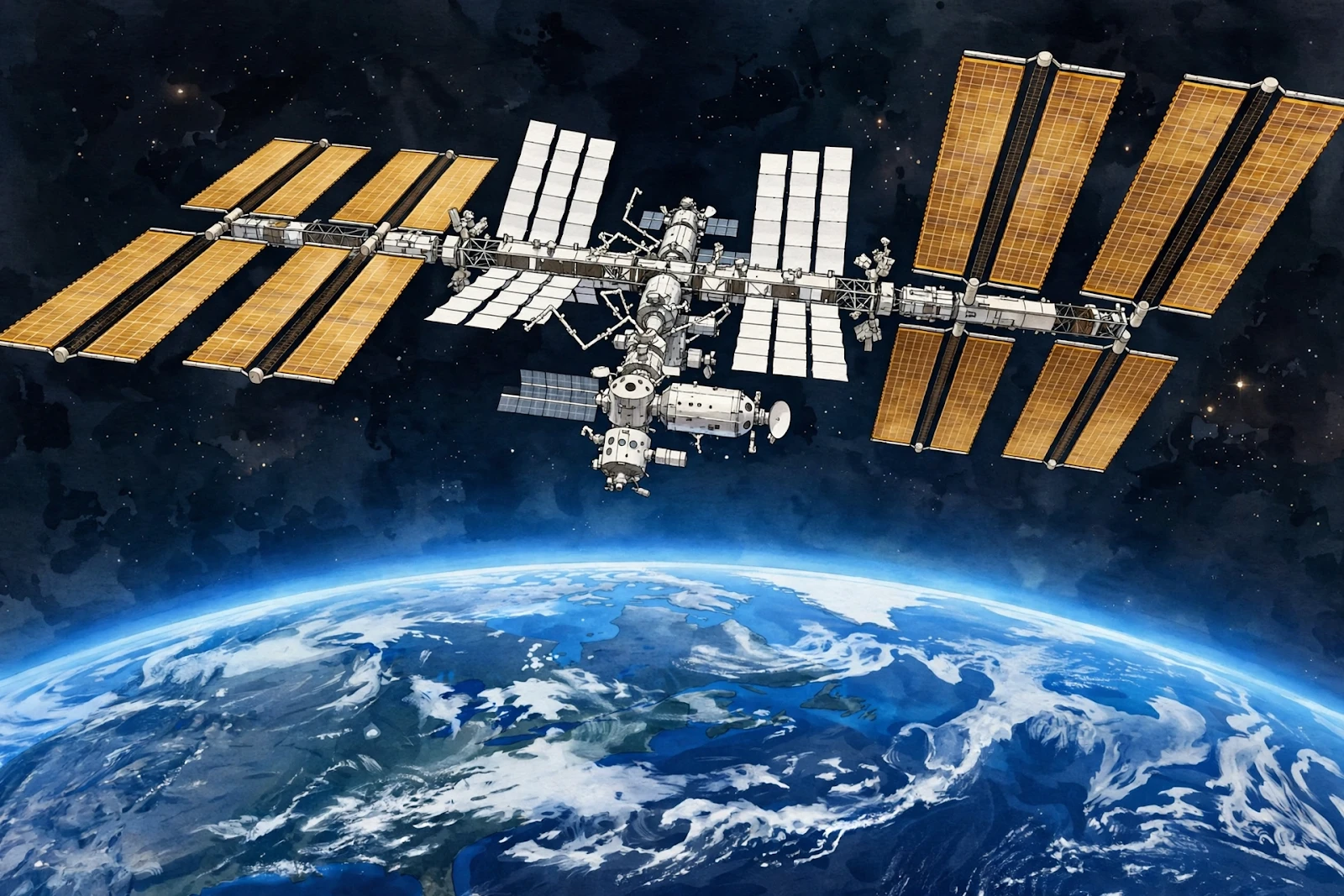
Illustration: The International Space Station in orbit, with large golden roll-out solar arrays extended above Earth.
What Happened
NASA announced the spacewalk plan in an advisory on October 14, 2026, and previewed the operations at a news conference from Johnson Space Center on October 20. During U.S. spacewalk 100 on Thursday, October 29, Menon and Kutryk will exit the station's Quest airlock to install and deploy the seventh IROSA on the 2A electrical power channel, on the port side of the station's truss. NASA+ coverage begins at 6:30 a.m. EDT, with the spacewalk scheduled to start at 8 a.m. EDT, according to NASA's station blog.
During U.S. spacewalk 101 on Thursday, November 5, the same pair will install and deploy the eighth and final IROSA on the 3B power channel, on the starboard side. NASA+ coverage starts at 6:45 a.m. EST, with the spacewalk beginning at 8:10 a.m. EST. The two outings will be the 285th and 286th spacewalks conducted in support of station assembly, maintenance and upgrades, NASA said.
The assignments carry personal milestones as well. The October 29 outing will be Menon's fourth spacewalk and Kutryk's first. Menon, a NASA astronaut selected in the 2021 class and an emergency medicine physician with aerospace medicine training, already spacewalked on August 6, 2026, to prepare the station's truss for one of the new arrays. Kutryk, who reached the station with SpaceX Crew-13 on October 1 on his first spaceflight, will become the fifth Canadian astronaut to work outside the station, and the first since David Saint-Jacques in April 2019, according to the Canadian Space Agency.
Preparations have been under way for weeks. NASA's station blog reported on October 19 and 21 that Menon and Kutryk cleaned cooling loops in their spacesuits, filled suit tanks and liquid cooling garments, organised tools, inspected tethers and cleaned helmet components, while fellow crew members Jessica Watkins and Luke Delaney rehearsed the procedures for helping them in and out of their suits. The Canadian-built Canadarm2 robotic arm will serve as a platform for one of the spacewalkers during the work, the Canadian Space Agency said.
Background
The roll-out solar array upgrade is one of the station's most important engineering projects. The original solar wings, launched with the station's early modules, have degraded after more than two decades in orbit. Rather than replacing them entirely, engineers designed IROSAs — thin, flexible panels that unroll in space and mount in front of an original wing, partly covering it — to augment the existing power system without rebuilding it.
The first IROSAs reached the station in June 2021, and six have been installed since. Each new array adds generating capacity to a specific power channel, so the upgrade has proceeded channel by channel, spacewalk by spacewalk, over five years. The final pair — channels 2A and 3B — completes the set, and with all eight in place the station's available power rises by up to 30 percent.
That power is not a luxury. The station hosts dozens of experiments at any time, from biomedical research and 3D cell printing to Earth observation and technology demonstrations, all of which compete for electricity alongside life support, communications and thermal control. More power means more science can run at once, and more demanding experiments — including those preparing for future Moon and Mars missions — can be supported.
The upgrade also looks ahead to the station's end of life. NASA has said the additional power will support critical station operations, including its safe and controlled deorbit, currently planned for around 2030. Bringing a structure the size of a football field safely out of orbit requires a functioning, well-powered spacecraft until the very end, and the final arrays help guarantee that capability.

Illustration: Two astronauts in white spacesuits working outside a space station truss, installing a rolled solar panel.
Why It Matters
Finishing the power upgrade matters first for science. The station's research programme has grown steadily more power-hungry as instruments have become more capable, and the original arrays alone could no longer keep up. By restoring the station to roughly 215 kilowatts, the final IROSAs remove a bottleneck that has constrained which experiments can run together — a practical gain for every laboratory aboard.
It matters second as a demonstration of in-orbit servicing. Unrolling a solar wing the size of a large carpet while wearing a pressurised suit, tethered to a truss travelling at 28,000 kilometres per hour, is among the most demanding work humans do in space. That the same technique has now been repeated eight times, by different crews over five years, shows that large structures can be upgraded in orbit rather than replaced — a lesson directly relevant to future lunar stations and Mars transit vehicles, which will also need maintenance far from Earth.
It matters third for the station's international partnership. The final spacewalks pair an American astronaut with a Canadian one, use a Canadian robotic arm as a work platform, and complete an upgrade that has involved crews from several partner nations. At a time when the station's future is often debated in budget terms, the work itself remains a daily exercise in multinational cooperation — and Kutryk's first spacewalk is a visible milestone for Canada's space programme.
Finally, it matters for the station's legacy. The space station is scheduled to end its life around 2030, and every major upgrade in its final years is judged against the same question: will it leave the station safer and more capable for the time it has left? A completed power system answers that question affirmatively, supporting both the science of the next few years and the controlled disposal that must follow.
What Happens Next
All eyes turn first to October 29. If the seventh IROSA installs and deploys as planned on spacewalk 100, NASA will confirm the new power channel is generating electricity and the station's power balance has improved. Any problem — a stuck mechanism, a stubborn bolt, a suit issue — could delay the second outing, as spacewalk schedules always carry contingency for exactly those risks.
On November 5, spacewalk 101 should finish the job. Once the eighth and final array is deployed on channel 3B, NASA will be able to declare the power augmentation complete, five years after the first IROSA arrived. Engineers will then monitor the full eight-array system as a whole, verifying that the combined output matches the planned increase to approximately 215 kilowatts.
Beyond the arrays, Menon and Kutryk's Expedition 75 crew will continue a busy science schedule, including biomedical research, space agriculture experiments and respiratory studies reported in NASA's station blog. The station's research does not pause for power upgrades — indeed, the upgrades exist so that research can expand.
For space enthusiasts, both spacewalks will be streamed live on NASA+, with coverage beginning more than an hour before each outing. And for the station itself, the two October and November mornings will mark the end of a long engineering story: a power system built in the 1990s, augmented in the 2020s, and ready for its final years in orbit.

Illustration: A mission control room, with engineers watching a spacewalk on large screens showing a space station.
Sponsored: explore today's featured sponsored offers
FAQ
What is an IROSA?
An International Space Station Roll-Out Solar Array is a thin, flexible solar panel that unrolls in orbit and mounts in front of one of the station's original solar wings, partly covering it, to add generating capacity without replacing the old wing.
When are the final two spacewalks?
U.S. spacewalk 100 is scheduled for Thursday, October 29, 2026, to install the seventh IROSA on power channel 2A. U.S. spacewalk 101 follows on Thursday, November 5, 2026, to install the eighth and final IROSA on channel 3B.
Who is performing the spacewalks?
NASA astronaut Anil Menon and Canadian Space Agency astronaut Joshua Kutryk. It will be Menon's fourth spacewalk and Kutryk's first.
How much power will the upgrade add?
Together, the eight roll-out arrays increase available power by up to 30 percent, raising the station's generation capacity from 160 kilowatts to approximately 215 kilowatts, according to NASA.
Why does the station need more power at the end of its life?
More power supports current science and daily operations, and it is also needed for the station's safe and controlled deorbit, currently planned for around 2030.
Sources
- NASA, "NASA to Host News Conference Previewing US Spacewalks 100, 101," October 14, 2026.
- NASA Space Station Blog, "Spacewalk Preps and Advanced Biomedical Research Begin Week," October 19, 2026.
- NASA Space Station Blog, "Spacesuits, Lunar Agriculture, and Breathing Research Top Wednesday's Schedule," October 21, 2026.
- Canadian Space Agency reporting on Joshua Kutryk's spacewalks, October 2026.
Comments
Post a Comment